
Revision summary
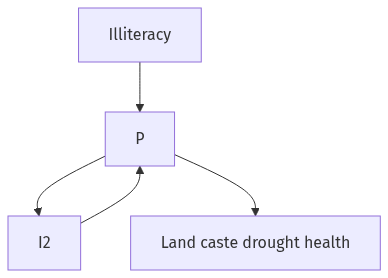
Poor rural households lose income when they cannot read forms, wages, or labels. Poverty also produces illiteracy when children are pulled into farm and care work. Women’s schooling affects health and household decisions. Literacy without land or a job does not end poverty. Caste, gender, drought, and health shocks also sustain rural deprivation.
Model answer
Introduction
Rural development policy treats literacy and income as connected. A critical evaluation must show the two-way link and must also show that roads, land, caste, and health can keep poverty in place even when a school exists.
Body
How the two are linked
- A household that cannot read forms, wages, or a fertiliser label pays more to middlemen and loses public benefits, which deepens poverty.
- Poor households pull children into farm and care work, which keeps enrolment and learning low, so poverty also produces illiteracy.
- Women with little schooling have weaker say in delay of marriage, spacing of births, and use of a health centre, which raises household risk.
- Official schemes such as MGNREGA, PM-KISAN, and school midday meals assume that someone in the house can complete a form or a digital step.
Critical evaluation
- Literacy without land, irrigation, or a non-farm job does not end rural poverty, which is why many literate youth still migrate for casual work.
- Poverty without discrimination does not explain the whole gap: caste and gender still decide who stays in school after class eight.
- Learning poverty can continue even when the literacy rate rises, if the school has few teachers and little teaching time.
- Health shocks and drought can wipe a literate household’s savings, so illiteracy is not the only rural development trap.
What follows for policy
- Rural development has to join schooling with wages, land records, and primary health, rather than treat literacy as a single cure.
- Adult literacy for women and digital help at the panchayat can cut the form-cost of poverty while schools raise the next cohort.
Flow diagram
Conclusion
Illiteracy and poverty in rural India reinforce each other through work, forms, and women’s schooling. The link is real, but it is not the only cause of rural deprivation, so a critical evaluation must keep land, caste, health, and jobs in the same frame.
Quick related
Students also ask
-
Regionalism in modern India is both a challenge and an opportunity. Clarify.
Next question in the 2025 paper (Q6). View answer →
-
If literacy rises, will rural poverty end?
No. Literacy cuts some costs, but land, irrigation, health, and non-farm work still decide income.
-
Is the link only from illiteracy to poverty?
No. Poverty also produces illiteracy through child labour and early marriage. The relationship is two-way.
Same topic · past papers
UPPSC has asked this before
These previous-year questions sit on the same topic. Open one to practise the earlier ask.
-
2023 · Q18 · UPGS1 · 12 marks
Discuss the relationship between El Nino and south-east monsoon in India and its impact on agriculture.
More from this paper
Q1 · UPSC Mains 2025 · UPGS1 · 8 marks · Solution
Comment briefly on the development of art and technology during the Maurya period.
Indian culture
Mauryan art is court stone: edict pillars, the Sarnath lion capital, yaksha figures, Barabar caves, and early stupas. Mauryan technology is iron, state mines, punch-marked coins, roads, wells, and the Sudarshana lake begun under Pushyagupta. Both grew under one imperial administration from Chandragupta to Ashoka.
Q2 · UPSC Mains 2025 · UPGS1 · 8 marks · Solution
"Women's issue was a major concern in the socio-religious reform movements of 19th century India." Explain.
Women, population and associated issues
Reformers treated women’s status as a public test of social change in the nineteenth century. Sati was prohibited in Bengal Presidency in 1829 after Rammohan Roy’s campaign. The Hindu Widows’ Remarriage Act, 1856, followed Vidyasagar’s work. Phule schools and later women writers showed that education and household power were part of the same question. Child marriage remained contested in the Age of Consent debates of 1891.
Q3 · UPSC Mains 2025 · UPGS1 · 8 marks · Solution
"Extremism was a reaction against the ideas and modus operandi of the moderates." Critically explain this statement.
Modern Indian history
Moderates trusted petitions, councils, and British public opinion. The 1905 partition and failed prayers pushed Tilak, Pal, and Lajpat Rai toward Swaraj, boycott, and Swadeshi. Surat 1907 displayed the clash of methods inside Congress. Extremism also had a constructive Swadeshi programme, so it was not only a reaction. Later nationalism combined constitutional work with mass pressure.