
Revision summary
Globalization moves media, people, and goods, which can create shared tastes and workplaces. Indian cinema, food, and software also travel outward, so integration is two-way. The same flow produces conflict over language, food, faith, and neighbourhoods. Gains are uneven between English urban work and rural insecure work. Both integration and conflict can appear in the same film, town, or platform.
Model answer
Introduction
Globalization moves goods, media, people, and rules across borders. The same movement can mix cultures and can also produce conflict over language, food, faith, and jobs.
Body
Cultural integration
- Satellite television, the internet, and English-medium work have spread common films, sport, and consumer styles across Indian regions.
- Indian food, yoga, cinema, and software work have also moved outward, so integration is not only a one-way copy of the West.
- Cities mix migrants from many states, which creates shared workplaces, mixed marriages, and common public festivals.
- International law and human-rights language have entered Indian courts and classrooms, which is another form of cultural integration.
Cultural conflict
- The same media flow produces fear that local languages, dress, and food will lose ground, which has led to campaigns for language and cow-protection politics.
- Trade and tourism bring new consumption, but they also produce disputes over temple towns, hill stations, and who may live in a neighbourhood.
- Social media spreads rumour across groups faster than older print, which can turn a local insult into a national clash.
- Integration is uneven: English-speaking urban youth enter a global culture while many rural households meet globalization mainly as cheap imports and insecure work.
Both at once
- A multiplex film can integrate taste and still start a conflict over its story, which shows that the two results are not opposites in sequence.
- Policy therefore has to protect language and livelihood while keeping the gains of exchange, rather than choosing only integration or only resistance.
Flow diagram
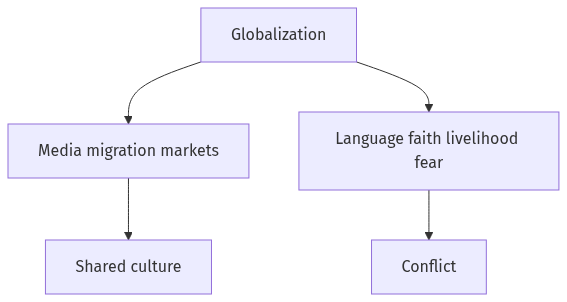
Conclusion
Globalization does lead to cultural integration through media, migration, and shared markets. It also leads to cultural conflict where language, faith, and work feel threatened, and an elucidation must hold both results together.
Quick related
Students also ask
-
What is the relationship between illiteracy and poverty in the context of developmental issues in rural India? Critically evaluate.
Next question in the 2025 paper (Q5). View answer →
-
Is conflict proof that globalization has failed?
No. Conflict shows that integration is uneven and that groups defend language and livelihood while they also use global media.
-
Is integration only Westernisation?
No. Indian cultural goods also travel abroad, and Indian cities mix many Indian cultures, not only Western ones.
Same topic · past papers
UPPSC has asked this before
These previous-year questions sit on the same topic. Open one to practise the earlier ask.
-
2021 · Q6 · UPGS1 · 8 marks
Examine how regionalism affects national integration. -
2018 · Q1 · UPGS1 · 8 marks
Explain the role of Sardar Vallabhbhai Patel in the integration of Princely States of India.
More from this paper
Q1 · UPSC Mains 2025 · UPGS1 · 8 marks · Solution
Comment briefly on the development of art and technology during the Maurya period.
Indian culture
Mauryan art is court stone: edict pillars, the Sarnath lion capital, yaksha figures, Barabar caves, and early stupas. Mauryan technology is iron, state mines, punch-marked coins, roads, wells, and the Sudarshana lake begun under Pushyagupta. Both grew under one imperial administration from Chandragupta to Ashoka.
Q2 · UPSC Mains 2025 · UPGS1 · 8 marks · Solution
"Women's issue was a major concern in the socio-religious reform movements of 19th century India." Explain.
Women, population and associated issues
Reformers treated women’s status as a public test of social change in the nineteenth century. Sati was prohibited in Bengal Presidency in 1829 after Rammohan Roy’s campaign. The Hindu Widows’ Remarriage Act, 1856, followed Vidyasagar’s work. Phule schools and later women writers showed that education and household power were part of the same question. Child marriage remained contested in the Age of Consent debates of 1891.
Q3 · UPSC Mains 2025 · UPGS1 · 8 marks · Solution
"Extremism was a reaction against the ideas and modus operandi of the moderates." Critically explain this statement.
Modern Indian history
Moderates trusted petitions, councils, and British public opinion. The 1905 partition and failed prayers pushed Tilak, Pal, and Lajpat Rai toward Swaraj, boycott, and Swadeshi. Surat 1907 displayed the clash of methods inside Congress. Extremism also had a constructive Swadeshi programme, so it was not only a reaction. Later nationalism combined constitutional work with mass pressure.