
Revision summary
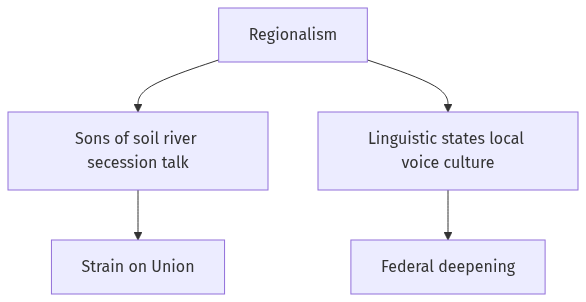
Regionalism is loyalty to language, state, or region inside the Union. It is a challenge when it becomes sons-of-the-soil exclusion, rail blockades, or secessionist talk. River and boundary disputes show the material side of that challenge. Linguistic reorganisation and regional parties show the opportunity of a living federation. The line is between fair share and the denial of equal citizenship.
Model answer
Introduction
Regionalism is loyalty to a language, state, or region inside the Indian Union. In modern India it can strain national politics, and it can also deepen federal democracy.
Body
Challenge
- Language riots, sons-of-the-soil campaigns, and demands that shut a highway or a rail line can weaken the idea of a single citizenship.
- Regional parties may treat Union policy as an outside force, which makes all-India welfare and security harder to coordinate.
- Inter-state river disputes and boundary claims, such as those over Cauvery or a hill district, can freeze development for years.
- Extreme regionalism can slide into secessionist talk, which the Constitution treats as a threat to sovereignty.
Opportunity
- Linguistic states after the States Reorganisation Act, 1956, reduced a major source of cultural anger by giving language a political home.
- Regional parties bring local issues into Parliament and force the Union to negotiate, which is how a federation actually works.
- Cultural regionalism protects literature, film, and festivals that a single national market might ignore.
- Healthy regional pride can support cooperative federalism when states compete on schools, health, and investment rather than on exclusion.
How to keep the balance
- Articles 1, 3, and the Seventh Schedule already assume that India is a Union of states, not a unitary culture.
- The challenge becomes dangerous when regional identity is used to deny a migrant work or a minority language; the opportunity remains when it is used to demand a fair share of water, funds, and respect.
Flow diagram
Conclusion
Regionalism in modern India is a challenge when it blocks mobility, water, or national coordination. It is an opportunity when linguistic states, regional parties, and local culture make the federation more representative.
Quick related
Students also ask
-
Examine the variations in nature of glaciers in India.
Next question in the 2025 paper (Q7). View answer →
-
Is every regional party a threat?
No. Many regional parties translate local demand into parliamentary bargaining, which is ordinary federal politics.
-
Did linguistic states end regionalism?
They reduced language riots of that form. New regionalism now appears in jobs, water, and sub-regional statehood demands.
Same topic · past papers
UPPSC has asked this before
These previous-year questions sit on the same topic. Open one to practise the earlier ask.
-
2024 · Q17 · UPGS1 · 12 marks
'Population explosion is a serious challenge to India's holistic development.' – Examine the statement.
More from this paper
Q1 · UPSC Mains 2025 · UPGS1 · 8 marks · Solution
Comment briefly on the development of art and technology during the Maurya period.
Indian culture
Mauryan art is court stone: edict pillars, the Sarnath lion capital, yaksha figures, Barabar caves, and early stupas. Mauryan technology is iron, state mines, punch-marked coins, roads, wells, and the Sudarshana lake begun under Pushyagupta. Both grew under one imperial administration from Chandragupta to Ashoka.
Q2 · UPSC Mains 2025 · UPGS1 · 8 marks · Solution
"Women's issue was a major concern in the socio-religious reform movements of 19th century India." Explain.
Women, population and associated issues
Reformers treated women’s status as a public test of social change in the nineteenth century. Sati was prohibited in Bengal Presidency in 1829 after Rammohan Roy’s campaign. The Hindu Widows’ Remarriage Act, 1856, followed Vidyasagar’s work. Phule schools and later women writers showed that education and household power were part of the same question. Child marriage remained contested in the Age of Consent debates of 1891.
Q3 · UPSC Mains 2025 · UPGS1 · 8 marks · Solution
"Extremism was a reaction against the ideas and modus operandi of the moderates." Critically explain this statement.
Modern Indian history
Moderates trusted petitions, councils, and British public opinion. The 1905 partition and failed prayers pushed Tilak, Pal, and Lajpat Rai toward Swaraj, boycott, and Swadeshi. Surat 1907 displayed the clash of methods inside Congress. Extremism also had a constructive Swadeshi programme, so it was not only a reaction. Later nationalism combined constitutional work with mass pressure.