
Revision summary
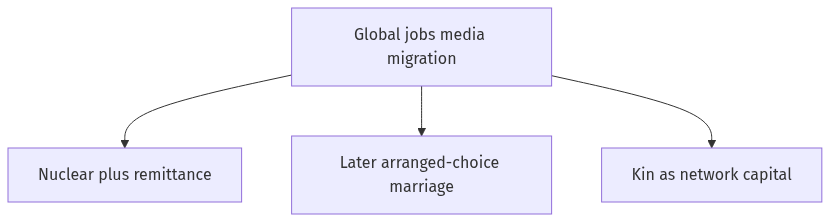
Urban families often live as nuclear units while sending money and care to parents. Global service work supports dual earners and later childbearing in metros. Marriage is later, and many matches mix arrangement with personal choice and apps. Wedding markets and a minority of inter-caste marriages are visible urban effects. Kinship remains in caste alliance and in networks for housing and migration.
Model answer
Introduction
Globalization reaches Indian households through jobs, media, migration, and consumer markets. Its visible effects on family, marriage, and kinship are not the same in every class or region, but some patterns are now clear.
Body
Family
- More urban households are nuclear in residence, while duty to parents continues through money and phone contact rather than a shared kitchen.
- Dual-earner couples and delayed childbearing are visible in metropolitan professional families that work in global services.
- Care of the old is partly marketised through paid helpers and private hospitals, which older joint families did inside the house.
- Transnational families appear when a member works in the Gulf or the West and the household is split across borders.
Marriage
- The average age at marriage has risen where girls stay longer in school and in paid work.
- Choice and dating exist beside arranged marriage; many matches are now “arranged-cum-choice” through family and apps.
- Inter-caste and inter-religious marriages remain a minority, yet they are more visible in cities and in law, including the Special Marriage Act.
- Wedding consumption has become a global-style market of hotels and display, which raises cost and status competition.
Kinship
- Caste and gotra still organise many alliances, so kinship has not disappeared.
- Kin networks are used for urban housing, migration, and start-up capital, which is kinship as an economic resource in a global labour market.
- Lineage rituals may shrink in daily life and still return at death, marriage, and festival, which is selective kinship rather than end of kinship.
Together
- Globalization has stretched the household across cities and countries without fully replacing caste alliance or parental duty.
- The analysis is that form has become more nuclear and more mobile, while the kinship grammar of match and care is rewritten, not erased.
Flow diagram
Conclusion
Visible effects include nuclear urban residence, later and more mixed-choice marriage, and kinship that works through money and migration. Indian society has not dropped family duty or caste alliance; it has fitted them to a global labour and media market.
Quick related
Students also ask
-
Examine the forest resources of India and explain the principles of conservation which could be applied to improve the forest wealth of India.
Next question in the 2025 paper (Q17). View answer →
-
Has the joint family ended?
Co-residence has fallen in cities. Joint duty through money, ritual, and care is still common.
-
Has caste left marriage?
No. Most marriages remain within caste. Globalization has added apps and some inter-caste visibility, not a general replacement.
Same topic · past papers
UPPSC has asked this before
These previous-year questions sit on the same topic. Open one to practise the earlier ask.
-
2025 · Q10 · UPGS1 · 8 marks
Examine critically the recent theories of the origin of monsoon and discuss the effects of El Niño on monsoon. -
2024 · Q20 · UPGS1 · 12 marks
Discuss the characteristics, causes and effects of Tsunami with example. -
2019 · Q3 · UPGS1 · 8 marks
Critically examine the effects of British Industrial Revolution on India's economic life.
More from this paper
Q1 · UPSC Mains 2025 · UPGS1 · 8 marks · Solution
Comment briefly on the development of art and technology during the Maurya period.
Indian culture
Mauryan art is court stone: edict pillars, the Sarnath lion capital, yaksha figures, Barabar caves, and early stupas. Mauryan technology is iron, state mines, punch-marked coins, roads, wells, and the Sudarshana lake begun under Pushyagupta. Both grew under one imperial administration from Chandragupta to Ashoka.
Q2 · UPSC Mains 2025 · UPGS1 · 8 marks · Solution
"Women's issue was a major concern in the socio-religious reform movements of 19th century India." Explain.
Women, population and associated issues
Reformers treated women’s status as a public test of social change in the nineteenth century. Sati was prohibited in Bengal Presidency in 1829 after Rammohan Roy’s campaign. The Hindu Widows’ Remarriage Act, 1856, followed Vidyasagar’s work. Phule schools and later women writers showed that education and household power were part of the same question. Child marriage remained contested in the Age of Consent debates of 1891.
Q3 · UPSC Mains 2025 · UPGS1 · 8 marks · Solution
"Extremism was a reaction against the ideas and modus operandi of the moderates." Critically explain this statement.
Modern Indian history
Moderates trusted petitions, councils, and British public opinion. The 1905 partition and failed prayers pushed Tilak, Pal, and Lajpat Rai toward Swaraj, boycott, and Swadeshi. Surat 1907 displayed the clash of methods inside Congress. Extremism also had a constructive Swadeshi programme, so it was not only a reaction. Later nationalism combined constitutional work with mass pressure.