
Revision summary
Forest wealth is cover quality, biodiversity, and catchment, not only recorded area. Western Ghats and the North-East hold wet forests; the peninsula holds dry deciduous forest; the Himalaya holds conifer and oak. Mangroves are a coastal forest resource. FRA community rights, the right species on the right site, corridors, and LPG alternatives are the main conservation principles. Wealth rises when growing stock and livelihood rise together.
Model answer
Introduction
India’s forest wealth is timber, fuel, fodder, wildlife, and catchment water. It is uneven by region, and conservation principles have to raise quality, not only the percentage of recorded forest.
Body
Forest resources
- The Forest Survey of India classifies cover as very dense, moderately dense, and open forest, which shows that area and quality are different resources.
- Tropical wet evergreen and semi-evergreen forests in the Western Ghats and the North-East hold high biodiversity and catchment value.
- Dry deciduous forests of the peninsula supply fuel and fodder but are under heavy people pressure.
- The Himalaya holds conifer and oak belts that protect soil and snow-fed rivers.
- Mangroves, as already noted for the coast, are a specialised forest resource for storm protection and fishery.
- Recorded forest is not always well-stocked forest; fire, grazing, and illegal felling reduce growing stock even where the map is green.
Conservation principles
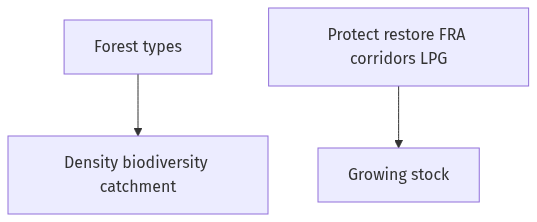
- Protection of remaining intact patches is cheaper than later plantation, which is the principle of avoiding the first cut in a biodiversity hotspot.
- Community rights under the Forest Rights Act, 2006, can improve wealth if gram sabhas have a real share in patrol and produce, not only paper titles.
- Joint forest management and later CAMPA funds must plant the right species on the right site, not a single exotic block.
- Wildlife corridors and a ban on fragmentation by linear projects keep gene flow, which is a principle of landscape conservation.
- Sustainable harvest of fuel and non-timber produce, plus alternatives such as LPG, reduces the daily drain on open forest.
- Fire management, invasive-species control, and restoration of degraded open forest raise growing stock inside the existing estate.
Improving wealth
- Forest wealth improves when density, species mix, and local livelihood rise together, not when only the green cover percentage is quoted.
- Principles that ignore people fail; principles that ignore ecology produce plantations without a forest.
Flow diagram
Conclusion
India’s forest resources vary from wet Ghats and North-East forests to dry deciduous, Himalayan, and mangrove belts. Conservation that protects intact forest, restores degraded stock, shares rights with communities, and keeps corridors will improve that wealth more than a map percentage alone.
Quick related
Students also ask
-
Differentiate between refugees and infiltrators. What steps have been taken by the Government of India for the security and assistance of refugees?
Next question in the 2025 paper (Q18). View answer →
-
Does a rise in forest-cover percentage mean wealth has improved?
Not by itself. Open forest, plantation, and tea or palm can add area without adding growing stock or biodiversity.
-
Is exclusion of people the only conservation principle?
No. Strict protection of core habitat can sit beside community rights in buffer landscapes. Either extreme fails.
Same topic · past papers
UPPSC has asked this before
These previous-year questions sit on the same topic. Open one to practise the earlier ask.
More from this paper
Q1 · UPSC Mains 2025 · UPGS1 · 8 marks · Solution
Comment briefly on the development of art and technology during the Maurya period.
Indian culture
Mauryan art is court stone: edict pillars, the Sarnath lion capital, yaksha figures, Barabar caves, and early stupas. Mauryan technology is iron, state mines, punch-marked coins, roads, wells, and the Sudarshana lake begun under Pushyagupta. Both grew under one imperial administration from Chandragupta to Ashoka.
Q2 · UPSC Mains 2025 · UPGS1 · 8 marks · Solution
"Women's issue was a major concern in the socio-religious reform movements of 19th century India." Explain.
Women, population and associated issues
Reformers treated women’s status as a public test of social change in the nineteenth century. Sati was prohibited in Bengal Presidency in 1829 after Rammohan Roy’s campaign. The Hindu Widows’ Remarriage Act, 1856, followed Vidyasagar’s work. Phule schools and later women writers showed that education and household power were part of the same question. Child marriage remained contested in the Age of Consent debates of 1891.
Q3 · UPSC Mains 2025 · UPGS1 · 8 marks · Solution
"Extremism was a reaction against the ideas and modus operandi of the moderates." Critically explain this statement.
Modern Indian history
Moderates trusted petitions, councils, and British public opinion. The 1905 partition and failed prayers pushed Tilak, Pal, and Lajpat Rai toward Swaraj, boycott, and Swadeshi. Surat 1907 displayed the clash of methods inside Congress. Extremism also had a constructive Swadeshi programme, so it was not only a reaction. Later nationalism combined constitutional work with mass pressure.