
Revision summary
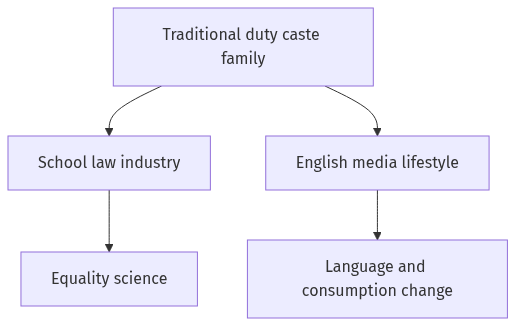
Traditional values include family duty, ritual, caste rank, and respect for age. Modernisation through school, law, and industry has weakened some caste authority and joint-family form. Westernisation is copy of English, dress, and media, which Srinivas separated from modernisation. Gains include women’s and Dalit rights and modern medicine. Festivals, pilgrimage, and parental care show continuity, so the impact is mixed.
Model answer
Introduction
Traditional Indian values are family duty, religious practice, caste rank, and respect for age and teacher. Modernisation and westernisation have changed how those values are lived, and a critical evaluation must separate useful change from simple loss.
Body
Modernisation
- Modernisation here means industry, the state, science, and formal schooling, which can come from Indian as well as foreign sources.
- School and law have weakened the absolute authority of caste panchayats in many public spaces, which is a change in the value of rank.
- A nuclear urban household and women’s paid work have changed the joint-family value of living under one roof, though remittances often keep duty alive at a distance.
- Secular public offices and a written Constitution place equal citizenship beside older religious duty, which is modernisation of political value.
Westernisation
- Westernisation means copying Western dress, English, dating, and consumer style, which M. N. Srinivas distinguished from modernisation.
- English-medium schooling and global media can lower the everyday use of Indian languages and ritual calendars among urban youth.
- Some Western legal ideas, such as individual consent in marriage, have entered statute and courts, which reformers also wanted from inside Indian debate.
- Blind copy of consumption can weaken restraint and savings, which older household ethics treated as a value.
Critical evaluation
- Traditional values were never one block: Buddhist, bhakti, and reform currents already criticised caste and ritual excess.
- Modern medicine and rights for women and Dalits are gains that a purely restorationist view would refuse.
- Continuity remains in festivals, pilgrimage, vegetarian ethics for many households, and care of parents, even in cities.
- The fair evaluation is that modernisation has opened equality and science, westernisation has mixed language and lifestyle, and neither has erased duty and faith in a single line.
Flow diagram
Conclusion
Modernisation has moved Indian values toward schooling, law, and more individual choice. Westernisation has added language and lifestyle copy. Traditional duty and faith continue, so the impact is change and selection, not total replacement.
Quick related
Students also ask
-
What are the visible effects of globalization on family, marriage and kinship system? Analyse with reference to the Indian society.
Next question in the 2025 paper (Q16). View answer →
-
Are modernisation and westernisation the same?
No. Modernisation is industry, science, and the modern state. Westernisation is copying Western lifestyle. India can modernise without copying every Western custom.
-
Have traditional values disappeared?
No. They have been selected and reshaped. Ritual, family duty, and pilgrimage remain widespread.
Same topic · past papers
UPPSC has asked this before
These previous-year questions sit on the same topic. Open one to practise the earlier ask.
-
2023 · Q18 · UPGS1 · 12 marks
Discuss the relationship between El Nino and south-east monsoon in India and its impact on agriculture. -
2020 · Q19 · UPGS1 · 12 marks
What is 'reverse migration'? What was its impact on the economy and social order of Uttar Pradesh during the COVID-19 Lockdown? -
2018 · Q15 · UPGS1 · 12 marks
Discuss the impact of globalization on the status of women in Indian society by citing suitable examples. -
2018 · Q16 · UPGS1 · 12 marks
What is globalization? Discuss its impact on the social structure of India.
More from this paper
Q1 · UPSC Mains 2025 · UPGS1 · 8 marks · Solution
Comment briefly on the development of art and technology during the Maurya period.
Indian culture
Mauryan art is court stone: edict pillars, the Sarnath lion capital, yaksha figures, Barabar caves, and early stupas. Mauryan technology is iron, state mines, punch-marked coins, roads, wells, and the Sudarshana lake begun under Pushyagupta. Both grew under one imperial administration from Chandragupta to Ashoka.
Q2 · UPSC Mains 2025 · UPGS1 · 8 marks · Solution
"Women's issue was a major concern in the socio-religious reform movements of 19th century India." Explain.
Women, population and associated issues
Reformers treated women’s status as a public test of social change in the nineteenth century. Sati was prohibited in Bengal Presidency in 1829 after Rammohan Roy’s campaign. The Hindu Widows’ Remarriage Act, 1856, followed Vidyasagar’s work. Phule schools and later women writers showed that education and household power were part of the same question. Child marriage remained contested in the Age of Consent debates of 1891.
Q3 · UPSC Mains 2025 · UPGS1 · 8 marks · Solution
"Extremism was a reaction against the ideas and modus operandi of the moderates." Critically explain this statement.
Modern Indian history
Moderates trusted petitions, councils, and British public opinion. The 1905 partition and failed prayers pushed Tilak, Pal, and Lajpat Rai toward Swaraj, boycott, and Swadeshi. Surat 1907 displayed the clash of methods inside Congress. Extremism also had a constructive Swadeshi programme, so it was not only a reaction. Later nationalism combined constitutional work with mass pressure.