
Revision summary
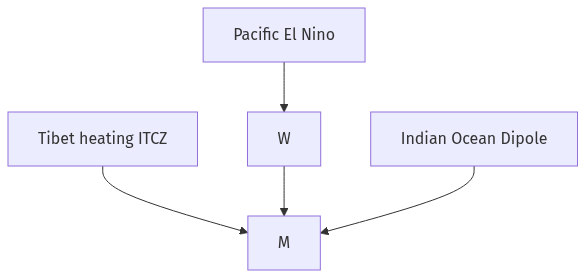
The monsoon is not only a land–sea breeze; ITCZ shift and Tibetan heating are central in recent theory. Indian Ocean coupling, including the dipole, also shapes rainfall anomalies. El Niño often weakens all-India summer rain by altering the Walker circulation. Not every El Niño year is a drought, so the effect is probabilistic. Forecasts use Niño 3.4 together with the Indian Ocean Dipole.
Model answer
Introduction
The Indian monsoon is a seasonal reversal of wind and rain. Recent theories no longer treat it as only a giant land–sea breeze, and El Niño is one ocean control that can weaken the rain.
Body
Recent theories of origin
- The classical Halley idea of a thermal contrast between a hot Asian landmass and a cooler Indian Ocean remains a base, but it is not a complete origin theory.
- Flohn and later workers treated the monsoon as a seasonal shift of the Inter-Tropical Convergence Zone over India, which explains the sudden onset better than a simple breeze.
- The Tibetan Plateau is now given a large role: summer heating of the plateau and the Himalayan barrier set up an upper-level high and a tropical easterly jet.
- Air–sea coupling in the Indian Ocean, including the Indian Ocean Dipole, is treated as a partner origin of rainfall anomalies, not only as a side effect.
- A critical limit is that no single theory yet gives a stable seasonal forecast, because convection, aerosols, and Himalayan snow all still add noise.
Effects of El Niño
- El Niño is the warm phase of the equatorial Pacific; it often weakens the Walker circulation and can reduce Indian summer monsoon rainfall.
- Many severe all-India drought years have coincided with El Niño, but not every El Niño year is a drought, which is why the link is statistical and not mechanical.
- El Niño can also shift the timing of onset and withdrawal, so the effect is on distribution as well as on the seasonal total.
- La Niña, the cold phase, has more often been linked with excess rain, yet floods still need local depressions and orography.
- Forecast agencies therefore watch the Niño 3.4 index together with the Indian Ocean Dipole, not El Niño alone.
Flow diagram
Conclusion
Recent monsoon theory joins land heating, the ITCZ, the Tibetan Plateau, and Indian Ocean coupling. El Niño often dries the Indian summer monsoon, but not in every event, so a critical examination must keep Pacific and Indian Ocean indices together.
Quick related
Students also ask
-
Critically analyse the role of Sardar Patel in the unification of India after Independence.
Next question in the 2025 paper (Q11). View answer →
-
Does El Niño always cause drought in India?
No. It raises the chance of below-normal rain. Some El Niño years are near normal when the Indian Ocean Dipole or other factors compensate.
-
Is the Halley theory discarded?
It is incomplete, not discarded. Land–sea heating is still a base, now joined to ITCZ, Tibet, and ocean coupling.
Same topic · past papers
UPPSC has asked this before
These previous-year questions sit on the same topic. Open one to practise the earlier ask.
-
2023 · Q18 · UPGS1 · 12 marks
Discuss the relationship between El Nino and south-east monsoon in India and its impact on agriculture.
More from this paper
Q1 · UPSC Mains 2025 · UPGS1 · 8 marks · Solution
Comment briefly on the development of art and technology during the Maurya period.
Indian culture
Mauryan art is court stone: edict pillars, the Sarnath lion capital, yaksha figures, Barabar caves, and early stupas. Mauryan technology is iron, state mines, punch-marked coins, roads, wells, and the Sudarshana lake begun under Pushyagupta. Both grew under one imperial administration from Chandragupta to Ashoka.
Q2 · UPSC Mains 2025 · UPGS1 · 8 marks · Solution
"Women's issue was a major concern in the socio-religious reform movements of 19th century India." Explain.
Women, population and associated issues
Reformers treated women’s status as a public test of social change in the nineteenth century. Sati was prohibited in Bengal Presidency in 1829 after Rammohan Roy’s campaign. The Hindu Widows’ Remarriage Act, 1856, followed Vidyasagar’s work. Phule schools and later women writers showed that education and household power were part of the same question. Child marriage remained contested in the Age of Consent debates of 1891.
Q3 · UPSC Mains 2025 · UPGS1 · 8 marks · Solution
"Extremism was a reaction against the ideas and modus operandi of the moderates." Critically explain this statement.
Modern Indian history
Moderates trusted petitions, councils, and British public opinion. The 1905 partition and failed prayers pushed Tilak, Pal, and Lajpat Rai toward Swaraj, boycott, and Swadeshi. Surat 1907 displayed the clash of methods inside Congress. Extremism also had a constructive Swadeshi programme, so it was not only a reaction. Later nationalism combined constitutional work with mass pressure.