
Revision summary
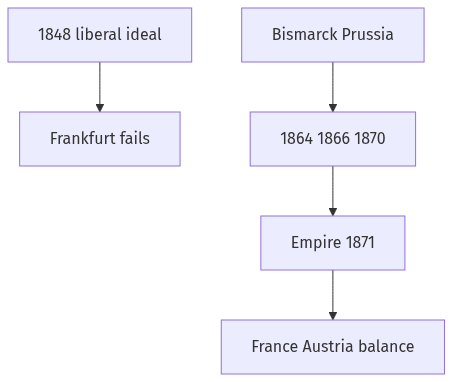
1848 wanted a liberal German nation; Frankfurt could not impose it. Bismarck unified Germany by the kleindeutsch path, excluding Austria. Wars of 1864, 1866, and 1870–71 were the method of iron and blood. The 1871 empire combined a Reichstag with Prussian military monarchy. Internationally, France was humiliated and the European balance was recast around German power.
Model answer
Introduction
German unification in 1871 created a nation-state that many nationalists had wanted. It was achieved by Prussian wars and diplomacy under Bismarck, which is why it is read as a contradiction between the ideal of nationalism and the realities of power politics.
Body
Ideal versus power
- The nationalist ideal of 1848 wanted a liberal German parliament and a nation based on citizenship and culture.
- The Frankfurt Parliament failed to command an army or to make the Prussian king accept a crown from below.
- Power politics meant that Prussia, Austria, France, and the smaller states would decide Germany by war and alliance, not by a constitution alone.
- Bismarck stated that the great questions would be decided by iron and blood, which is the open claim of power over the 1848 ideal.
Paths of unification
- The grossdeutsch path would have included Austria; the kleindeutsch path excluded Austria and centred Prussia.
- Bismarck used the 1864 war with Denmark, the 1866 war with Austria, and the 1870–71 war with France to isolate rivals and rally German princes.
- The North German Confederation and then the proclamation of the German Empire at Versailles in January 1871 completed the kleindeutsch empire under the Prussian king.
- Universal male suffrage for the Reichstag sat beside an army and a chancellor responsible to the emperor, so liberal nationalism was only partly honoured.
International implications
- A powerful Germany in the middle of Europe ended the older balance that had treated the German lands as a weak centre.
- France was defeated and lost Alsace-Lorraine, which planted a lasting hostility.
- Austria was pushed out of German affairs and turned toward the Balkans, which later fed the alliance system before 1914.
- Britain and Russia had to treat Germany as a new industrial and military pole, which is the European implication of unification by power.
Flow diagram
Conclusion
German unification fulfilled a national ideal in form and denied it in method. Bismarck’s wars made a Prussian-led empire, and the international implication was a new German power that unsettled France and the European balance.
Quick related
Students also ask
-
Discuss the socio-economic problems associated with urbanization. What structural measures are necessary for sustainable urban development?
Next question in the 2025 paper (Q14). View answer →
-
Was unification only Bismarck’s work?
Bismarck directed Prussian policy. Coal, railways, and nationalist societies also mattered, but the decisive path was Prussian war and diplomacy.
-
Did nationalism disappear after 1871?
No. The empire used national feeling. The contradiction is that the feeling was realised by dynastic power, not by the 1848 constitution.
Same topic · past papers
UPPSC has asked this before
These previous-year questions sit on the same topic. Open one to practise the earlier ask.
More from this paper
Q1 · UPSC Mains 2025 · UPGS1 · 8 marks · Solution
Comment briefly on the development of art and technology during the Maurya period.
Indian culture
Mauryan art is court stone: edict pillars, the Sarnath lion capital, yaksha figures, Barabar caves, and early stupas. Mauryan technology is iron, state mines, punch-marked coins, roads, wells, and the Sudarshana lake begun under Pushyagupta. Both grew under one imperial administration from Chandragupta to Ashoka.
Q2 · UPSC Mains 2025 · UPGS1 · 8 marks · Solution
"Women's issue was a major concern in the socio-religious reform movements of 19th century India." Explain.
Women, population and associated issues
Reformers treated women’s status as a public test of social change in the nineteenth century. Sati was prohibited in Bengal Presidency in 1829 after Rammohan Roy’s campaign. The Hindu Widows’ Remarriage Act, 1856, followed Vidyasagar’s work. Phule schools and later women writers showed that education and household power were part of the same question. Child marriage remained contested in the Age of Consent debates of 1891.
Q3 · UPSC Mains 2025 · UPGS1 · 8 marks · Solution
"Extremism was a reaction against the ideas and modus operandi of the moderates." Critically explain this statement.
Modern Indian history
Moderates trusted petitions, councils, and British public opinion. The 1905 partition and failed prayers pushed Tilak, Pal, and Lajpat Rai toward Swaraj, boycott, and Swadeshi. Surat 1907 displayed the clash of methods inside Congress. Extremism also had a constructive Swadeshi programme, so it was not only a reaction. Later nationalism combined constitutional work with mass pressure.