
Revision summary
Slums and insecure tenure are the housing face of Indian urbanisation. Informal work without social security is the labour face. Congestion, pollution, and weak municipal services hit poor wards first. Structural replies are tenure, public rental housing, buses and metro, and the 74th Amendment with real property tax. Climate-ready water and waste are part of sustainability, not an extra.
Model answer
Introduction
Indian urbanisation is fast, large, and uneven. Socio-economic problems appear in housing, work, services, and inequality, and sustainable urban development needs structural measures, not only a new flyover.
Body
Socio-economic problems
- Informal housing and slums grow faster than planned plots, so tenure, water, and toilets stay insecure.
- A large share of urban work is informal, without a written contract, which means low wages and no social security.
- Congestion, air pollution, and long travel times tax health and household time, especially for women who combine paid work and care.
- Municipal bodies are short of staff and own tax, so garbage, drainage, and bus systems fail first in poor wards.
- Urbanisation can raise land prices and push the poor to the periphery, which is spatial inequality, not only income inequality.
Structural measures
- Secure tenure, in-situ slum upgrading, and a public rental stock treat housing as infrastructure, not only as a private plot.
- Formalisation of work through e-shram, boards for construction labour, and enforceable minimum wages reduces the income side of urban poverty.
- Compact land use, public buses and metro, and walking access cut congestion more reliably than extra private cars.
- The 74th Amendment, property-tax reform, and predictable Union–state–city grants are the fiscal structure without which smart-city projects do not last.
- Water, sewer, and solid-waste systems have to be designed for climate heat and flood, which is the environmental half of sustainable urban development.
Matching the two
- Each problem has a structure behind it: land markets, informal labour, weak municipalities, and carbon-heavy transport.
- Measures that only beautify a central street leave the same structures in place, so they are not sustainable urban development.
Flow diagram
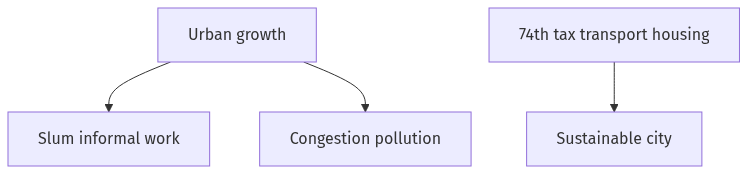
Conclusion
Urbanisation in India produces slums, informal work, congestion, and weak municipal services. Sustainable urban development needs tenure, public transport, municipal finance, and climate-ready water and waste, not only surface projects.
Quick related
Students also ask
-
Critically evaluate the impact of modernisation and westernisation on traditional Indian values.
Next question in the 2025 paper (Q15). View answer →
-
Is a metro enough for sustainable urban development?
No. A metro without feeder buses, walking access, and affordable housing can still leave the poor on the periphery.
-
Are slums only a housing shortage?
They are also a labour and municipal-finance problem: informal work and weak wards reproduce the slum.
Same topic · past papers
UPPSC has asked this before
These previous-year questions sit on the same topic. Open one to practise the earlier ask.
-
2021 · Q3 · UPGS1 · 8 marks
“The Industrial Revolution was not only a technological revolution but also socio-economic revolution that changed the way people lived.” Comment. -
2019 · Q2 · UPGS1 · 8 marks
Describe the role of Iron mineral in socio-economic development of human beings during 600-300 B.C.
More from this paper
Q1 · UPSC Mains 2025 · UPGS1 · 8 marks · Solution
Comment briefly on the development of art and technology during the Maurya period.
Indian culture
Mauryan art is court stone: edict pillars, the Sarnath lion capital, yaksha figures, Barabar caves, and early stupas. Mauryan technology is iron, state mines, punch-marked coins, roads, wells, and the Sudarshana lake begun under Pushyagupta. Both grew under one imperial administration from Chandragupta to Ashoka.
Q2 · UPSC Mains 2025 · UPGS1 · 8 marks · Solution
"Women's issue was a major concern in the socio-religious reform movements of 19th century India." Explain.
Women, population and associated issues
Reformers treated women’s status as a public test of social change in the nineteenth century. Sati was prohibited in Bengal Presidency in 1829 after Rammohan Roy’s campaign. The Hindu Widows’ Remarriage Act, 1856, followed Vidyasagar’s work. Phule schools and later women writers showed that education and household power were part of the same question. Child marriage remained contested in the Age of Consent debates of 1891.
Q3 · UPSC Mains 2025 · UPGS1 · 8 marks · Solution
"Extremism was a reaction against the ideas and modus operandi of the moderates." Critically explain this statement.
Modern Indian history
Moderates trusted petitions, councils, and British public opinion. The 1905 partition and failed prayers pushed Tilak, Pal, and Lajpat Rai toward Swaraj, boycott, and Swadeshi. Surat 1907 displayed the clash of methods inside Congress. Extremism also had a constructive Swadeshi programme, so it was not only a reaction. Later nationalism combined constitutional work with mass pressure.