
Revision summary
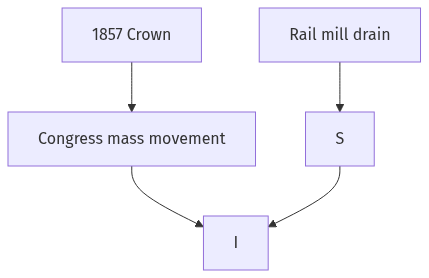
1857 transferred power from the Company to the Crown. Congress, League, Swadeshi, and Gandhian satyagraha turned petition into a mass national movement. The 1935 Act and 1947 Independence and Partition remade the state and the map. Railways, mills, and drain remade the economy; reform and caste politics remade society. Land, hierarchy, and poverty still continued, so change was immense but not total.
Model answer
Introduction
The century from the 1857 uprising to Independence in 1947 remade who ruled India, how the economy was tied to Britain, and how caste, gender, and community were argued in public. The statement is strong, and analysis must show both the scale of change and what continued.
Body
Political change
- 1857 ended Company rule and brought the British Crown, the 1858 Act, and a stronger garrison state.
- The Indian National Congress (1885), the Muslim League (1906), mass Swadeshi, Gandhi’s satyagrahas, and the 1935 provincial ministries changed politics from petition to a national movement.
- The Morley–Minto and Montagu–Chelmsford reforms, and then the 1935 Act, introduced elected elements without transferring sovereignty until 1947.
- Partition and Independence in 1947 were the largest political rupture, creating two states and a huge transfer of people.
Economic and social change
- Railways, telegraphs, cotton mills, and a deeper drain of wealth tied the Indian economy to British industry and to world prices.
- Famines, commercial agriculture, and new professional classes remade rural and urban society together.
- Socio-religious reform, print, and women’s schooling altered family debate; caste associations and the depressed-classes movement altered rank.
- Communal electorates and later riots show that public identity also hardened, which is change of a darker kind.
How immense, and what continued
- Village hierarchy, landlord power in many regions, and peasant poverty did not vanish in 1947, so immense change is not total replacement.
- The statement holds because sovereignty, the map, the national movement, and the industrial working class were not the same in 1947 as in 1857.
Flow diagram
Conclusion
1857 to 1947 was a time of immense political, economic, and social change, ending in Independence and Partition. The analysis is complete only if it also notes that land, caste, and poverty continued into the republic.
Quick related
Students also ask
-
The Unification of Germany is considered as a symbol of the contradiction between the 'ideal of nationalism' and the 'realities of power politics'. In this context, critically examine the paths of unification and its international implications.
Next question in the 2025 paper (Q13). View answer →
-
Did 1857 begin modern nationalism?
It began a new imperial structure. Organised nationalism of Congress type is later, though 1857 remained a political memory.
-
Is Partition part of ‘Indian history’ in this span?
Yes. 1947 is the end of the span named in the statement and is the largest political change inside it.
Same topic · past papers
UPPSC has asked this before
These previous-year questions sit on the same topic. Open one to practise the earlier ask.
-
2022 · Q14 · UPGS1 · 12 marks
Throw light on the factors of continuity and change in Indian Society.
More from this paper
Q1 · UPSC Mains 2025 · UPGS1 · 8 marks · Solution
Comment briefly on the development of art and technology during the Maurya period.
Indian culture
Mauryan art is court stone: edict pillars, the Sarnath lion capital, yaksha figures, Barabar caves, and early stupas. Mauryan technology is iron, state mines, punch-marked coins, roads, wells, and the Sudarshana lake begun under Pushyagupta. Both grew under one imperial administration from Chandragupta to Ashoka.
Q2 · UPSC Mains 2025 · UPGS1 · 8 marks · Solution
"Women's issue was a major concern in the socio-religious reform movements of 19th century India." Explain.
Women, population and associated issues
Reformers treated women’s status as a public test of social change in the nineteenth century. Sati was prohibited in Bengal Presidency in 1829 after Rammohan Roy’s campaign. The Hindu Widows’ Remarriage Act, 1856, followed Vidyasagar’s work. Phule schools and later women writers showed that education and household power were part of the same question. Child marriage remained contested in the Age of Consent debates of 1891.
Q3 · UPSC Mains 2025 · UPGS1 · 8 marks · Solution
"Extremism was a reaction against the ideas and modus operandi of the moderates." Critically explain this statement.
Modern Indian history
Moderates trusted petitions, councils, and British public opinion. The 1905 partition and failed prayers pushed Tilak, Pal, and Lajpat Rai toward Swaraj, boycott, and Swadeshi. Surat 1907 displayed the clash of methods inside Congress. Extremism also had a constructive Swadeshi programme, so it was not only a reaction. Later nationalism combined constitutional work with mass pressure.