
Revision summary
Indian glaciers sit mainly in the Greater Himalaya, Karakoram, Zanskar, and eastern high ranges. Valley glaciers and cirque glaciers are different forms. Debris cover and snout lakes change melt and flood risk. Karakoram ice has been more stable in some decades than many central Himalayan tongues. Melt feeds the Indus, Ganga, and Brahmaputra in different basins.
Model answer
Introduction
India’s glaciers are not one ice mass of the same kind. They vary by range, altitude, debris cover, and whether they sit in the Himalaya, Karakoram, or a small pocket of the trans-Himalaya.
Body
Location and type
- Most Indian glaciers lie in the Greater Himalaya, with further ice in the Karakoram, Zanskar, Ladakh, and parts of Sikkim and Arunachal.
- Valley glaciers such as Gangotri and Siachen fill long troughs, while smaller cirque glaciers occupy high hollows.
- Some tongues are clean ice; many Himalayan tongues are covered with rock debris, which changes how they melt.
- Karakoram glaciers have shown more stable or even advancing tongues in some decades, which is sometimes called the Karakoram anomaly.
Size, debris, and behaviour
- Siachen is among the longest glaciers in the Indian Himalaya; many Uttarakhand and Himachal glaciers are much shorter valley tongues.
- Debris-covered glaciers often have lakes at the snout, which raises glacial-lake outburst flood risk in Uttarakhand and Sikkim.
- Summer melt of Gangotri and related basins feeds the Ganga system; western ice feeds the Indus; eastern ice feeds the Brahmaputra.
- Surge-type behaviour and avalanche-fed glaciers occur in parts of Karakoram and Ladakh, so speed is not uniform.
Why the variation matters
- A single melt number for “Himalayan ice” hides these differences of slope, debris, and monsoon versus westerly snowfall.
- Water planning and disaster maps must treat a clean, steep Uttarakhand glacier and a debris-covered Karakoram glacier as different natural bodies.
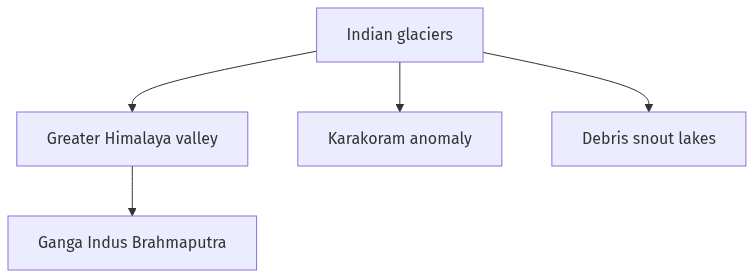
Flow diagram
Conclusion
Indian glaciers vary by range, length, debris cover, and climate source. Valley and cirque forms, the Karakoram anomaly, and snout lakes are the main differences in their nature, and they must be examined separately.
Quick related
Students also ask
-
How do India's mangroves and coral reefs contribute to marine resource management?
Next question in the 2025 paper (Q8). View answer →
-
Are all Himalayan glaciers retreating at the same rate?
No. Debris cover, altitude, and the Karakoram snowfall pattern produce different rates and even local advance.
-
Do glaciers exist only in the western Himalaya?
No. Sikkim and Arunachal also hold glaciers, though the longest tongues lie farther west and in Karakoram.
Same topic · past papers
UPPSC has asked this before
These previous-year questions sit on the same topic. Open one to practise the earlier ask.
-
2020 · Q20 · UPGS1 · 12 marks
Describe the role of Glaciers in shaping the land-forms in high mountain areas.
More from this paper
Q1 · UPSC Mains 2025 · UPGS1 · 8 marks · Solution
Comment briefly on the development of art and technology during the Maurya period.
Indian culture
Mauryan art is court stone: edict pillars, the Sarnath lion capital, yaksha figures, Barabar caves, and early stupas. Mauryan technology is iron, state mines, punch-marked coins, roads, wells, and the Sudarshana lake begun under Pushyagupta. Both grew under one imperial administration from Chandragupta to Ashoka.
Q2 · UPSC Mains 2025 · UPGS1 · 8 marks · Solution
"Women's issue was a major concern in the socio-religious reform movements of 19th century India." Explain.
Women, population and associated issues
Reformers treated women’s status as a public test of social change in the nineteenth century. Sati was prohibited in Bengal Presidency in 1829 after Rammohan Roy’s campaign. The Hindu Widows’ Remarriage Act, 1856, followed Vidyasagar’s work. Phule schools and later women writers showed that education and household power were part of the same question. Child marriage remained contested in the Age of Consent debates of 1891.
Q3 · UPSC Mains 2025 · UPGS1 · 8 marks · Solution
"Extremism was a reaction against the ideas and modus operandi of the moderates." Critically explain this statement.
Modern Indian history
Moderates trusted petitions, councils, and British public opinion. The 1905 partition and failed prayers pushed Tilak, Pal, and Lajpat Rai toward Swaraj, boycott, and Swadeshi. Surat 1907 displayed the clash of methods inside Congress. Extremism also had a constructive Swadeshi programme, so it was not only a reaction. Later nationalism combined constitutional work with mass pressure.