
Revision summary
Mangroves in the Sundarbans, Bhitarkanika, and Pichavaram trap sediment and cut storm waves. They nurse prawn, crab, and juvenile fish that later enter the fishery. Reefs in Mannar, Kachchh, Lakshadweep, and Andaman–Nicobar shelter fish and break waves on low islands. Bleaching and shrimp-farm conversion reduce both resources. CRZ, forest law, and marine protected areas are the main management tools.
Model answer
Introduction
Mangroves and coral reefs are living coastal structures. They manage marine resources by protecting the shore, nursing fish, and storing carbon, and India has both along different coasts.
Body
Mangroves
- Mangrove roots trap sediment and reduce storm-wave energy, which protects fish ponds, ports, and delta villages in the Sundarbans, Bhitarkanika, and Pichavaram.
- The same forests are nursery grounds for prawn, crab, and juvenile fish that later enter the open fishery.
- Mangrove peat and biomass store carbon, which is now counted in coastal climate management.
- The Forest Survey of India maps mangrove cover, and legal protection under the Forest Conservation framework and CRZ rules limits conversion to shrimp farms.
Coral reefs
- Reefs in the Gulf of Mannar, Gulf of Kachchh, Lakshadweep, and the Andaman–Nicobar chain shelter reef fish, molluscs, and ornamental species.
- A healthy reef breaks waves before they reach a low island, which is shoreline management for Lakshadweep and parts of the Andamans.
- Reefs support tourism and research, but bleaching from warm water and destructive fishing reduce that resource.
- India has declared marine protected areas and a National Coral Reef programme to survey, restore, and restrict damaging gear.
Joint contribution
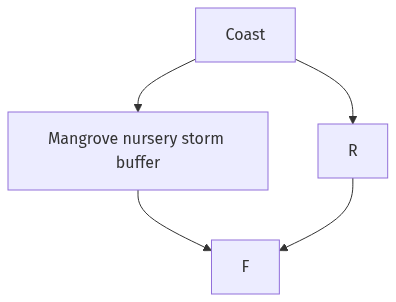
- Mangroves and reefs together keep sediment, nutrients, and young fish in the coastal food web, which is the base of artisanal catch.
- Management therefore has to join forest, fishery, and CRZ agencies, because a cut mangrove or a bleached reef lowers the same village catch.
Flow diagram
Conclusion
Indian mangroves manage the coast by cutting storm damage and raising nursery fish. Indian reefs manage marine life and island shores in the four reef regions. Both are resource systems, not only scenery, and both need legal and thermal protection.
Quick related
Students also ask
-
Examine the origin, dimensions and implications of the Sino-Indian border dispute.
Next question in the 2025 paper (Q9). View answer →
-
Do mangroves and reefs occur on the same shore?
Sometimes in a delta–reef seascape, but India’s largest mangroves are deltaic while the largest reefs are in the four reef regions named above.
-
Is tourism a marine resource here?
Reef and mangrove tourism is an economic use, but it is a resource only if bleaching, garbage, and boat damage are controlled.
Same topic · past papers
UPPSC has asked this before
These previous-year questions sit on the same topic. Open one to practise the earlier ask.
-
2021 · Q9 · UPGS1 · 8 marks
What is water crisis? Suggest suitable measures for water resource management.
More from this paper
Q1 · UPSC Mains 2025 · UPGS1 · 8 marks · Solution
Comment briefly on the development of art and technology during the Maurya period.
Indian culture
Mauryan art is court stone: edict pillars, the Sarnath lion capital, yaksha figures, Barabar caves, and early stupas. Mauryan technology is iron, state mines, punch-marked coins, roads, wells, and the Sudarshana lake begun under Pushyagupta. Both grew under one imperial administration from Chandragupta to Ashoka.
Q2 · UPSC Mains 2025 · UPGS1 · 8 marks · Solution
"Women's issue was a major concern in the socio-religious reform movements of 19th century India." Explain.
Women, population and associated issues
Reformers treated women’s status as a public test of social change in the nineteenth century. Sati was prohibited in Bengal Presidency in 1829 after Rammohan Roy’s campaign. The Hindu Widows’ Remarriage Act, 1856, followed Vidyasagar’s work. Phule schools and later women writers showed that education and household power were part of the same question. Child marriage remained contested in the Age of Consent debates of 1891.
Q3 · UPSC Mains 2025 · UPGS1 · 8 marks · Solution
"Extremism was a reaction against the ideas and modus operandi of the moderates." Critically explain this statement.
Modern Indian history
Moderates trusted petitions, councils, and British public opinion. The 1905 partition and failed prayers pushed Tilak, Pal, and Lajpat Rai toward Swaraj, boycott, and Swadeshi. Surat 1907 displayed the clash of methods inside Congress. Extremism also had a constructive Swadeshi programme, so it was not only a reaction. Later nationalism combined constitutional work with mass pressure.