
Revision summary
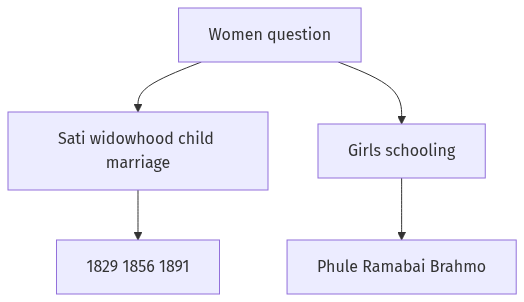
Reformers treated women’s status as a public test of social change in the nineteenth century. Sati was prohibited in Bengal Presidency in 1829 after Rammohan Roy’s campaign. The Hindu Widows’ Remarriage Act, 1856, followed Vidyasagar’s work. Phule schools and later women writers showed that education and household power were part of the same question. Child marriage remained contested in the Age of Consent debates of 1891.
Model answer
Introduction
Nineteenth-century socio-religious reform treated the condition of women as a test of whether Indian society could change. The women’s question was therefore not a side topic, and an explanation must show both the issues and the campaigns.
Body
Why the question was central
- Sati, child marriage, the ban on widow remarriage, and the denial of girls’ schooling were public facts that reformers could not ignore.
- Colonial law and print made these practices visible, so reform associations had to answer them if they claimed social improvement.
- Male reformers often treated women’s status as a measure of civilisation, which placed the women’s question at the centre of their programmes.
Issues and campaigns
- Raja Rammohan Roy and the Brahmo Samaj argued against sati, and Regulation XVII of 1829 made sati illegal in Bengal Presidency.
- Ishwar Chandra Vidyasagar led the campaign that produced the Hindu Widows’ Remarriage Act, 1856.
- Jyotirao and Savitribai Phule opened schools for girls in Pune and treated women’s education as social equality, not only household improvement.
- The Age of Consent debates, including the 1891 Act after the Phulmonee case, show that child marriage remained a live legal issue.
- Pandita Ramabai, Tarabai Shinde, and later women’s associations stated that reform written only by men left property, work, and the household untouched.
- Mission schools and vernacular print spread the debate beyond one city, which is why the women’s question appears in almost every major reform programme of the century.
Flow diagram
Conclusion
The women’s question was a major concern because sati, widowhood, child marriage, and girls’ schooling stood at the centre of nineteenth-century reform. Law and associations moved some practices, but property and household power changed more slowly, which is why the concern remained unfinished.
Quick related
Students also ask
-
"Extremism was a reaction against the ideas and modus operandi of the moderates." Critically explain this statement.
Next question in the 2025 paper (Q3). View answer →
-
Did law complete the women’s question?
No. Law banned sati and permitted widow remarriage, but household labour, property, and consent remained unfinished.
-
Were only men involved?
No. Savitribai Phule, Pandita Ramabai, and Tarabai Shinde wrote and organised; many associations were still led by men.
Same topic · past papers
UPPSC has asked this before
These previous-year questions sit on the same topic. Open one to practise the earlier ask.
-
2022 · Q2 · UPGS1 · 8 marks
Throw light on the nature of Renaissance in Uttar Pradesh in the 19th Century. -
2021 · Q12 · UPGS1 · 12 marks
How did the Indian Renaissance Movement of the 19th Century help in the development of India? Describe. -
2024 · Q5 · UPGS1 · 8 marks
Explain the contribution of women’s organisations in the development of Indian rural society. -
2023 · Q6 · UPGS1 · 8 marks
Do you agree with the statement that crime against women in India is increasing? -
2021 · Q14 · UPGS1 · 12 marks
Why is social empowerment of women necessary for inclusive development? Elaborate in detail.
More from this paper
Q1 · UPSC Mains 2025 · UPGS1 · 8 marks · Solution
Comment briefly on the development of art and technology during the Maurya period.
Indian culture
Mauryan art is court stone: edict pillars, the Sarnath lion capital, yaksha figures, Barabar caves, and early stupas. Mauryan technology is iron, state mines, punch-marked coins, roads, wells, and the Sudarshana lake begun under Pushyagupta. Both grew under one imperial administration from Chandragupta to Ashoka.
Q3 · UPSC Mains 2025 · UPGS1 · 8 marks · Solution
"Extremism was a reaction against the ideas and modus operandi of the moderates." Critically explain this statement.
Modern Indian history
Moderates trusted petitions, councils, and British public opinion. The 1905 partition and failed prayers pushed Tilak, Pal, and Lajpat Rai toward Swaraj, boycott, and Swadeshi. Surat 1907 displayed the clash of methods inside Congress. Extremism also had a constructive Swadeshi programme, so it was not only a reaction. Later nationalism combined constitutional work with mass pressure.
Q4 · UPSC Mains 2025 · UPGS1 · 8 marks · Solution
Does globalization lead to both cultural integration and cultural conflict? Elucidate.
Liberalisation, privatisation and globalisation
Globalization moves media, people, and goods, which can create shared tastes and workplaces. Indian cinema, food, and software also travel outward, so integration is two-way. The same flow produces conflict over language, food, faith, and neighbourhoods. Gains are uneven between English urban work and rural insecure work. Both integration and conflict can appear in the same film, town, or platform.