
Revision summary
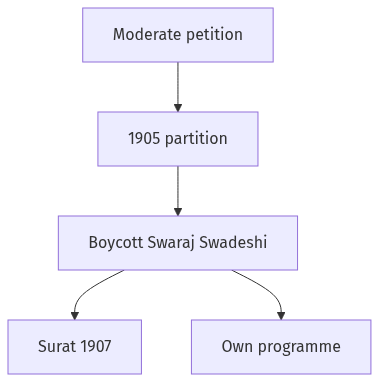
Moderates trusted petitions, councils, and British public opinion. The 1905 partition and failed prayers pushed Tilak, Pal, and Lajpat Rai toward Swaraj, boycott, and Swadeshi. Surat 1907 displayed the clash of methods inside Congress. Extremism also had a constructive Swadeshi programme, so it was not only a reaction. Later nationalism combined constitutional work with mass pressure.
Model answer
Introduction
The statement says extremism was a reaction against moderate ideas and methods. A critical explanation must show that reaction, and it must also show that extremists had aims of their own.
Body
Moderates: ideas and methods
- Moderates such as Dadabhai Naoroji, Pherozeshah Mehta, and Gopal Krishna Gokhale believed that British rule could be improved by argument inside the law.
- They used petitions, speeches in councils, and the drain-of-wealth case to ask for Indian share in administration.
- Their modus operandi was annual Congress sessions, prayer, and faith that British public opinion would correct official policy.
- They accepted gradual constitutional progress and did not call for a mass boycott of British goods or offices.
Extremism as reaction
- The partition of Bengal in 1905, the failure of moderate petitions, and racial bars in service made many younger leaders reject that method.
- Bal Gangadhar Tilak, Bipin Chandra Pal, and Lala Lajpat Rai asked for Swaraj, boycott, Swadeshi, and national education instead of petition.
- Extremists treated prayer and loyalty as a method that had not stopped the partition, which is the reaction named in the statement.
- The Surat split of 1907 made the clash of methods public inside the Congress.
Critical limit
- Extremism was not only a mood against moderates; it had a positive programme of Swadeshi enterprise, festivals, and political education.
- Some extremist methods stayed within public agitation, while a smaller revolutionary stream used arms, so “extremism” is not one single practice.
- Moderates had already named economic drain; extremists changed the method more than they invented the economic diagnosis.
- After 1916 the Lucknow Pact and later Gandhi’s mass satyagraha show that later nationalism used both constitutional work and extra-constitutional pressure.
Flow diagram
Conclusion
Extremism did react against moderate faith in petition and gradualism after 1905. The statement is incomplete if it hides the Swadeshi programme and the later mix of methods that followed Surat.
Quick related
Students also ask
-
Does globalization lead to both cultural integration and cultural conflict? Elucidate.
Next question in the 2025 paper (Q4). View answer →
-
Were extremists only violent?
No. Public extremism meant boycott, Swadeshi, and Swaraj. Armed revolutionaries were a smaller and separate stream.
-
Did moderates achieve nothing?
They built the Congress, named economic drain, and entered councils. Their method did not stop the 1905 partition, which is why the reaction came.
Same topic · past papers
UPPSC has asked this before
These previous-year questions sit on the same topic. Open one to practise the earlier ask.
-
2023 · Q6 · UPGS1 · 8 marks
Do you agree with the statement that crime against women in India is increasing?
More from this paper
Q1 · UPSC Mains 2025 · UPGS1 · 8 marks · Solution
Comment briefly on the development of art and technology during the Maurya period.
Indian culture
Mauryan art is court stone: edict pillars, the Sarnath lion capital, yaksha figures, Barabar caves, and early stupas. Mauryan technology is iron, state mines, punch-marked coins, roads, wells, and the Sudarshana lake begun under Pushyagupta. Both grew under one imperial administration from Chandragupta to Ashoka.
Q2 · UPSC Mains 2025 · UPGS1 · 8 marks · Solution
"Women's issue was a major concern in the socio-religious reform movements of 19th century India." Explain.
Women, population and associated issues
Reformers treated women’s status as a public test of social change in the nineteenth century. Sati was prohibited in Bengal Presidency in 1829 after Rammohan Roy’s campaign. The Hindu Widows’ Remarriage Act, 1856, followed Vidyasagar’s work. Phule schools and later women writers showed that education and household power were part of the same question. Child marriage remained contested in the Age of Consent debates of 1891.
Q4 · UPSC Mains 2025 · UPGS1 · 8 marks · Solution
Does globalization lead to both cultural integration and cultural conflict? Elucidate.
Liberalisation, privatisation and globalisation
Globalization moves media, people, and goods, which can create shared tastes and workplaces. Indian cinema, food, and software also travel outward, so integration is two-way. The same flow produces conflict over language, food, faith, and neighbourhoods. Gains are uneven between English urban work and rural insecure work. Both integration and conflict can appear in the same film, town, or platform.