
Revision summary
Caste conflict is organised competition over honour, land, jobs and votes. Prevention needs prosecution under atrocity law, not only peace meetings. Common schooling, wages and land reduce the material fuse. Panchayat reservation forces some sharing of dominant-caste power. Anti-caste public culture and slow change in endogamy are the deep levers.
Model answer
Copper italics in this answer — like this — are the key facts. Each one is unpacked in the Facts & figures rail.
Introduction
Caste conflict is not a misunderstanding that a poster can cure. It is competition over honour, women, land, jobs and the vote, organised by ranked birth groups. Prevention must therefore change interests and everyday contact, not only preach harmony.
Body
What works, and why
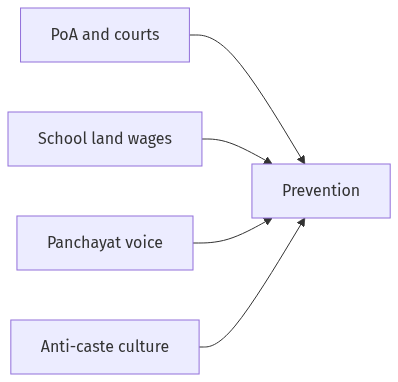
- Law: swift PoA prosecution, witness protection, and action against social boycott reduce the payoff to public violence. Impunity is a cause. Ambedkar was right that political safeguards without social mixing fail; but law still raises the cost of atrocity.
- Economy and education: land to the landless, enforcement of minimum wages, and common schools (not caste-segregated hostels as destiny) shrink the material fuse. Béteille’s point that education can split caste from class is a preventive if access is real. Reservation lowers zero-sum street fights over the first clerk’s post by routing claim into rules—while generating its own backlash, which must be politically managed, not denied.
- Local institutions: mixed panchayats, shared irrigation, and public dining in mid-day meals attack untouchability as practice. Srinivas’s dominant caste will not vanish; rotating chairs and SC/ST/women seats force some sharing.
- Culture: Ambedkarite public (books, Buddha viharas, jalsas) and inter-caste association in unions and cities create counter-honour. Moral appeals to varna harmony reproduce the hierarchy that explodes. Police reform and social-media rumour control matter because many recent clashes travel as forwarded honour.
- Justify: conflict falls when exit and voice exist—migration, parties, courts—and when endogamy slowly yields, which is the slowest lever. Béteille’s asymmetry thesis is practical here: if class, caste and power no longer coincide, cross-cutting ties can dampen total war. If they re-align in a riot, prevention has failed.
Flow diagram
Conclusion
Prevent caste conflict by raising the legal cost of violence, spreading assets and common schooling, sharing local office, and building anti-caste public culture. Harmony without annihilation of caste is a truce, not a prevention.
Quick related
Students also ask
-
Is it possible to have sustainable development in India? Cite major environmental issues and suggest a few measures to achieve the sustainability
Next question on this syllabus topic (2025 · Q8(a)). View answer →
-
Will development automatically end caste riots?
No. Mobility can intensify honour conflicts, as in several Green Revolution and urbanising districts.
-
Should reservation be ended to reduce conflict?
Ending it without equalising assets would likely shift conflict back onto raw domination, not into class peace.
Same topic · past papers
UPSC has asked this before
These previous-year questions sit on the same topic. Open one to practise the earlier ask.
-
2024 · Q7(b) · Sociology GS 2 · 20 marks
To what extent have the legal provisions been effective in curbing violence against women in India? Give your argument -
2022 · Q6(a) · Sociology GS 2 · 20 marks
Examine whether rural bondage still continues to be a social reality. Give your argument . -
2026 · Q4(b) · Sociology GS 2 · 20 marks
Draw the current population pyramid of India. What policy measures would you recommend for population dynamics to achieve sustainability? -
2024 · Q6(a) · Sociology GS 2 · 20 marks
Discuss the major challenges related to women's reproductive health in India. What measures would you suggest to overcome these challenges? -
2023 · Q6(c) · Sociology GS 2 · 20 marks
What actionable measures would you suggest to curb the recurrent child labour menace in India?
More from this topic
Q7(b) · UPSC Mains 2026 · Sociology GS 2 · 20 marks · Solution
Give a sociological explanation of violence against women in India. What suggestions would you give to mitigate these violences?
Challenges of Social Transformation
• Rooted in structural patriarchy, unequal socialization, and institutionalized gender roles within public and private spheres. • Sustained by family, marriage, and religion, which normalize male dominance and control over women's autonomy. • Intersecting factors like class, caste, and religion expose marginalized women to multiple layers of structural violence. • Requires rigorous legal enforcement and gender-sensitizing law enforcement to improve justice delivery. • Demands stronger institutional support, including one-stop crisis centers, helplines, and accessible legal aid. • Calls for educational reforms and community engagement to dismantle toxic masculinity and promote gender equality. • Grounded in Articles 14 and 21, demanding a shift toward transformative social engineering and substantive equality.
Q8(b) · UPSC Mains 2025 · Sociology GS 2 · 20 marks · Solution
Do you think that forced displacement of labourers has caused their deprivation and resultant inequalities during the recent past years? Elaborate
Challenges of Social Transformation
Forced displacement strips land, commons and urban foothold, then cheapens labour. Cernea’s impoverishment risks and Fernandes’s undercounting still describe Indian projects. Recent drivers include mining, highways, city beautification, conflict, climate and COVID reverse migration. Women, ST, SC and migrants lose most; land-value winners gain. R&R law exists; deprivation remains the modal outcome when consent and livelihoods are thin.
Q8(a) · UPSC Mains 2025 · Sociology GS 2 · 20 marks · Solution
Is it possible to have sustainable development in India? Cite major environmental issues and suggest a few measures to achieve the sustainability
Challenges of Social Transformation
Sustainable development is possible in India only if growth is decoupled from dumping costs on the poor. Main issues are climate risk, air and water stress, forest loss, land conversion and inequality. Guha–Gadgil’s sociology of ecosystem people versus omnivores still explains who suffers. Measures include just energy transition, FRA, crop and city reform, and SDG-consistent budgets. Possibility is a political path, not a technical guarantee.