
Revision summary
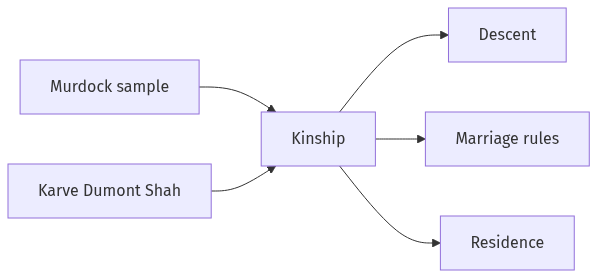
Kinship organises descent, marriage, residence, inheritance and care beyond raw biology. Murdock’s Social Structure compared hundreds of societies on those axes. He argued the nuclear family is a universal functional unit, often inside larger kin groups. Indian joint family, gotra exogamy and Dravidian cross-cousin marriage qualify a simple nuclear picture. Caste endogamy makes Indian kinship a political as well as a domestic institution.
Model answer
Copper italics in this answer — like this — are the key facts. Each one is unpacked in the Facts & figures rail.
Introduction
Kinship is the organised set of relations that come from descent, marriage and socially recognised parenting. It allocates who may marry whom, who inherits, who lives together, and who must care. It is not only biology. G. P. Murdock made this a comparative science with a world sample, which Indian sociology still uses—and argues with.
Body
Murdock’s contribution
In Social Structure (1949) Murdock coded hundreds of societies (the number often cited is about 250 in that book, later expanded in the Ethnographic Atlas). He classified residence (patrilocal, matrilocal, neolocal, avunculocal), descent (patrilineal, matrilineal, bilateral), and cousin marriage. His famous claim was that the nuclear family is universal: a man and woman and their children as a functional unit of sex, economy and socialisation, even when embedded in larger kin groups.
The method was cross-cultural statistical comparison, a break from purely speculative evolutionism. It gave later demographers and family sociologists a grid.
Indian caveats
India’s joint family, vansh, gotra, North Indian village exogamy, and Dravidian cross-cousin marriage (Karve, Dumont, Trautmann) do not fit a simple nuclear-universal story. Murdock allowed that nuclear units sit inside extended structures; Indian ethnography shows the property and ritual corporation of the joint household as more than a cluster of nuclear cells. Patricia Uberoi and A. M. Shah document change: residential nuclearisation with continuing joint obligations. Kinship here is also caste: endogamy is the hinge of the jati.
Murdock remains the pioneer of systematic comparison. Indian kinship studies supply the necessary resistance: region, caste and jointness.
Flow diagram
Conclusion
Kinship is the rule-bound organisation of descent and marriage. Murdock gave a comparative map and a nuclear-family thesis. Indian systems of joint family, gotra and Dravidian alliance show why that map needs local theory, not why comparison should be abandoned.
Quick related
Students also ask
-
'The transfer of land from cultivating to the non-cultivating owners is bringing about transformation in Indian society.' Justify your answer by giving suitable illustrations.
Next question on this syllabus topic (2025 · Q5(a)). View answer →
-
Did Murdock say extended families do not exist?
No. He said nuclear units are always present as a functional core, including inside extended families.
-
Is Indian kinship only Hindu?
No. Muslim, Christian, Sikh and tribal systems have their own descent and marriage rules; caste-like closure still often appears.
Same topic · past papers
UPSC has asked this before
These previous-year questions sit on the same topic. Open one to practise the earlier ask.
-
2021 · Q1(d) · Sociology GS 2 · 10 marks
Critically examine briefly the phrase "Little 'Republics" as used to denote India's villages
More from this topic
Q5(e) · UPSC Mains 2026 · Sociology GS 2 · 10 marks · Solution
Bring out the debates of 'insiders' and 'outsiders' approaches in understanding Indian society.
Perspectives on the study of Indian society
• The insider (emic) approach studies Indian society using native categories, sacred texts, and cultural immersion, championed by G.S. Ghurye and D.P. Mukerji. • Critics argue the insider view suffers from upper-caste bias and ignores ground realities in favor of normative texts. • The outsider (etic) approach applies universal models and comparative frameworks, famously used by Western scholars like Louis Dumont. • Critics dismiss the outsider view as orientalist reductionism that imposes Western concepts and misinterprets local idioms. • Modern Indian sociology bridges this binary through a reflexive methodology combining cultural familiarity with analytical rigor. • Ultimately, combining native insights with objective scrutiny is essential to capture India's complex social dynamics.
Q5(a) · UPSC Mains 2026 · Sociology GS 2 · 10 marks · Solution
Discuss the challenges faced by the aged people in receiving 'elder care'.
Perspectives on the study of Indian society
• India's aging population faces severe elder care challenges due to the breakdown of traditional joint families and youth out-migration. • Over 80% of seniors lack formal pensions because they worked in the informal sector, worsening financial vulnerability. • High out-of-pocket medical costs for chronic illnesses quickly drain meager personal savings. • Public hospitals suffer from an acute shortage of geriatric specialists, dedicated wards, and rehabilitation facilities. • Implementation of the Maintenance and Welfare of Parents and Senior Citizens Act, 2007 remains weak, leaving legal tribunals overburdened. • Solutions require shifting from a welfare approach to a rights-based framework, combining community care networks with strict legal enforcement under Article 41.
Q4(c) · UPSC Mains 2026 · Sociology GS 2 · 10 marks · Solution
Compare G. S. Ghurye's and A. R. Desai's approaches used in understanding Indian society
Perspectives on the study of Indian society
• **Ghurye’s Indological Approach:** Relied on sacred texts and classical literature to study Indian society through civilizational continuity. • **Core Themes in Ghurye:** Focused on caste, kin, and how Hinduism historically integrated diverse tribal and regional groups. • **Desai’s Materialist Approach:** Rejected textual idealism in favor of Marxist political economy to study social structures. • **Economic Formations:** Analyzed Indian society through successive modes of production—ancient, feudal, and colonial capitalist. • **Caste vs. Class:** Viewed caste and religion as superstructural elements that mask underlying economic exploitation. • **Critique of State and Nationalism:** Argued that the nationalist movement was bourgeois, leaving agrarian inequalities intact post-independence. • **Key Contrast:** Ghurye highlights cultural tradition and integration, while Desai emphasizes economic power and class conflict.