
Revision summary
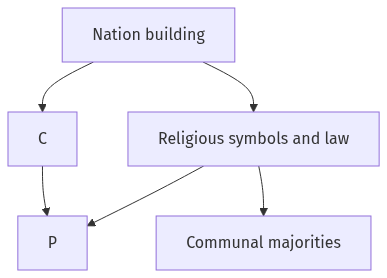
Nation building is the creation of a shared political community on top of a diverse social structure. In India religion provides both unifying symbols and census-based fracture lines. Partition, personal law, and Articles 25–28 institutionalised that double role. Secularism, Ambedkarite critique and majoritarian nationalism are competing methods of building the we. The outcome depends on courts, parties and everyday pluralism, not on religion vanishing.
Model answer
Copper italics in this answer — like this — are the key facts. Each one is unpacked in the Facts & figures rail.
Introduction
Nation building is the long work of turning a state into a felt political community: a people who share institutions, a story, and some willingness to pay tax and accept the vote of strangers. In India that work began under colonial sociology of communities and exploded at Partition. Religion is not a side theme. It is one of the main languages in which the nation is imagined, contested and administered.
Body
What nation building requires
M. N. Srinivas and later political sociologists stressed a horizontal solidarity across caste and region. A. R. Desai read the national movement as a bourgeois project with peasant and working-class tributaries. Partha Chatterjee split the inner spiritual domain from the outer material domain of the colonial state. Nation building after 1947 meant Constitution, planning, official language bargains, and a developmental state that promised dignity without erasing diversity.
Religion’s double role
Religion supplied symbols of sacrifice (Gandhi’s Ram, Khilafat, Gurbani in the INA’s mixed registers) and everyday pluralism—shared shrines, syncretic practice, the constitutional bundle of Articles 25–28. It also supplied enumerated majorities and minorities (census, separate electorates, personal law). T. N. Madan and Ashis Nandy criticised Nehruvian secularism as too thin for believers; Rajeev Bhargava defended a principled distance. Ambedkar warned that Hinduism as social structure (caste) could not be the unspoken nation unless annihilated.
- Mechanisms of fracture: riot systems (Paul Brass), temple–mosque litigation, personal-law exceptionalism, and party mobilisation of sacred geography. Mechanisms of binding: a common electoral roll, military and cricket public, pilgrimage mixed with tourism, and court-enforced rights. Uniform Civil Code remains a sociological test: equality of citizens versus autonomy of religious groups.
Contemporary majoritarian nationalism tries to nation-build through a dominant religious identity. That can produce a strong we-feeling for some and a second-class script for others. Classical Congress secularism tried to nation-build around religion as private and personal-law as group right. Both are nation-building strategies; they allocate dignity differently.
Religion will not leave the Indian nation. The sociological question is whether it remains a plural public ethic or becomes a boundary of blood and census.
Flow diagram
Conclusion
Nation building in India is the making of a civic we on a religiously dense society. Religion can sacralise the Republic or split it into enumerated flocks. Institutions—vote, court, school, personal law—decide which face prevails, not a hope that belief will simply fade.
Quick related
Students also ask
-
What is kinship? Briefly explain G. P. Murdock's contribution to the study of the kinship system
Next question on this syllabus topic (2025 · Q4(c)). View answer →
-
Is a secular state hostile to religion?
Indian secularism historically regulated and recognised religions rather than banishing them; the fight is over equal respect versus majority capture.
-
Can nation building ignore religion?
Not in India. Even a civic nationalism must still handle personal law, festivals and the memory of Partition.
Same topic · past papers
UPSC has asked this before
These previous-year questions sit on the same topic. Open one to practise the earlier ask.
-
2017 · Q7(b) · Sociology GS 2 · 20 marks
To what extent does nation building depends on strengthening of pluralities in Indian society?
More from this topic
Q5(e) · UPSC Mains 2026 · Sociology GS 2 · 10 marks · Solution
Bring out the debates of 'insiders' and 'outsiders' approaches in understanding Indian society.
Perspectives on the study of Indian society
• The insider (emic) approach studies Indian society using native categories, sacred texts, and cultural immersion, championed by G.S. Ghurye and D.P. Mukerji. • Critics argue the insider view suffers from upper-caste bias and ignores ground realities in favor of normative texts. • The outsider (etic) approach applies universal models and comparative frameworks, famously used by Western scholars like Louis Dumont. • Critics dismiss the outsider view as orientalist reductionism that imposes Western concepts and misinterprets local idioms. • Modern Indian sociology bridges this binary through a reflexive methodology combining cultural familiarity with analytical rigor. • Ultimately, combining native insights with objective scrutiny is essential to capture India's complex social dynamics.
Q5(a) · UPSC Mains 2026 · Sociology GS 2 · 10 marks · Solution
Discuss the challenges faced by the aged people in receiving 'elder care'.
Perspectives on the study of Indian society
• India's aging population faces severe elder care challenges due to the breakdown of traditional joint families and youth out-migration. • Over 80% of seniors lack formal pensions because they worked in the informal sector, worsening financial vulnerability. • High out-of-pocket medical costs for chronic illnesses quickly drain meager personal savings. • Public hospitals suffer from an acute shortage of geriatric specialists, dedicated wards, and rehabilitation facilities. • Implementation of the Maintenance and Welfare of Parents and Senior Citizens Act, 2007 remains weak, leaving legal tribunals overburdened. • Solutions require shifting from a welfare approach to a rights-based framework, combining community care networks with strict legal enforcement under Article 41.
Q4(c) · UPSC Mains 2026 · Sociology GS 2 · 10 marks · Solution
Compare G. S. Ghurye's and A. R. Desai's approaches used in understanding Indian society
Perspectives on the study of Indian society
• **Ghurye’s Indological Approach:** Relied on sacred texts and classical literature to study Indian society through civilizational continuity. • **Core Themes in Ghurye:** Focused on caste, kin, and how Hinduism historically integrated diverse tribal and regional groups. • **Desai’s Materialist Approach:** Rejected textual idealism in favor of Marxist political economy to study social structures. • **Economic Formations:** Analyzed Indian society through successive modes of production—ancient, feudal, and colonial capitalist. • **Caste vs. Class:** Viewed caste and religion as superstructural elements that mask underlying economic exploitation. • **Critique of State and Nationalism:** Argued that the nationalist movement was bourgeois, leaving agrarian inequalities intact post-independence. • **Key Contrast:** Ghurye highlights cultural tradition and integration, while Desai emphasizes economic power and class conflict.