
Revision summary
Village industries declined through colonial competition, forest enclosure and the collapse of patronage. Post-independence mill goods, power-looms and plastics continued the squeeze. Credit, GST, and migration now pull youth out of hereditary crafts. Some clusters brand and survive; most artisan households enter informal labour. The process reorders caste occupations, not only GDP shares.
Model answer
Copper italics in this answer — like this — are the key facts. Each one is unpacked in the Facts & figures rail.
Introduction
Village industries—handloom, pottery, oil-press, carpentry, leather, smithy—were never a romantic extra. They were a caste-organised division of labour tied to the agrarian surplus. Their decline is a long process with colonial roots and contemporary accelerators.
Body
Long decline
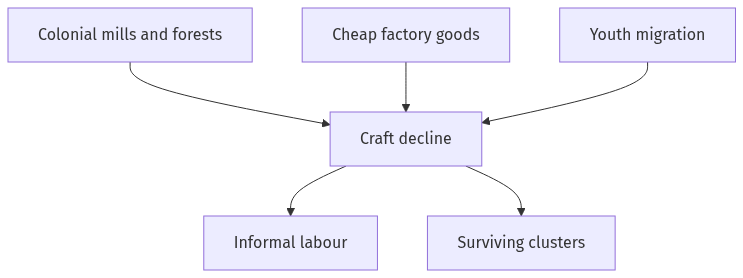
Colonial free trade and mills undercut weavers and many urban-rural crafts (the deindustrialisation debate). Forest law cut artisan access to wood, bamboo and lac. Moneylenders replaced patronage. After Independence, KVIC, handloom boards and reservations slowed but did not reverse the fall. Factory soap, plastic and mill cloth are cheaper than the village product. Power-looms ate handlooms; Chinese and Tiruppur goods ate residual niches.
Present factors
Credit is scarce without collateral; GST and compliance hurt tiny units. Youth migrate to construction and delivery rather than inherit a stigmatised craft. Raw materials are commercialised. Skills are not aligned with NEP 2020’s promise unless local clusters (Moradabad brass, Kannauj attar, Khurja pottery) capture a brand. Jajmani collapse means the potter is not paid in grain by the dominant caste; he needs a cash market that the village no longer is.
Electricity, roads and mobile money did not automatically revive the workshop. They often made urban factory goods cheaper to fetch. Cooperative and SHG credit under NRLM helps some women weavers and food processors; it rarely rebuilds a whole jati occupation. Leather and sanitation-linked crafts still carry pollution stigma, so “skill India” without anti-caste dignity is a half measure.
Sociologically, decline is occupational mobility mixed with distress. Some artisan castes sanskritize or enter government jobs; many become footloose labour (Breman). Women home-based workers remain invisible in the informal sector. Village industry decline is thus a chapter in class formation and caste re-ranking, not only a missing subsidy.
Flow diagram
Conclusion
Village industries fell because cheaper manufactures, lost commons, thin credit, and out-migration destroyed their market and labour. Caste crafts became either branded clusters or residual poverty.
Quick related
Students also ask
-
What are the Private and Public network and support systems operative in Indian society for the aged? Suggest measures to curb down the challenges before care givers of the aged
Next question on this syllabus topic (2025 · Q7(a)). View answer →
-
Can GI tags save village industry?
They help a few clusters with export or tourist demand. They do not restore a whole jajmani economy.
-
Is decline only colonial?
Colonial shock began it; independent India’s factory goods, policy bias to large industry, and migration completed it.
Same topic · past papers
UPSC has asked this before
These previous-year questions sit on the same topic. Open one to practise the earlier ask.
-
2016 · Q7(a) · Sociology GS 2 · 20 marks
Bring out the impact of the declining significance of the agrarian economy.
More from this topic
Q5(e) · UPSC Mains 2026 · Sociology GS 2 · 10 marks · Solution
Bring out the debates of 'insiders' and 'outsiders' approaches in understanding Indian society.
Perspectives on the study of Indian society
• The insider (emic) approach studies Indian society using native categories, sacred texts, and cultural immersion, championed by G.S. Ghurye and D.P. Mukerji. • Critics argue the insider view suffers from upper-caste bias and ignores ground realities in favor of normative texts. • The outsider (etic) approach applies universal models and comparative frameworks, famously used by Western scholars like Louis Dumont. • Critics dismiss the outsider view as orientalist reductionism that imposes Western concepts and misinterprets local idioms. • Modern Indian sociology bridges this binary through a reflexive methodology combining cultural familiarity with analytical rigor. • Ultimately, combining native insights with objective scrutiny is essential to capture India's complex social dynamics.
Q5(a) · UPSC Mains 2026 · Sociology GS 2 · 10 marks · Solution
Discuss the challenges faced by the aged people in receiving 'elder care'.
Perspectives on the study of Indian society
• India's aging population faces severe elder care challenges due to the breakdown of traditional joint families and youth out-migration. • Over 80% of seniors lack formal pensions because they worked in the informal sector, worsening financial vulnerability. • High out-of-pocket medical costs for chronic illnesses quickly drain meager personal savings. • Public hospitals suffer from an acute shortage of geriatric specialists, dedicated wards, and rehabilitation facilities. • Implementation of the Maintenance and Welfare of Parents and Senior Citizens Act, 2007 remains weak, leaving legal tribunals overburdened. • Solutions require shifting from a welfare approach to a rights-based framework, combining community care networks with strict legal enforcement under Article 41.
Q4(c) · UPSC Mains 2026 · Sociology GS 2 · 10 marks · Solution
Compare G. S. Ghurye's and A. R. Desai's approaches used in understanding Indian society
Perspectives on the study of Indian society
• **Ghurye’s Indological Approach:** Relied on sacred texts and classical literature to study Indian society through civilizational continuity. • **Core Themes in Ghurye:** Focused on caste, kin, and how Hinduism historically integrated diverse tribal and regional groups. • **Desai’s Materialist Approach:** Rejected textual idealism in favor of Marxist political economy to study social structures. • **Economic Formations:** Analyzed Indian society through successive modes of production—ancient, feudal, and colonial capitalist. • **Caste vs. Class:** Viewed caste and religion as superstructural elements that mask underlying economic exploitation. • **Critique of State and Nationalism:** Argued that the nationalist movement was bourgeois, leaving agrarian inequalities intact post-independence. • **Key Contrast:** Ghurye highlights cultural tradition and integration, while Desai emphasizes economic power and class conflict.