
Revision summary
Articles 15–17, 16(4), legislative reservation, commissions and the Schedules form the SC/ST constitutional machine. They produced political presence and an educated professional minority unprecedented in 1950. PoA, PESA and FRA extend protection into violence and livelihood, with weak delivery. Landlessness, atrocities, displacement and intra-group inequality remain. The Constitution changed conditions without completing social democracy.
Model answer
Copper italics in this answer — like this — are the key facts. Each one is unpacked in the Facts & figures rail.
Introduction
The Constitution did not leave Scheduled Castes and Scheduled Tribes to charity. It built a protective discrimination and representation machine: equality clauses, abolition of untouchability, reservation in legislatures and services, scheduled-area government, and later national commissions. The sociological question is how far that machine changed life chances as well as letterhead.
Body
What the provisions did
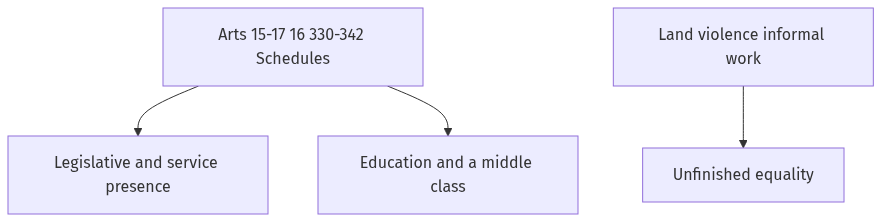
Article 17 made untouchability a public crime, later given teeth by the Protection of Civil Rights Act and the SC/ST (PoA) Act, 1989. Articles 15(4) and 16(4) authorised reservation in education and posts; 330–334 (and analogous Rajya Sabha/state seats) guaranteed political presence. 338 and 338A created NCSC and NCST. Fifth and Sixth Schedules recognised tribal territorial difference. Article 46 directed the state to promote educational and economic interests. Together they produced an SC/ST professional and political class that did not exist in 1950: IAS and engineering graduates, panchayat presidents, and a Dalit-Bahujan intelligentsia.
Panchayati Raj reservations (73rd/74th) and scholarships widened the base. Forest rights (FRA 2006) and PESA (1996) tried to convert schedule into livelihood, with mixed results. Article 21A and RTE matter here because SC/ST exclusion from school was a social fact, not a taste.
Critical remainder
Landlessness among SC agricultural labour remains high. Atrocities continue; conviction rates disappoint. ST displacement by dams and mines shows that schedule plus industrial policy can collide. A creamy layer debate, and the Supreme Court’s opening to sub-classification within SC, register internal inequality. Women of both groups face a double bind. Political reservation can yield proxy candidates. Urban informal SC/ST workers live outside the reservation office.
E. V. Ramasamy and regional anti-caste parties show that constitutional clauses work only when a movement uses them. Ghurye’s assimilation thesis for tribes sits uneasily beside Fifth Schedule autonomy; policy still wobbles. Manual scavenging bans exist; the occupation persists as a caste-class knot. Constitutional change is real and unfinished: status mobility for a minority of families, continued structural violence and asset poverty for the many.
Ambedkar wanted social democracy, not only a schedule. The provisions moved India toward that; they did not complete it. A critical exam answer therefore holds two sentences together: representation rose; land, safety and dignity did not rise in step.
Flow diagram
Conclusion
Constitutional provisions created representation, a service class, and a legal language against untouchability and tribal dispossession. They have not equalised land, safety or dignity. The record is structural progress with a harsh remainder.
Quick related
Students also ask
-
What are the definitional problems involved in identifying tribes in India? Discuss the main obstacles to tribal development in India
Next question on this syllabus topic (2024 · Q2(b)). View answer →
-
Has reservation created only a creamy layer?
It has created a visible elite and also a wider clerical and teaching stratum. It has not lifted landless labour as a class.
-
Do Fifth Schedule protections stop mining?
Samata and Gram Sabha cases show legal brakes. Practice still often favours the project.
Same topic · past papers
UPSC has asked this before
These previous-year questions sit on the same topic. Open one to practise the earlier ask.
-
2025 · Q1(d) · Sociology GS 2 · 10 marks
How did Colonial Policies for the tribes affected their socio-economic conditions in India? Discuss.
More from this topic
Q8(c) · UPSC Mains 2026 · Sociology GS 2 · 10 marks · Solution
Where would you locate the tribal community in the Varna system of India? Discuss
Tribal communities in India
• Historically, tribal groups (Adivasis) lived outside the classical Varna system in distinct forest
Q1(d) · UPSC Mains 2025 · Sociology GS 2 · 10 marks · Solution
How did Colonial Policies for the tribes affected their socio-economic conditions in India? Discuss.
Tribal communities in India
Colonial tribal policy combined forest reservation, land revenue, labour recruitment and criminal tribes law. Economic effects were land alienation, indebtedness and incorporation as cheap labour. Missions and schools created a small elite and cultural change. Elwin’s isolation and Ghurye’s assimilation framed official thought more than they described the frontier. Independent India’s ST law and FRA still answer that colonial structure.
Q2(b) · UPSC Mains 2024 · Sociology GS 2 · 20 marks · Solution
What are the definitional problems involved in identifying tribes in India? Discuss the main obstacles to tribal development in India
Tribal communities in India
Tribe in India is an administrative and historical label, not one anthropological type. Ghurye’s assimilation and Elwin’s isolation disagree on what tribes are. ST lists, not isolation tests, now identify groups, which creates political and scientific problems. Land alienation, forest law and displacement are the main development obstacles. FRA, PESA and the Fifth and Sixth Schedules exist; implementation and consent remain weak.