
Revision summary
Tribe in India is an administrative and historical label, not one anthropological type. Ghurye’s assimilation and Elwin’s isolation disagree on what tribes are. ST lists, not isolation tests, now identify groups, which creates political and scientific problems. Land alienation, forest law and displacement are the main development obstacles. FRA, PESA and the Fifth and Sixth Schedules exist; implementation and consent remain weak.
Model answer
Copper italics in this answer — like this — are the key facts. Each one is unpacked in the Facts & figures rail.
Introduction
‘Tribe’ in India is not a clean scientific species. It is a colonial and constitutional label laid on many kinds of community: plough peasants, forest cultivators, pastoralists and hunters. Definitional problems are therefore the first obstacle to policy. Development schemes then meet land alienation, forest law, displacement and a thin voice in the state. Virginius Xaxa has insisted that tribes be treated as a society with history, not as a leftover of evolution.
Body
Definitional problems
Nineteenth-century ethnography used isolation, ‘primitive’ technology, animism and kinship as markers. The census then froze lists. Ghurye argued that many so-called aborigines were backward Hindus, sharing caste-like ranking and Sanskritic contact. Elwin stressed distinct culture, myth and forest livelihood and favoured protection. Neither definition matches all groups. The Santal, Gonds, Bhils, Nagas and Andaman peoples do not form one social type.
- After Independence the operational definition is the Scheduled Tribe list: a political-administrative schedule, not a fieldwork test. Groups campaign to enter or leave it. Criteria used by commissions—geographical isolation, distinctive culture, backwardness, shy contact—are circular and often outdated. Sanskritization and conversion blur ‘animism’. Inter-marriage and markets blur isolation. Some ST groups are stratified internally; some non-ST forest peasants look similar on the ground. Tribe versus caste is a continuum in many regions, as Srinivas and Bailey noted in different ways. Language is not decisive: tribal speakers of Indo-Aryan or Dravidian tongues still sit on lists. Religion is not decisive: Christian, Hindu and sarna identifications coexist.
- So identification problems are: (1) colonial evolutionist residue; (2) mismatch between anthropological type and ST schedule; (3) internal diversity; (4) mobility and contact that ruin isolation tests; (5) political incentive to claim or deny the label.
Obstacles to tribal development
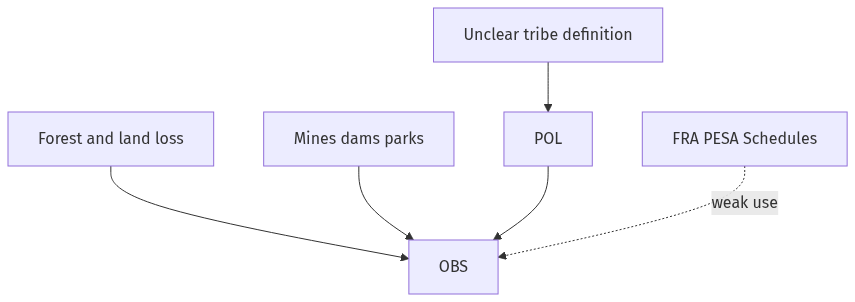
Land and forest are the material core. Colonial Forest Acts and the Indian Forest Act, 1927 turned customary use into concession. Post-Independence dams, mines, factories and protected areas displaced millions. The Forest Rights Act, 2006 promised community and individual rights; implementation is uneven and often hostile in the field. Fifth Schedule protections, Governors’ powers and PESA, 1996 are weakly used. Sixth Schedule councils in the Northeast have more institutional muscle but their own elite politics.
- Human development obstacles follow: boarding schools that break language, poor health and nutrition, indebtedness, and trafficking. Development-induced displacement without land-for-land creates a new casual labour class. Mining and counter-insurgency in central India militarise everyday life. A small tribal elite captures jobs and contracts; Xaxa and others warn against reading ST reservation as group development. Isolation, assimilation and integration as policy models (Elwin, Ghurye, and official integration) have all failed when they ignore land and consent.
Health, schooling and language are not side issues. Residential schools can produce a small salariat and a large experience of cultural loss. NEP 2020’s mother-tongue aim matters here if it includes tribal languages rather than only major regional standards. Without land, a degree still sends youth into the same informal labour stream described for industry.
Obstacles are therefore definitional and structural together. If the state cannot say who is a tribe except by a list, and if the list’s lands are taken for national development, ‘tribal development’ becomes a residual welfare budget beside extraction.
Flow diagram
Conclusion
Tribes in India are hard to identify because the word mixes colonial typing, lived diversity and a political ST schedule. Development stalls where forest and land rights are insecure, displacement is routine, and policy oscillates between isolation and assimilation without tribal control over resources. FRA, PESA and the Schedules are the available tools; their weak use is the main contemporary obstacle.
Quick related
Students also ask
-
What is 'Ageing'? Discuss the major problems of aged people in India
Next question on this syllabus topic (2023 · Q8(c)). View answer →
-
Are all Adivasis Scheduled Tribes?
No. Some communities claim Adivasi identity without ST status; some ST groups reject the Adivasi label.
-
Is isolation still a valid test?
Most listed groups have long contact with markets, missions and the state. Isolation describes a few cases, not the category.
Same topic · past papers
UPSC has asked this before
These previous-year questions sit on the same topic. Open one to practise the earlier ask.
-
2020 · Q1(d) · Sociology GS 2 · 10 marks
Explain the definitional problems concerning the tribal communities in India.
More from this topic
Q8(c) · UPSC Mains 2026 · Sociology GS 2 · 10 marks · Solution
Where would you locate the tribal community in the Varna system of India? Discuss
Tribal communities in India
• Historically, tribal groups (Adivasis) lived outside the classical Varna system in distinct forest
Q6(a) · UPSC Mains 2025 · Sociology GS 2 · 20 marks · Solution
In what respects have the constitutional provisions changed the socio-economic and political conditions of Scheduled Castes and Scheduled Tribes in India? Critically examine
Tribal communities in India
Articles 15–17, 16(4), legislative reservation, commissions and the Schedules form the SC/ST constitutional machine. They produced political presence and an educated professional minority unprecedented in 1950. PoA, PESA and FRA extend protection into violence and livelihood, with weak delivery. Landlessness, atrocities, displacement and intra-group inequality remain. The Constitution changed conditions without completing social democracy.
Q1(d) · UPSC Mains 2025 · Sociology GS 2 · 10 marks · Solution
How did Colonial Policies for the tribes affected their socio-economic conditions in India? Discuss.
Tribal communities in India
Colonial tribal policy combined forest reservation, land revenue, labour recruitment and criminal tribes law. Economic effects were land alienation, indebtedness and incorporation as cheap labour. Missions and schools created a small elite and cultural change. Elwin’s isolation and Ghurye’s assimilation framed official thought more than they described the frontier. Independent India’s ST law and FRA still answer that colonial structure.