
Revision summary
Navtej Johar decriminalised consensual same-sex relations; Supriyo did not create a right to marry. National fertility and population growth are driven by education, contraception and urban costs. Any demographic effect of same-sex unions is small because numbers are small and many still enter heterosexual marriage. The clearer effects are on household form, inheritance gaps and kinship ideology. Serious analysis avoids both moral panic and the claim that queer marriage will reshape India’s age structure.
Model answer
Copper italics in this answer — like this — are the key facts. Each one is unpacked in the Facts & figures rail.
Introduction
Same-sex marriage is not a general civil right in India today. Navtej Singh Johar (2018) read down Section 377 and protected adult consensual same-sex relations. Supriyo @ Supriya Chakraborty (2023) refused to constitutionalise marriage, leaving adoption, succession and spousal social security largely to the heterosexual legal family. Population dynamics must be discussed from that thin legal base, not from a Western marriage-equality census.
Body
Law, kinship and numbers
India’s fertility decline is driven by female schooling, contraception, urban costs and the two-child norm, not by queer marriage. Even where same-sex couples live together in metros, their share of households is small. Any effect on crude birth rate or TFR is negligible at national scale. Some couples raise children through prior heterosexual marriage, kinship care, or informal adoption; that rearranges a few households, it does not rewrite the age pyramid.
- What can change, slowly, is the morphology of the household: more single-person and chosen-kin units in cities, less automatic joint-family absorption of a gay adult as a “unmarried child.” G. P. Murdock’s nuclear-family universalism never fitted India well; queer households make the misfit visible. Stigma, family violence, and dependence on natal property still push many people into opposite-sex marriage, which supports fertility more than it reduces it.
- Health and migration matter more than nuptiality: HIV programmes, urban anonymity, and IT/service class cultures create visible queer scenes without moving the Sample Registration System.
- Honest sociology: same-sex marriage talk affects kinship ideology, law, and middle-class identity far more than it “causes” population increase or decrease. If Parliament or a future Court extends civil unions, the demographic imprint would still be modest beside female labour, education and urban housing.
Flow diagram
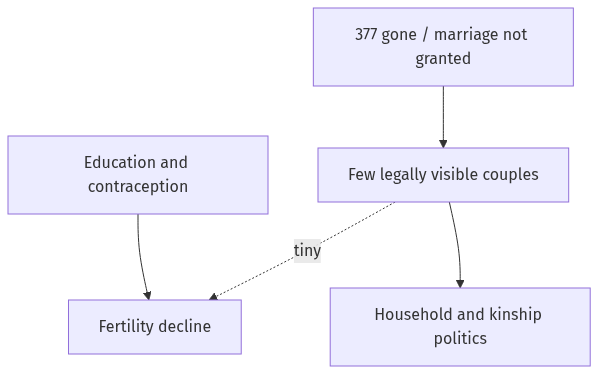
Conclusion
Same-sex relations are partly decriminalised; marriage is not generally recognised. Population size and fertility are almost untouched. The live effects are on household form, legal exclusion, and the politics of kinship—not on a national birth crisis or boom.
Quick related
Students also ask
-
Discuss the major challenges related to women's reproductive health in India. What measures would you suggest to overcome these challenges?
Next question on this syllabus topic (2024 · Q6(a)). View answer →
-
Will same-sex marriage collapse India’s population?
No. The population of such marriages would be too small to move national fertility in any measurable way.
-
Are same-sex couples counted in the census as married?
There is no general legal marriage status for them; household listing may record them as other kinds of related or unrelated members.
Same topic · past papers
UPSC has asked this before
These previous-year questions sit on the same topic. Open one to practise the earlier ask.
-
2026 · Q4(b) · Sociology GS 2 · 20 marks
Draw the current population pyramid of India. What policy measures would you recommend for population dynamics to achieve sustainability? -
2020 · Q8(b) · Sociology GS 2 · 15 marks
What were the salient features of the India's Population Policy (2000)? How far its goals have been achieved?
More from this topic
Q5(c) · UPSC Mains 2026 · Sociology GS 2 · 10 marks · Solution
Clarify how the family planning programmes have taken a political 'U'-turn in present India.
Population Dynamics
* India shifted from aggressive, coercive sterilization drives in the 1970s to a voluntary
Q4(b) · UPSC Mains 2026 · Sociology GS 2 · 20 marks · Solution
Draw the current population pyramid of India. What policy measures would you recommend for population dynamics to achieve sustainability?
Population Dynamics
India's population pyramid is transitioning from an expansive base to a constrictive or urn-shaped demographic structure, characterised by a bulge in the working-age cohort (15–64 years). This demographic dividend offers a unique window of economic opportunity, but also necessitates targeted interventions in health, education, and social security. To achieve demographic sustainability, policy measures must shift away from coercive population control toward human capital enhancement, gender parity, and geriatric care. Key strategies include expanding vocational training, improving female labour force participation, and strengthening institutional frameworks for the elderly. Ultimately, aligning population dynamics with sustainable development requires a rights-based approach focused on quality of life rather than mere numerical targets.
Q6(a) · UPSC Mains 2024 · Sociology GS 2 · 20 marks · Solution
Discuss the major challenges related to women's reproductive health in India. What measures would you suggest to overcome these challenges?
Population Dynamics
Reproductive health covers survival, fertility control, nutrition and freedom from violence. India improved institutional delivery while anaemia, unmet need and obstetric violence remain. Caste, class and son preference structure who gets respectful care. Female sterilisation still carries too much of the programme burden. Measures must join public facilities to food, wages, schooling and male responsibility.