
Revision summary
Reproductive health covers survival, fertility control, nutrition and freedom from violence. India improved institutional delivery while anaemia, unmet need and obstetric violence remain. Caste, class and son preference structure who gets respectful care. Female sterilisation still carries too much of the programme burden. Measures must join public facilities to food, wages, schooling and male responsibility.
Model answer
Copper italics in this answer — like this — are the key facts. Each one is unpacked in the Facts & figures rail.
Introduction
Reproductive health is not only hospital births. It is the social chance to control fertility, survive pregnancy, eat enough, and live without sexual violence. In India those chances are still sorted by class, caste, region and patriarchy. NFHS rounds show progress in institutional delivery and stubborn gaps in anaemia, unmet need and respectful care. The challenge is a health system problem and a gender-structure problem together.
Body
Major challenges
Maternal mortality has fallen nationally but remains high in pockets of BIMARU and tribal districts. Anaemia among women of reproductive age is widespread, which is nutrition and unpaid work, not only iron tablets. Unmet need for contraception persists; female sterilisation still dominates the method mix, which places the body-burden on women. Adolescent marriage and pregnancy continue in several states. Unsafe abortion sits beside the MTP law because stigma and access fail. Infertility is medicalised for those who can pay and is a source of abandonment for those who cannot. Son preference, despite PCPNDT, shapes sex-selective practices and the experience of repeated pregnancy.
Caste and Adivasi status structure who meets a specialist and who meets a rude labour room. Dalit and Muslim women report discrimination in some facilities. Violence—domestic and sexual—makes reproductive autonomy a fiction. Occupational exposure in agriculture and informal work, and the double shift of care, undermine health before a clinic is reached. Surrogacy and the ART market create a class split: some women’s reproduction is a service.
Patriarchy is the hinge. Who decides the next child, who goes to the PHC, who pays for a C-section in a private nursing home—these are household power questions. Uma Chakravarti’s control of sexuality is visible in honour and in the silence around RTIs.
Measures
A public system of free, high-quality antenatal, delivery, abortion and postnatal care, including respectful midwifery, is the base. ASHA and ANM workers need pay, training and protection; they are the gendered frontline of the state. Expand reversible contraception and male methods so sterilisation is not the default. Enforce PCPNDT without turning every pregnancy into a police event. Tie POSHAN, PDS and women’s wages (MNREGA, NRLM) to anaemia, because tablets fail on hungry bodies. Delay marriage through schooling (NEP-era access is relevant) and enforce child-marriage law with community work, not only raids.
- Legal measures: full implementation of MTP amendments, POSH and the Domestic Violence Act as reproductive-health infrastructure. Panchayat women members can audit facilities if they are not proxies. Community-based monitoring, as in some Jan Swasthya experiments, reduces humiliation. Address infertility as public care, not only as a private IVF market.
- Measures must include men and in-laws: counselling, paternity leave where the formal sector exists, and campaigns that treat spacing as a joint duty. For Adivasi areas, language-capable staff and FRA-linked livelihoods reduce the malnutrition that pregnancy then reveals.
Nutrition, violence and the last mile
ASHAs cannot fix a household that withholds food from a daughter-in-law or that demands a son. POSHAN and PDS matter only if women control rations. Transport to a FRU at night is a public-goods and safety question, which is why maternal death is also a village-road and police-attitude story. Private nursing homes convert obstetric emergency into debt, which is class. Measures that ignore this last mile will keep reproducing NFHS gaps even as institutional delivery percentages look good on a dashboard.
Without land, wages and an end to obstetric violence, clinic construction will not finish the job. Reproductive health is a social development target, which is why it belongs in Paper II beside education and labour.
Flow diagram
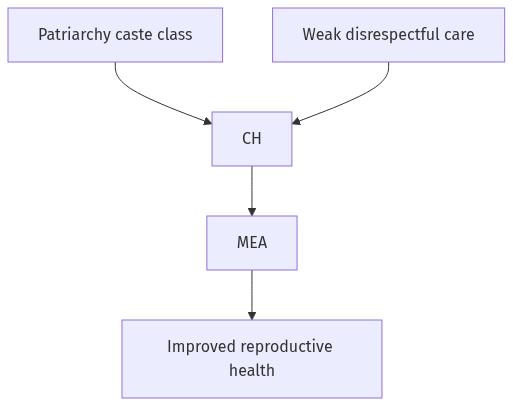
Conclusion
Women’s reproductive health in India is constrained by anaemia, uneven maternity care, a sterilisation-heavy programme, son preference, violence and caste-class barriers. Measures that work are a respectful public system, nutrition and wages, contraception that does not dump risk on women, and a direct attack on household patriarchy. Clinics without those social supports will keep reproducing the same NFHS gaps.
Quick related
Students also ask
-
Discuss the dynamics of 'migrant workers' in India in the context of Corona pandemic.
Next question on this syllabus topic (2020 · Q3(b)). View answer →
-
Is institutional delivery enough?
It lowers some risks. Without respectful care, blood, transport and postnatal support, women still die or suffer fistula and debt.
-
Why is sterilisation a sociological issue?
It shows the state and household placing permanent bodily cost on women rather than sharing contraception with men.
Same topic · past papers
UPSC has asked this before
These previous-year questions sit on the same topic. Open one to practise the earlier ask.
-
2017 · Q5(e) · Sociology GS 2 · 10 marks
What are the Emerging concerns on women's reproductive health ? -
2017 · Q7(a) · Sociology GS 2 · 20 marks
Despite gains from the women's gender movement and states policy of women empowerment, gender equality is far from achieved. Identify two major challenges the prevent this goal from being reached -
2016 · Q5(b) · Sociology GS 2 · 15 marks
Discuss the emerging forms of 'inequalities' and 'acute poverty' as major challenges of social transformation in India.
More from this topic
Q5(c) · UPSC Mains 2026 · Sociology GS 2 · 10 marks · Solution
Clarify how the family planning programmes have taken a political 'U'-turn in present India.
Population Dynamics
* India shifted from aggressive, coercive sterilization drives in the 1970s to a voluntary
Q4(b) · UPSC Mains 2026 · Sociology GS 2 · 20 marks · Solution
Draw the current population pyramid of India. What policy measures would you recommend for population dynamics to achieve sustainability?
Population Dynamics
India's population pyramid is transitioning from an expansive base to a constrictive or urn-shaped demographic structure, characterised by a bulge in the working-age cohort (15–64 years). This demographic dividend offers a unique window of economic opportunity, but also necessitates targeted interventions in health, education, and social security. To achieve demographic sustainability, policy measures must shift away from coercive population control toward human capital enhancement, gender parity, and geriatric care. Key strategies include expanding vocational training, improving female labour force participation, and strengthening institutional frameworks for the elderly. Ultimately, aligning population dynamics with sustainable development requires a rights-based approach focused on quality of life rather than mere numerical targets.
Q2(c) · UPSC Mains 2025 · Sociology GS 2 · 10 marks · Solution
How same sex marriages are responsible for population dynamics in India? Discuss
Population Dynamics
Navtej Johar decriminalised consensual same-sex relations; Supriyo did not create a right to marry. National fertility and population growth are driven by education, contraception and urban costs. Any demographic effect of same-sex unions is small because numbers are small and many still enter heterosexual marriage. The clearer effects are on household form, inheritance gaps and kinship ideology. Serious analysis avoids both moral panic and the claim that queer marriage will reshape India’s age structure.