
Revision summary
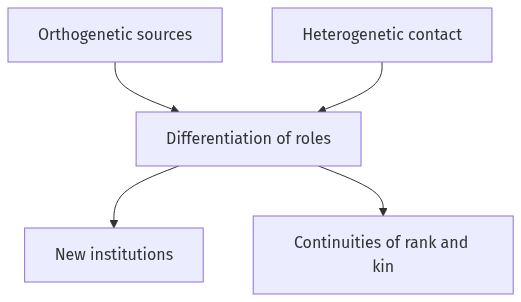
Yogendra Singh’s orthogenetic change is transformation generated inside Indian civilisation. Differentiation of roles, jati, household and sect is the main inner mechanism. Sanskritization and Bhakti are examples of mobility and critique on inherited ladders. Continuities appear in marriage, village, and sacred public language even after factories and votes. Western and Islamic contacts are heterogenetic; they are absorbed through this differentiating structure.
Model answer
Copper italics in this answer — like this — are the key facts. Each one is unpacked in the Facts & figures rail.
Introduction
Yogendra Singh argued that Indian society changes from within—orthogenetic change—and not only when the West arrives. That inner change works largely through differentiation: roles, cults and institutions split and specialise, while older meanings hitch a ride. Continuities are therefore not failures of modernity; they are how the orthogenetic process actually looks.
Body
Orthogenetic change and differentiation
Orthogenetic sources include the Little and Great traditions (Redfield via Marriott and Singer), Bhakti and reform, the internal logic of varna–jati, and the long history of statecraft. Differentiation means a priestly role splits from kingship, a jati splits by occupation and region, a joint household throws out a nuclear residential unit, a sect splits from a sampradaya, and a caste association splits from the village panchayat. Sanskritization is orthogenetic mobility: groups rearrange themselves on an inherited ladder rather than inventing class from nothing.
Singh did not deny heterogenetic shocks—Islam, British law, industrial capitalism, the Constitution. He insisted that those shocks are interpreted through an already differentiating civilisation. NEP 2020’s bilingual classroom, electronic voting, and corporate mandirs are intelligible as new specialised institutions wearing old names.
Continuities you can still observe
- Hierarchy does not vanish when a factory opens. It re-specialises: a dominant caste becomes a political caste; purity rules weaken in the canteen and tighten at marriage. I. P. Desai and A. M. Shah showed family continuity beneath residential split. Village studies after Srinivas show the village remaining a ritual and vote unit even when men live in Surat or Gulf dormitories. Dumont’s encompassing hierarchy is too stiff as a total theory, but the idiom of rank continues in matrimony and food.
- Examples of continuity-through-differentiation: the Khap using WhatsApp; Jat and Patel agitations mixing agrarian status with OBC demand; Ambedkarite Buddhism as orthogenetic critique using a civilisational repertoire; Ramjanmabhoomi politics as politicised great tradition. Green Revolution technology differentiated kulak from labourer without ending caste in the labour gang.
- So yes: in a society like India, orthogenetic change proceeds through differentiation. Continuities are the other face of the same process—not a separate “tradition” sitting outside history.
Flow diagram
Conclusion
- Singh’s orthogenetic thesis is still usable: India modernises by splitting roles and institutions while recycling hierarchy, kinship and sacred language. Heterogenetic forces matter, but they land on a differentiating old structure. The task is to name both the split and the leftover bond.
Quick related
Students also ask
-
What do you understand by decentralisation of power? What is its role in strengthening the roots of democracy in India? Elaborate
Next question on this syllabus topic (2024 · Q4(b)). View answer →
-
Is orthogenetic change the same as sanskritization?
Sanskritization is one important case. Orthogenetic change also includes sectarian splits, state formation and internal reform.
-
Do continuities mean India is unchanging?
No. Continuity here means old principles operating in new specialised institutions, which is change with a memory.
Same topic · past papers
UPSC has asked this before
These previous-year questions sit on the same topic. Open one to practise the earlier ask.
-
2021 · Q2(b) · Sociology GS 2 · 20 marks
Is Indian society moving from "Hierarchy" towards "differentiation" ? Illustrate your answer with suitable examples
More from this topic
Q8(c) · UPSC Mains 2024 · Sociology GS 2 · 10 marks · Solution
What are pressure groups? Discuss their role in decision-making in democracy
Politics and Society
Pressure groups influence public decisions without mainly seeking office. Unions, chambers, caste sabhas, farm unions and NGOs are Indian types. They aggregate demands, supply expertise and sometimes veto legislation. The Rudolphs read caste associations as modern interest groups. Informal poor are under-organised, so influence stays unequal.
Q4(b) · UPSC Mains 2024 · Sociology GS 2 · 20 marks · Solution
What do you understand by decentralisation of power? What is its role in strengthening the roots of democracy in India? Elaborate
Politics and Society
Decentralisation transfers authority, funds and functions to local governments. The 73rd and 74th Amendments are India’s main constitutional design for that transfer. Reservations and local elections can broaden who holds power. PESA links decentralisation to tribal consent in Schedule Five areas. Parallel missions, weak finance and proxy rule limit democratic deepening.
Q7(a) · UPSC Mains 2023 · Sociology GS 2 · 20 marks · Solution
Do you think that the decades of Dalit political mobilizations and movements have helped in strengthening India's democracy? Substantiate your arguments with facts
Politics and Society
Dalit movements turned a graded population into a rights-bearing electoral and legal public. Ambedkarite parties, reservations and atrocity law are democratic gains. Beteille’s disharmony between equality and hierarchy is kept visible by this politics. Land, labour and violence show the social revolution is incomplete. The democratic yes holds; a claim of completed equality does not.