
Revision summary
Pressure groups influence public decisions without mainly seeking office. Unions, chambers, caste sabhas, farm unions and NGOs are Indian types. They aggregate demands, supply expertise and sometimes veto legislation. The Rudolphs read caste associations as modern interest groups. Informal poor are under-organised, so influence stays unequal.
Model answer
Copper italics in this answer — like this — are the key facts. Each one is unpacked in the Facts & figures rail.
Introduction
Pressure groups are organised bodies that try to shape public decisions without, as their main goal, forming the government. Trade unions, FICCI and CII, caste associations, farmers’ unions, student bodies, and issue NGOs are Indian examples. In a democracy they can carry information and votes to decision-makers. They can also capture the state for a narrow interest. Their role is therefore double.
Body
What they do in decision-making
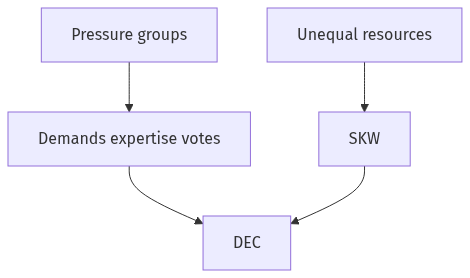
- They aggregate demands: a chamber drafts a tax memo; a union bargains a wage board; a caste mahasabha bargains on reservation lists. They supply expertise that bureaucracies lack. They veto: the 2020–21 farm unions blocked three laws; business lobbies slow labour reform; environmental groups delay projects through courts. Lloyd and Susanne Rudolph treated caste sabhas as modern pressure groups—the modernity of tradition. Panchayati Raj opened a local target for these groups.
Parties need them for funds and crowds; that is how they enter cabinets without being parties. Media campaigns and PIL are Indian tools of pressure.
Democratic gain and loss
- Gain: minorities, workers and farmers can be heard between elections. Ambedkarite organisations keep atrocity law on the agenda. Women’s groups pushed Vishaka and POSH. Loss: moneyed groups out-shout slum dwellers; khaps pressure on marriage; communal organisations pressure policing. Unorganised informal labour has weak groups, so decision-making hears the mill union or the chamber more than the migrant.
- Role in democracy: necessary intermediaries, unequal in power, sometimes a parallel government. Regulation of lobbying, inner democracy in unions, and RTI are attempts to civilise that role. Without pressure groups, representative democracy is only a periodic vote. With only the strongest groups, it is a market of influence.
Decision-making in India also runs through courts and regulators. Environmental groups, industry chambers and campus unions all use PIL and public hearings. That is pressure as legal mobilisation. It can expand democracy (information, delay of harmful projects) or stall redistribution (endless litigation by those who can pay lawyers). The role is still decision-shaping, not office-seeking.
The 73rd Amendment, POSH committees, and farm-law repeal are all decision sites where pressure groups were visible. That is the empirical core of the answer.
Flow diagram
Conclusion
Pressure groups are organised interests that seek to influence decisions rather than to sit as the cabinet. In Indian democracy they deepen voice and also skew it toward those who can organise money, caste and logistics. Their role in decision-making is indispensable and structurally unequal.
Quick related
Students also ask
-
Do you think that the decades of Dalit political mobilizations and movements have helped in strengthening India's democracy? Substantiate your arguments with facts
Next question on this syllabus topic (2023 · Q7(a)). View answer →
-
Is a political party a pressure group?
Parties seek office. Pressure groups mainly seek influence. Some organisations sit on the border.
-
Are NGOs pressure groups?
Advocacy NGOs that target policy are. Service NGOs that only deliver schemes are a weaker case.
Same topic · past papers
UPSC has asked this before
These previous-year questions sit on the same topic. Open one to practise the earlier ask.
-
2022 · Q5(d) · Sociology GS 2 · 10 marks
Discuss the role of pressure groups in strengthening democracy.
More from this topic
Q2(a) · UPSC Mains 2025 · Sociology GS 2 · 20 marks · Solution
Do you think that in a society like India orthogenetic changes take place through differentiation? Do you observe continuities in the orthogenetic process ? Elaborate your answer with suitable examples
Politics and Society
Yogendra Singh’s orthogenetic change is transformation generated inside Indian civilisation. Differentiation of roles, jati, household and sect is the main inner mechanism. Sanskritization and Bhakti are examples of mobility and critique on inherited ladders. Continuities appear in marriage, village, and sacred public language even after factories and votes. Western and Islamic contacts are heterogenetic; they are absorbed through this differentiating structure.
Q4(b) · UPSC Mains 2024 · Sociology GS 2 · 20 marks · Solution
What do you understand by decentralisation of power? What is its role in strengthening the roots of democracy in India? Elaborate
Politics and Society
Decentralisation transfers authority, funds and functions to local governments. The 73rd and 74th Amendments are India’s main constitutional design for that transfer. Reservations and local elections can broaden who holds power. PESA links decentralisation to tribal consent in Schedule Five areas. Parallel missions, weak finance and proxy rule limit democratic deepening.
Q7(a) · UPSC Mains 2023 · Sociology GS 2 · 20 marks · Solution
Do you think that the decades of Dalit political mobilizations and movements have helped in strengthening India's democracy? Substantiate your arguments with facts
Politics and Society
Dalit movements turned a graded population into a rights-bearing electoral and legal public. Ambedkarite parties, reservations and atrocity law are democratic gains. Beteille’s disharmony between equality and hierarchy is kept visible by this politics. Land, labour and violence show the social revolution is incomplete. The democratic yes holds; a claim of completed equality does not.