
Revision summary
Dalit movements turned a graded population into a rights-bearing electoral and legal public. Ambedkarite parties, reservations and atrocity law are democratic gains. Beteille’s disharmony between equality and hierarchy is kept visible by this politics. Land, labour and violence show the social revolution is incomplete. The democratic yes holds; a claim of completed equality does not.
Model answer
Copper italics in this answer — like this — are the key facts. Each one is unpacked in the Facts & figures rail.
Introduction
Dalit political mobilisation has strengthened Indian democracy by turning a graded population into a public of rights-bearing citizens. It has not abolished caste. Democracy is stronger when the excluded can speak, vote, and sit in office, even if honour and land still lag.
Body
Yes: deepening of the demos
- B. R. Ambedkar’s organisations, the Republican tradition, and later the Bahujan Samaj Party under Kanshi Ram and Mayawati made Dalit vote a national bargaining force rather than a silent appendix of Congress factions.
- Reservations in legislatures, panchayats, and services created a Dalit political class; presence in the house is a democratic fact, not a social miracle.
- The Constitution’s abolition of untouchability, the Protection of Civil Rights Act, and the Scheduled Castes and Scheduled Tribes (Prevention of Atrocities) Act are movement-backed legal teeth.
- Local satyagrahas for water, temples, land, and against atrocities, from Mahad onward to contemporary fact-finding, taught the state that citizenship is tested in the village square.
- Andre Beteille’s disharmonic society is exactly this: legal equality against social hierarchy. Dalit movements keep that disharmony public, which is how a democracy learns.
Facts of mobilisation
- Independent Dalit parties in Uttar Pradesh, Maharashtra, Tamil Nadu, and elsewhere forced alliances; even when they lose office, the agenda of dignity remains on the table.
- Dalit literature, Buddhism as conversion politics, and student groups expanded the public sphere beyond elections.
- The Rudolphs’ modernity of tradition fits caste associations that became modern parties of the excluded.
Limits: democracy strengthened, not completed
- Land and labour still show Desai’s class structure; a Dalit MLA does not automatically mean a Dalit landless household is free of bondage or boycott.
- Fragmentation by sub-caste, region, and personality has weakened a single bahujan bloc.
- Atrocities and under-enforcement of the PoA Act show that electoral inclusion can sit beside everyday unfreedom.
- Some mobilisation is captured as vote bank without organisational democracy inside the party.
Judgement
- Strengthening democracy means expanding who can contest the public thing. On that test, Dalit movements are central to India’s democratic story.
- They have not produced Dumont’s collapse of hierarchy, and they were never only a copy of Sanskritization; they often reject the ladder.
Flow diagram
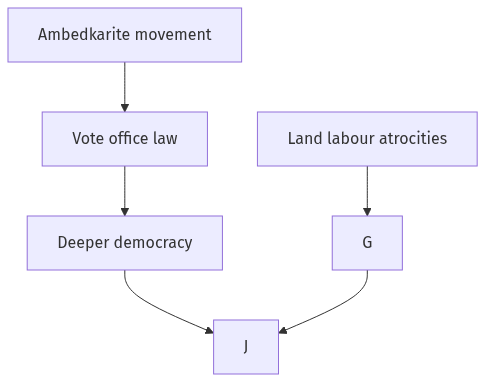
Conclusion
Decades of Dalit mobilisation have strengthened Indian democracy by adding voice, office, and law against graded inequality. The same decades show incomplete social democracy. The honest answer is a substantiated yes, with those limits named.
Quick related
Students also ask
-
Examine different understandings of secularization in india?
Next question on this syllabus topic (2022 · Q5(b)). View answer →
-
If atrocities continue, did mobilisation fail?
Continuing violence shows incomplete social power. Electoral and legal presence still changed the democratic field.
-
Is Dalit politics only a vote bank?
Parties can reduce it to votes. The longer movement also produced law, literature and local rights claims.
Same topic · past papers
UPSC has asked this before
These previous-year questions sit on the same topic. Open one to practise the earlier ask.
-
2025 · Q6(b) · Sociology GS 2 · 20 marks
Discuss the trend of urbanization in India. Do you think that Industrialization is the only precondition of urbanization? Give you arguments
More from this topic
Q2(a) · UPSC Mains 2025 · Sociology GS 2 · 20 marks · Solution
Do you think that in a society like India orthogenetic changes take place through differentiation? Do you observe continuities in the orthogenetic process ? Elaborate your answer with suitable examples
Politics and Society
Yogendra Singh’s orthogenetic change is transformation generated inside Indian civilisation. Differentiation of roles, jati, household and sect is the main inner mechanism. Sanskritization and Bhakti are examples of mobility and critique on inherited ladders. Continuities appear in marriage, village, and sacred public language even after factories and votes. Western and Islamic contacts are heterogenetic; they are absorbed through this differentiating structure.
Q8(c) · UPSC Mains 2024 · Sociology GS 2 · 10 marks · Solution
What are pressure groups? Discuss their role in decision-making in democracy
Politics and Society
Pressure groups influence public decisions without mainly seeking office. Unions, chambers, caste sabhas, farm unions and NGOs are Indian types. They aggregate demands, supply expertise and sometimes veto legislation. The Rudolphs read caste associations as modern interest groups. Informal poor are under-organised, so influence stays unequal.
Q4(b) · UPSC Mains 2024 · Sociology GS 2 · 20 marks · Solution
What do you understand by decentralisation of power? What is its role in strengthening the roots of democracy in India? Elaborate
Politics and Society
Decentralisation transfers authority, funds and functions to local governments. The 73rd and 74th Amendments are India’s main constitutional design for that transfer. Reservations and local elections can broaden who holds power. PESA links decentralisation to tribal consent in Schedule Five areas. Parallel missions, weak finance and proxy rule limit democratic deepening.