
Revision summary
Decentralisation transfers authority, funds and functions to local governments. The 73rd and 74th Amendments are India’s main constitutional design for that transfer. Reservations and local elections can broaden who holds power. PESA links decentralisation to tribal consent in Schedule Five areas. Parallel missions, weak finance and proxy rule limit democratic deepening.
Model answer
Copper italics in this answer — like this — are the key facts. Each one is unpacked in the Facts & figures rail.
Introduction
Decentralisation of power means shifting decision, money and administration from distant capitals toward local governments that citizens can see. In India the constitutional form is Panchayati Raj and urban local bodies after the 73rd and 74th Amendments (1992). The sociological claim is that democracy grows roots when the village and the ward can tax, plan and punish, not only when they vote in a Lok Sabha election.
Body
What decentralisation is
Political decentralisation creates elected councils. Administrative decentralisation posts functionaries downward. Fiscal decentralisation assigns revenues and grants. India attempted all three, unevenly. The Eleventh and Twelfth Schedules list functions. State Finance Commissions and the Union Finance Commission (from the Eleventh Commission onward) were meant to fund them. PESA extends Gram Sabha powers in Fifth Schedule areas. This is more than ‘participation theatre’ if the Gram Sabha can refuse a mining lease or a fake beneficiary list.
M. N. Srinivas’s dominant caste and Béteille’s local power warn that the village is not a republic of equals. Decentralisation without land reform can strengthen the already strong. That is not an argument against local government. It is an argument for who sits in it.
Strengthening democratic roots
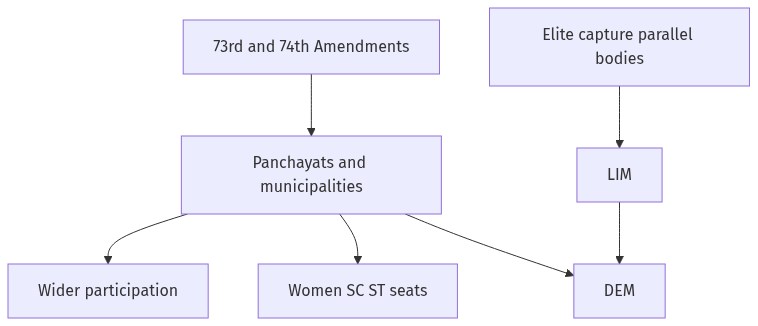
Regular local elections create a second and third tier of politicians. Reservation for women, SCs, STs and often OBCs brings new personnel into the state, which is a change in the social composition of power, not only in procedure. MNREGA social audits, local planning, drinking water and sanitation schemes need a panchayat to be more than a contractor’s desk. Urban ward committees, however weak, are the only everyday face of the city for slum citizens.
- Decentralisation also trains opposition and accountability: a sarpanch can be unseated locally. That is democratic deepening in the sense of more arenas of contest, closer to livelihood. Rajni Kothari’s worry about a distant Congress system meets a partial reply here: multiple centres.
Limits that keep roots shallow
States still control inspectors, engineers and many funds. Parallel bodies—mission societies, smart-city special purpose vehicles, nominated boards—recentralise. Elite capture and proxy women sarpanchs are documented. Caste panchayats and khaps can rival statutory panchayats on marriage. Municipalities lack staff and depend on octroi-replacement grants. Without control over land use and police, local democracy is a grievance window.
Fiscal design decides whether the root is a tap or a poster. When the Union and state run MNREGA, housing and sanitation as missions with parallel staff, the panchayat becomes a last-mile contractor. When a Gram Sabha can publish a list and refuse a fake job card, decentralisation is a democratic check. Urban local bodies face a sharper version: city growth (census towns, peri-urban NCR) often sits outside municipal limits, so the people who need local democracy are still in a village panchayat or a census village with urban work.
So the role in strengthening democracy is real and conditional. It works where elections are held, seats are not purely proxies, and functions-funds-functionaries actually move. It fails where decentralisation is a slogan over a scheme-driven collectorate.
Flow diagram
Conclusion
Decentralisation is the constitutional shift of power to panchayats and municipalities. It strengthens democratic roots by multiplying elected offices, reserving seats for excluded groups, and locating some goods in the Gram Sabha. Capture, parallel bodies and starved finances limit that role. The roots grow only where the local body is a government, not a helpdesk.
Quick related
Students also ask
-
What are pressure groups? Discuss their role in decision-making in democracy
Next question on this syllabus topic (2024 · Q8(c)). View answer →
-
Is decentralisation the same as privatisation?
No. It is a shift inside the public authority, not a sale of assets. Parallel PPPs can undermine it.
-
Did Gandhi’s village republic arrive in 1992?
No. Statutory panchayats are modern local states in a caste-class village, not self-sufficient republics.
Same topic · past papers
UPSC has asked this before
These previous-year questions sit on the same topic. Open one to practise the earlier ask.
-
2023 · Q7(a) · Sociology GS 2 · 20 marks
Do you think that the decades of Dalit political mobilizations and movements have helped in strengthening India's democracy? Substantiate your arguments with facts -
2022 · Q5(d) · Sociology GS 2 · 10 marks
Discuss the role of pressure groups in strengthening democracy. -
2017 · Q7(b) · Sociology GS 2 · 20 marks
To what extent does nation building depends on strengthening of pluralities in Indian society?
More from this topic
Q2(a) · UPSC Mains 2025 · Sociology GS 2 · 20 marks · Solution
Do you think that in a society like India orthogenetic changes take place through differentiation? Do you observe continuities in the orthogenetic process ? Elaborate your answer with suitable examples
Politics and Society
Yogendra Singh’s orthogenetic change is transformation generated inside Indian civilisation. Differentiation of roles, jati, household and sect is the main inner mechanism. Sanskritization and Bhakti are examples of mobility and critique on inherited ladders. Continuities appear in marriage, village, and sacred public language even after factories and votes. Western and Islamic contacts are heterogenetic; they are absorbed through this differentiating structure.
Q8(c) · UPSC Mains 2024 · Sociology GS 2 · 10 marks · Solution
What are pressure groups? Discuss their role in decision-making in democracy
Politics and Society
Pressure groups influence public decisions without mainly seeking office. Unions, chambers, caste sabhas, farm unions and NGOs are Indian types. They aggregate demands, supply expertise and sometimes veto legislation. The Rudolphs read caste associations as modern interest groups. Informal poor are under-organised, so influence stays unequal.
Q7(a) · UPSC Mains 2023 · Sociology GS 2 · 20 marks · Solution
Do you think that the decades of Dalit political mobilizations and movements have helped in strengthening India's democracy? Substantiate your arguments with facts
Politics and Society
Dalit movements turned a graded population into a rights-bearing electoral and legal public. Ambedkarite parties, reservations and atrocity law are democratic gains. Beteille’s disharmony between equality and hierarchy is kept visible by this politics. Land, labour and violence show the social revolution is incomplete. The democratic yes holds; a claim of completed equality does not.