
Revision summary
Reform movements made custom criticisable and legislable before Independence. Sati abolition, widow remarriage and girls’ schooling are core gender contributions. Brahmo, Arya, Aligarh and Singh Sabha recast religious communities. Phule, Narayana Guru and Ambedkar pushed reform beyond elite salons. Limits include caste-class narrowness; the institutional legacy remains large.
Model answer
Copper italics in this answer — like this — are the key facts. Each one is unpacked in the Facts & figures rail.
Introduction
Reform movements in pre-independent India were organised efforts to change religion, caste, gender and education under colonial rule. They did not begin the nationalist movement, but they created a public in which the nation could later speak. Their major contributions are institutional and moral, not only famous names.
Body
Social and gender contributions
The campaign against sati (Rammohan Roy, 1829 abolition) and Vidyasagar’s widow remarriage work made women’s bodily fate a public legislative question. Age of consent debates, however contested, put child marriage on the table. Savitribai and Jotirao Phule contributed schools for girls and for those excluded by caste, which is a deeper contribution than bhadralok petitioning. These moves built the later ground for Hindu Code and for constitutional equality.
Religious and caste contributions
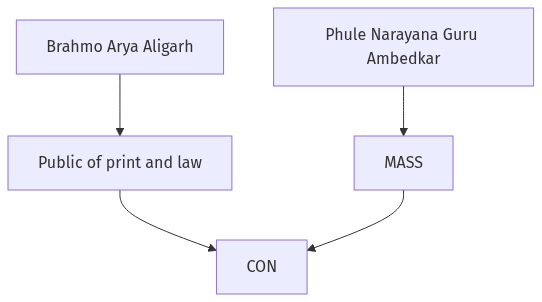
Brahmo Samaj and later Prarthana currents contributed a critique of idolatry and caste rigidity among elites. Arya Samaj contributed shuddhi, vernacular education, and a militant reform of Hindu practice that also fed majoritarian politics. Aligarh and related Muslim modernism contributed English-modern education for a Muslim elite (and a contested political legacy). Singh Sabha reform recast Sikh institutions. Narayana Guru in Kerala contributed a temple-opening, ‘one caste, one religion, one god’ attack on pollution that massified reform beyond the salon. Ambedkar’s pre-1947 work is both Dalit movement and reform: Mahad, temple, and a programme to annihilate caste.
Missionary and anti-missionary contests contributed print, schools and a new competitive public. Temperance, anti-nautch and sanitising campaigns contributed a middle-class moral code with both emancipatory and controlling sides for women.
National and institutional contributions
Reform produced associations, colleges, presses and laws that nationalism later used. It contributed the idea that custom is criticisable. M. N. Srinivas’s sanskritization and westernization both run through these movements: some copied Sanskritic respectability; some copied missionary education.
- Reform also contributed new subjectivities: the widow as a person who may remarry, the lower-caste student as a person who may read, the community as something that can be purified or annihilated. Those subjectivities later filled legislatures. The nationalist movement borrowed this moral energy and sometimes asked women and Dalits to wait. Highlighting contributions therefore includes that tension: reform made the social question public; it did not finish it.
Limits are part of the highlight. Many movements were upper-caste, male and urban. They often sought a purified community, not annihilation of caste. Peasants and Adivasis had parallel risings that textbooks under-name as reform. Contribution is still large: without this pre-independence work, independent India’s women’s law, Dalit constitutionalism and public education would have had a thinner soil.
Flow diagram
Conclusion
Pre-independence reform movements contributed public critique of sati, widowhood, child marriage and caste exclusion, new schools and sects, and the habit of legislating custom. Phule, Narayana Guru and Ambedkar massified what bhadralok reform began. The contribution is foundational and socially uneven.
Quick related
Students also ask
-
Discuss the challenges faced by the cooperative movements in India. Suggest measures to strengthen the movement at the grass-roots level
Next question on this syllabus topic (2023 · Q8(b)). View answer →
-
Were reformers only Hindu?
No. Muslim modernism, Sikh Singh Sabha, and Christian and anti-caste conversions were part of the same historical field.
-
Did reform cause nationalism?
It created publics, schools and issues. Nationalism also used and overrode reform, especially on gender and unity.
Same topic · past papers
UPSC has asked this before
These previous-year questions sit on the same topic. Open one to practise the earlier ask.
-
2025 · Q4(a) · Sociology GS 2 · 20 marks
Who is said to be the pioneer of village studies in India? Illustratively describe contributions of some Indian sociologists on village studies. How their approaches are distinct from each other? -
2019 · Q2(a) · Sociology GS 2 · 20 marks
Critically examine Dube's contributions to the study of Indian villages
More from this topic
Q8(b) · UPSC Mains 2026 · Sociology GS 2 · 20 marks · Solution
How have the women's movements made the presence of women in every moment felt and more women participation in various fields? Discuss
Social Movements in Modern India
• 19th-century social reformers initiated the women's movement by targeting regressive practices like sati and child marriage. • The nationalist freedom struggle successfully pulled women out of households into public satyagrahas and political forums. • Post-independence autonomous movements in the 1970s–80s fiercely protested dowry, price rises, and custodial violence. • Constitutional amendments (73rd and 74th) reserved one-third of local governance seats, drawing millions into grassroots leadership. • Grassroots unions like SEWA successfully organized informal female labourers to secure fair wages and basic social security. • Sustained public advocacy and PILs compelled historic criminal law reforms against domestic violence and workplace harassment. • Modern agitations continue to push for structural equality, demanding legislative reservation in Parliament and state assemblies.
Q5(b) · UPSC Mains 2026 · Sociology GS 2 · 10 marks · Solution
Examine the transiting social movements from physical movements to virtual movements in 21st century India.
Social Movements in Modern India
• 21st-century Indian social movements have shifted from physical street protests to digital and virtual mobilisation. • Virtual platforms provide borderless reach, instant information sharing, and bypass traditional gatekeepers. • Movements like #MeToo India show a shift toward decentralised, network-centric leadership without rigid hierarchies. • Digital tools lower transaction costs and enable real-time narration to counter official state narratives. • Severe limitations remain, including the digital divide, gender gaps in internet access, and superficial "slacktivism." • True democratic dissent requires blending fast digital outreach with deep, durable grassroots solidarity for marginalised voices.
Q1(c) · UPSC Mains 2026 · Sociology GS 2 · 10 marks · Solution
In the context of women's movements and laws do you think that matriarchy is the need of the hour? Discuss in detail.
Social Movements in Modern India
This answer evaluates the proposition of matriarchy as a remedy for patriarchal oppression in modern India. It traces the historical trajectory of women's movements and legal reforms from social reform acts to contemporary rights-based frameworks. It analyses the distinction between matrilineal systems and matriarchy, noting that true matriarchy involves institutionalized female authority rather than mere descent tracking. The discussion highlights the limitations of replacing one power hierarchy with another, advocating instead for gender-egalitarian models. Constitutional provisions like Article 15 and statutory measures such as the Protection of Women from Domestic Violence Act, 2005 are integrated to ground the analysis in Indian jurisprudence. Finally, a policy-oriented conclusion emphasizes substantive equality and shared governance over inverted power structures.