
Revision summary
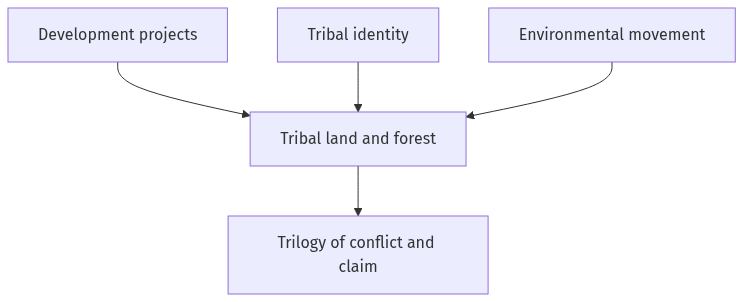
The trilogy means development, environment and tribal identity define one another on the ground. Dams, mines and parks have displaced Adivasis in the name of the nation. Chipko, Narmada and Niyamgiri joined livelihood, ecology and peoplehood. FRA and PESA are legal attempts to institutionalise that join. Urban green talk that drops tribe and class misunderstands Indian environmentalism.
Model answer
Copper italics in this answer — like this — are the key facts. Each one is unpacked in the Facts & figures rail.
Introduction
Environmental movement, development, and tribal identity form a trilogy because each term defines the other two in central India and the Himalaya. ‘Development’ as dam, mine, plantation or park arrives on Adivasi land. The protest is called environmental in the city and is lived as identity, livelihood and sacred geography in the village. Virginius Xaxa and Guha–Gadgil help us keep all three in one analysis.
Body
Development as dispossession
Post-Independence planning treated forests and rivers as national stock. Dams on the Narmada, mines in Odisha, Jharkhand and Chhattisgarh, and protected areas produced development-induced displacement. Tribal identity is not a costume. It is a relation to land, myth, clan and language. When the hill is mined, identity is attacked, not only income. The Fifth Schedule, PESA and FRA exist because this was already known and still happens.
Environmentalism and identity
Chipko is often remembered as tree-hugging. In the hills it was also peasant and women’s control of forests against commercial felling—identity as pahari livelihood. Narmada combined environmental critique of large dams with adivasi and peasant displacement. Niyamgiri fused Dongria Kondh sacred identity, biodiversity, and a no to bauxite. Pathalgadi and related assertions mix constitutional Schedule identity with resistance to land laws.
Urban climate discourse can strip these movements of tribe and class and keep only carbon. That is a sociological error. Conversely, identity politics without ecology can bargain for a share of mining royalties and still lose the forest. The trilogy is the claim that you cannot analyse one vertex alone.
How the three now interlock
The state offers development as jobs and roads; companies offer CSR; security forces treat some belts as insurgency. Environmental law (EIA, Forest Conservation) is the paperwork of the same conflict. Tribal identity becomes a legal resource (ST, FRA claims) and a stigma (primitive, anti-national). Movements succeed when they join Gram Sabha legality, ecological knowledge, and a public story the rest of India can hear.
Mining belts also show the trilogy inside the movement. Some households want jobs in the plant; some want the sacred grove left alone; women often carry both the water shortage and the protest. The state then offers cash and a public hearing. Development becomes a language of compensation; environment becomes a file in the ministry; identity becomes an ST certificate. The trilogy is the refusal to let those three files stay separate.
- The trilogy also includes internal difference: tribal elites, Christian and sarna splits, and women who carry water and oppose liquor and mines in different ways. A trilogy is not a harmony.
Flow diagram
Conclusion
Environmental movements, development projects and tribal identity are one structure of conflict over land and meaning. Development that ignores identity is dispossession; environmentalism that ignores tribe is aesthetic; identity that ignores ecology can sell the hill. FRA and Gram Sabha consent are the institutional names of the trilogy.
Quick related
Students also ask
-
Trace the social and historical origins of Dalit movements in modern India
Next question on this syllabus topic (2024 · Q7(c)). View answer →
-
Are all environmental movements tribal?
No. Urban pollution and middle-class green belts differ. The trilogy is specific to forest and highland frontiers.
-
Is tribal identity anti-development?
It is often anti-this-project. Roads and schools are widely demanded; mines without consent are not the same thing.
Same topic · past papers
UPSC has asked this before
These previous-year questions sit on the same topic. Open one to practise the earlier ask.
-
2020 · Q7(b) · Sociology GS 2 · 15 marks
Evaluate the nature and scope of anthropogenic influence on Climate in India and also analyze the environmental movements arising out of it. -
2016 · Q5(c) · Sociology GS 2 · 15 marks
Discuss the various forms of environmental movements waged in india. ·. -
2025 · Q8(a) · Sociology GS 2 · 20 marks
Is it possible to have sustainable development in India? Cite major environmental issues and suggest a few measures to achieve the sustainability -
2024 · Q6(b) · Sociology GS 2 · 20 marks
What is sustainable development? How can sustainability be achieved in India where livelihood needs conflict with environmental protection?
More from this topic
Q8(b) · UPSC Mains 2026 · Sociology GS 2 · 20 marks · Solution
How have the women's movements made the presence of women in every moment felt and more women participation in various fields? Discuss
Social Movements in Modern India
• 19th-century social reformers initiated the women's movement by targeting regressive practices like sati and child marriage. • The nationalist freedom struggle successfully pulled women out of households into public satyagrahas and political forums. • Post-independence autonomous movements in the 1970s–80s fiercely protested dowry, price rises, and custodial violence. • Constitutional amendments (73rd and 74th) reserved one-third of local governance seats, drawing millions into grassroots leadership. • Grassroots unions like SEWA successfully organized informal female labourers to secure fair wages and basic social security. • Sustained public advocacy and PILs compelled historic criminal law reforms against domestic violence and workplace harassment. • Modern agitations continue to push for structural equality, demanding legislative reservation in Parliament and state assemblies.
Q5(b) · UPSC Mains 2026 · Sociology GS 2 · 10 marks · Solution
Examine the transiting social movements from physical movements to virtual movements in 21st century India.
Social Movements in Modern India
• 21st-century Indian social movements have shifted from physical street protests to digital and virtual mobilisation. • Virtual platforms provide borderless reach, instant information sharing, and bypass traditional gatekeepers. • Movements like #MeToo India show a shift toward decentralised, network-centric leadership without rigid hierarchies. • Digital tools lower transaction costs and enable real-time narration to counter official state narratives. • Severe limitations remain, including the digital divide, gender gaps in internet access, and superficial "slacktivism." • True democratic dissent requires blending fast digital outreach with deep, durable grassroots solidarity for marginalised voices.
Q1(c) · UPSC Mains 2026 · Sociology GS 2 · 10 marks · Solution
In the context of women's movements and laws do you think that matriarchy is the need of the hour? Discuss in detail.
Social Movements in Modern India
This answer evaluates the proposition of matriarchy as a remedy for patriarchal oppression in modern India. It traces the historical trajectory of women's movements and legal reforms from social reform acts to contemporary rights-based frameworks. It analyses the distinction between matrilineal systems and matriarchy, noting that true matriarchy involves institutionalized female authority rather than mere descent tracking. The discussion highlights the limitations of replacing one power hierarchy with another, advocating instead for gender-egalitarian models. Constitutional provisions like Article 15 and statutory measures such as the Protection of Women from Domestic Violence Act, 2005 are integrated to ground the analysis in Indian jurisprudence. Finally, a policy-oriented conclusion emphasizes substantive equality and shared governance over inverted power structures.