
Revision summary
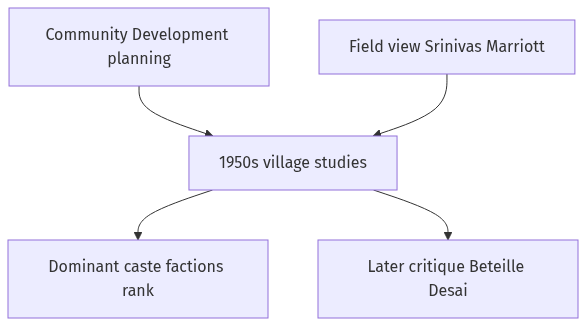
The 1950s joined planning, Community Development, and intensive village ethnography. Srinivas, Dube, Marriott, Bailey, Mayer and others built the classic monographs. Dominant caste, factions, and the field view came from this decade. The village was treated as a keyhole to Indian society. Beteille and class analysis later limited that claim.
Model answer
Copper italics in this answer — like this — are the key facts. Each one is unpacked in the Facts & figures rail.
Introduction
The 1950s joined new Indian universities, Community Development, and intensive village ethnography. Indian sociology for a decade treated the village as the keyhole through which civilisation, caste, and planned change could be seen.
Body
Why the decade was ‘golden’
- Independence, the Planning Commission, and Community Development asked for field knowledge of caste, leadership, and agrarian relations.
- Anthropology and sociology shared methods: long residence, caste mapping, and the village monograph became the professional product.
- Funding, foreign collaboration, and the idea that India still lived in villages made the field both patriotic and scientific.
Landmark studies
- M. N. Srinivas’s Rampura work developed dominant caste, Sanskritization, and the field view against a book view of India.
- S. C. Dube’s Shamirpet, McKim Marriott’s Kishan Garhi, Oscar Lewis’s Rampur, F. G. Bailey’s Bisipara, and Adrian Mayer’s Ramkheri mapped rank, faction, and economy.
- M. N. Srinivas’s edited village volumes and the Dumont–Pocock call for a sociology of India framed the village as a theoretical object, not only a place.
Limits already visible
- Andre Beteille later argued that a village cannot simply represent India’s civilisational values, because texts, towns, and the state also make India.
- Many monographs underplayed class struggle that Desai placed at the centre, and they underplayed women and Adivasi hinterlands.
- The golden period is therefore a peak of method and archive, not a complete theory of Indian society.
Flow diagram
Conclusion
The 1950s were golden because they produced a dense, comparable village archive just as the new state planned rural change. Later sociology kept the field view and dropped the claim that one village is India.
Quick related
Students also ask
-
Discuss the main features of Land Reforms in post-independence India
Next question on this syllabus topic (2023 · Q1(e)). View answer →
-
Were there no village studies before 1950?
There were surveys and colonial gazetteers. The 1950s made the intensive sociological monograph the main Indian method.
-
Did the golden period end because villages vanished?
No. Theory moved to class, city, gender, and the state. The village remained, but it stopped standing for all of India.
Same topic · past papers
UPSC has asked this before
These previous-year questions sit on the same topic. Open one to practise the earlier ask.
-
2016 · Q1(b) · Sociology GS 2 · 10 marks
Significance of Village Studies in Indian Sociology -
2026 · Q3(a) · Sociology GS 2 · 20 marks
Examine the challenges of applying micro-level village studies to macro-level village structure of Indian society -
2025 · Q4(a) · Sociology GS 2 · 20 marks
Who is said to be the pioneer of village studies in India? Illustratively describe contributions of some Indian sociologists on village studies. How their approaches are distinct from each other? -
2022 · Q4(c) · Sociology GS 2 · 15 marks
Discuss the challenges during village studies in India. -
2026 · Q6(a) · Sociology GS 2 · 20 marks
Differentiate between protests and movements. Discuss some of those movements which changed the fabric of Indian agrarian society during the colonial period
More from this topic
Q3(a) · UPSC Mains 2026 · Sociology GS 2 · 20 marks · Solution
Examine the challenges of applying micro-level village studies to macro-level village structure of Indian society
Rural and Agrarian Social Structure
This model answer examines the inherent difficulties in scaling micro-level village studies to macro-level Indian social structures. It highlights issues of regional diversity, caste variations, the impact of globalisation, and methodological limitations. It demonstrates why early sociological attempts to view the Indian village as a self-sufficient 'little republic' fail in contemporary reality. The response uses classical and modern sociological perspectives to bridge the gap between microscopic ethnography and macroscopic generalisation.
Q4(a) · UPSC Mains 2025 · Sociology GS 2 · 20 marks · Solution
Who is said to be the pioneer of village studies in India? Illustratively describe contributions of some Indian sociologists on village studies. How their approaches are distinct from each other?
Rural and Agrarian Social Structure
Srinivas is the pioneer of intensive village fieldwork in Indian sociology, with Rampura and the dominant caste. Dube’s Shamirpet offered a holistic community study; Majumdar mixed survey and anthropology. Marriott and Dumont–Pocock insisted the village be read through civilisational and ideological categories. Béteille separated caste, class and power as no longer symmetrical. Marxist and political-anthropological village studies further shifted the master variable to surplus and faction.
Q3(b) · UPSC Mains 2025 · Sociology GS 2 · 20 marks · Solution
Do you think that new economic reforms of British rule have disrupted the old economic system of India? Substantiate your answer with suitable examples
Rural and Agrarian Social Structure
The old economy combined peasant agriculture, artisan castes and layered trade, not a frozen idyll. Land settlements monetised revenue and strengthened landlord or state claims on the peasant. Nationalists argued deindustrialisation and drain; revisionists note regional survival and later mills. Socially, craft castes and towns lost patronage and many entered labour markets. Disruption is the right word: the old articulation of field and craft was broken even if not every loom stopped.