
Revision summary
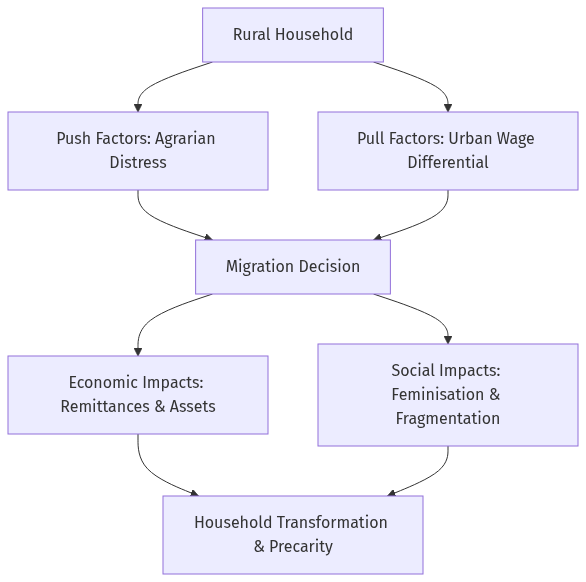
1. **Financial Cushion:** Remittances diversify income, reduce crop-failure risks, and fund household health, education, and asset creation. 2. **Feminization of Farms:** Male out-migration leaves women managing agriculture, often without legal land titles or institutional credit. 3. **Social Disruption:** Prolonged separation fragments families, increases elder-care burdens, and strains child socialization. 4. **Precarity:** Most migrants enter low-wage informal urban jobs lacking social security and urban shock absorption. 5. **Debt Risks:** High initial migration costs funded by informal loans can trap vulnerable families in severe debt cycles. 6. **Limited Transformation:** Remittances generally act as short-term survival subsidies rather than drivers of sustainable local development. 7. **Policy Needs:** Interventions must expand rural non-farm jobs and secure social protection floors for migrant workers.
Model answer
Copper italics in this answer — like this — are the key facts. Each one is unpacked in the Facts & figures rail.
Introduction
Rural-to-urban migration is a defining structural shift in contemporary developing societies, fundamentally altering agrarian social structures and household economies. While it serves as a critical livelihood diversification strategy, it simultaneously induces deep social dislocations and uneven economic gains at the household level.
Body
Economic Impacts and Remittances
- Income Diversification: Migration functions as an insurance mechanism against agrarian risks, reducing household vulnerability to crop failures and monsoon vagaries.
- Remittance Economy: Inflows enhance household purchasing power, improve housing, and finance health and education expenditures, aligning with micro-economic theories of household survival.
- Asset Accumulation: Remittances often translate into investment in land, livestock, or small rural enterprises, altering local class dynamics.
Social Costs and Changing Gender Roles
- Feminisation of Agriculture: Out-migration of male members leaves women behind to shoulder farm management without formal land titles or institutional credit access.
- Family Fragmentation: Prolonged separation strains marital relations, impacts child socialisation, and increases elder-care burdens on women.
- Social Remittances: Return migrants bring back progressive values, urban skills, and political awareness, gradually transforming traditional rural stratification.
Structural Limitations and Precarity
- Informality and Vulnerability: Most rural migrants enter low-paying, informal urban sectors without social security, making households vulnerable during urban shocks.
- Debt Traps: High initial migration costs funded through informal loans often push vulnerable rural households into deeper debt cycles if employment fails.
- Incomplete Development: Remittances frequently fail to generate sustainable local employment, acting merely as a survival subsidy rather than structural transformation.
Flow diagram
Conclusion
Migration remains a complex double-edged sword for rural households, offering vital economic cushions while intensifying social vulnerabilities. Sustainable policy intervention must focus on strengthening rural non-farm employment and extending social protection floors to migrant workers to ensure holistic human development.
Quick related
Students also ask
-
"The methods of natural sciences are inadequate in understanding the complex social phenomena." Discuss
Next question in the 2026 paper (Q4(c)). View answer →
-
How does migration impact rural households economically and socially?
Migration brings financial remittances and income diversification, but also results in social costs like the feminisation of agriculture and family fragmentation.
-
What are the structural limitations of rural-to-urban migration?
Informal employment, vulnerability to urban shocks, high initial migration debt, and lack of social security form the primary structural limitations.
Same topic · past papers
UPSC has asked this before
These previous-year questions sit on the same topic. Open one to practise the earlier ask.
-
2026 · Q8(b) · Sociology GS 1 · 20 marks
Critically evaluate the relevance of the cyclical theory of social change in understanding contemporary societies -
2025 · Q3(c) · Sociology GS 1 · 10 marks
What is hypothesis? Critically evaluate the significance of hypothesis in social research -
2018 · Q2(c) · Sociology GS 1 · 15 marks
Evaluate if social stratification is functional for society. -
2016 · Q1(d) · Sociology GS 1 · 10 marks
Evaluate Marx's ideas on mode of production
More from this paper
Q1(a) · UPSC Mains 2026 · Sociology GS 1 · 10 marks · Solution
In what ways do class and caste intersect and overlap in shaping social structure?
Sociological Thinkers: Karl Marx
This model answer examines the complex intersection and overlap between class and caste in shaping the Indian social structure. It demonstrates how traditional ritual hierarchies reinforce economic disparities while modern democratic forces create new class mobility within caste groups. Classical and modern sociological perspectives, including those of M.N. Srinivas and André Béteille, are integrated to explain structural transformations. The response outlines theoretical overlaps, contemporary economic shifts, and structural contradictions using a streamlined Mermaid diagram and WRAP house style.
Q1(b) · UPSC Mains 2026 · Sociology GS 1 · 10 marks · Solution
Critically examine the position of women in the informal economy.
Sociology
Women in the informal economy face structural precarity, low wages, and lack of social security, reflecting broader gender stratification. While informal work offers flexible entry, it reproduces patriarchal subordination and economic vulnerability. Sociologists view this as the feminisation of survival rather than genuine emancipation. Addressing this requires formalising women's work, ensuring social protection, and recognizing unpaid domestic labour through robust state policy.
Q1(c) · UPSC Mains 2026 · Sociology GS 1 · 10 marks · Solution
Discuss the role of geographical factors in social change and development.
Social Change in Modern Society
This model answer for UPSC Mains Sociology evaluates the role of geographical factors in social change and development. It moves beyond strict environmental determinism to examine how topography, climate, and natural resources shape settlement patterns, economic systems, and social stratification. Classical perspectives from Montesquieu to modern ecological approaches are integrated with examples like river valley civilizations and contemporary climate migration. The answer maintains a crisp, examiner-facing style with structural headings and a flowchart.