
Revision summary
Sociology and history both study power, class, belief and the state in time. Marx and Weber already worked historically inside social theory. History typically takes unique events and archival narrative. Sociology typically takes recurrent relations and comparative or survey methods. Windelband’s idiographic–nomothetic contrast still organises the syllabus point. Historical sociology shows the overlap without erasing the division of labour.
Model answer
Copper italics in this answer — like this — are the key facts. Each one is unpacked in the Facts & figures rail.
Introduction
Sociology and history both study human beings in society, and both refuse to treat the present as a natural fact. Karl Marx made history the method of social theory when he tracked modes of production. Max Weber wrote historical sociology of religion, bureaucracy and the city. The resemblance is real. The difference lies in what each discipline treats as its typical object and in the methods it trusts.
Body
Similarities of area
Both ask how power, belief, class and the state have been made. A caste census, a famine, or the making of a middle class is at once a historical episode and a sociological structure. Marc Bloch’s history of feudal society and Weber’s The Protestant Ethic sit on the same shelf. C. Wright Mills said that sociology without history is empty, and history without sociology is blind. The Annales school and later historical sociologists such as Barrington Moore and Theda Skocpol used archives to explain revolutions and agrarian class.
Differences of area and method
- History classically takes the unique event: a reign, a war, a statute, a particular famine year. Wilhelm Windelband called this the idiographic interest. Sociology classically seeks types and regularities: bureaucracy, anomie, patriarchy, the informal sector. That is the nomothetic interest. The historian’s area is often a time and a place with proper names. The sociologist’s area is a set of relations that may recur in other times and places.
Method follows that split, though practice overlaps. History leans on archives, chronicles and source criticism, then narrates sequence. Sociology uses comparison, survey, ethnography and explicit theory. Durkheim wanted social facts measured like things. Weber combined both: historical cases become ideal types, neither a full chronicle nor a law of physics. In India, the same peasant movement can be a narrative of 1857 or a type of agrarian mobilisation, as A. R. Desai and later subaltern historians differently did. Historical sociology blurs the line; the examination distinction still holds: situated sequence versus structured comparison.
Flow diagram
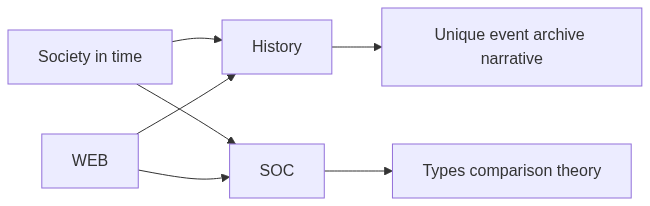
Conclusion
The two disciplines meet in the study of social life over time. They part in typical object and typical method: the unique, sourced event versus the comparable pattern. Weber’s historical sociology is the best reminder that the border is a division of labour, not a wall.
Quick related
Students also ask
-
What is positivism? Critically analyze the major arguments against it
Next question on this syllabus topic (2025 · Q2(a)). View answer →
-
Can a sociologist use archives?
Yes. Historical sociology does so routinely. The difference is the aim of comparison and type-building, not a ban on documents.
-
Is sociology only about the present?
No. Social change, nation-making and class formation are historical. The present is simply sociology’s most common fieldwork.
Same topic · past papers
UPSC has asked this before
These previous-year questions sit on the same topic. Open one to practise the earlier ask.
-
2025 · Q4(b) · Sociology GS 1 · 20 marks
What would you identify as the similarities and differences in the elite theories of Mosca, Michels and Pareto? Discuss their main/crucial issues -
2023 · Q4(c) · Sociology GS 1 · 10 marks
Highlight the differences and similarities between totemism and animism
More from this topic
Q7(a) · UPSC Mains 2026 · Sociology GS 1 · 20 marks · Solution
Compare and critically assess 'the grounded theory' with 'theory-driven research method' in sociology
Sociology as Science
• Grounded theory uses inductive emergence and constant comparison to build concepts directly from raw data without prior hypotheses. • Theory-driven research uses deductive verification, starting with established frameworks to test specific hypotheses against empirical reality. • Grounded methodology relies on iterative coding (open, axial, selective) happening simultaneously with ongoing data collection. • Theory-driven methodology requires strict operational definitions, variable isolation, and standardized protocols before field deployment. • Grounded theory excels at generating thick, micro-level context and thick descriptions, but struggles with macro-level generalizability. • Theory-driven research risks forcing complex social realities into rigid conceptual boxes, while grounded approaches risk subjective bias. • Contemporary sociology increasingly uses a pragmatic synthesis, leveraging grounded insights to refine broader macro-theoretical frameworks.
Q5(d) · UPSC Mains 2025 · Sociology GS 1 · 10 marks · Solution
How does Weber's Verstehen address the objectivity-subjectivity debate in sociology?
Sociology as Science
Verstehen is interpretative understanding of meaningful social action. Ideal types help compare cases without pretending to be full copies of reality. Value relevance selects topics; value freedom forbids twisting evidence to preach. This rejects naive positivist objectivity as a view from nowhere. It also rejects the idea that interpretation is only the scholar’s private feeling. Actors’ meanings remain checkable through comparison, documents and consequences.
Q2(c) · UPSC Mains 2025 · Sociology GS 1 · 10 marks · Solution
What do you mean by reliability? Discuss the importance of reliability in social science research.
Sociology as Science
Reliability is the consistency of a measure across time, items and raters. It differs from validity, which asks whether the right concept is being measured. Types include test–retest, split-half or alpha, and inter-coder agreement. Durkheimian rates and modern surveys both depend on stable classification. Qualitative work still needs transparent, repeatable coding. Without reliability, comparison, replication and policy use of data collapse.