
Revision summary
Reliability is the consistency of a measure across time, items and raters. It differs from validity, which asks whether the right concept is being measured. Types include test–retest, split-half or alpha, and inter-coder agreement. Durkheimian rates and modern surveys both depend on stable classification. Qualitative work still needs transparent, repeatable coding. Without reliability, comparison, replication and policy use of data collapse.
Model answer
Copper italics in this answer — like this — are the key facts. Each one is unpacked in the Facts & figures rail.
Introduction
Reliability means that a research instrument yields consistent results when the same thing is measured again under comparable conditions. If a scale of religiosity, a census occupation code, or two interviewers’ classifications jump about without a real change in the world, the finding is noise. In social science this matters because our objects—attitudes, class, stigma—are already slippery. Unreliable measures cannot support comparison, theory or policy.
Body
What reliability is, and is not
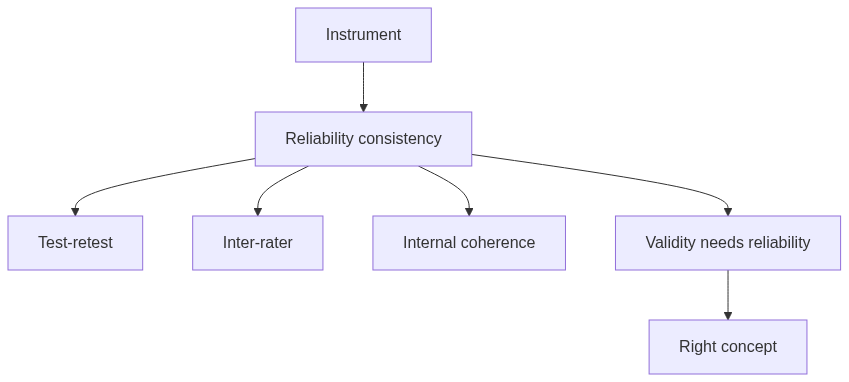
A reliable measure is stable and internally coherent. Classic types are test–retest consistency over time, split-half or Cronbach’s alpha for items on a scale, and inter-rater or inter-coder agreement when observers classify open material. Reliability is about the instrument and the procedure, not yet about whether we are measuring the right concept. That second question is validity. A clock that is always ten minutes fast is reliable and invalid. A one-item question on “are you modern?” may be unreliable and invalid at once.
Emile Durkheim’s suicide rates already depended on the reliability of official classification. If coroners in one district hide suicides as accidents, the social fact is distorted. Survey research on caste discrimination, domestic violence or vote intention faces the same problem of consistent wording, consistent probing and consistent coding. In qualitative work, reliability is sometimes recast as auditability and transparent coding rather than a coefficient, but the underlying demand for trustworthiness remains.
Importance follows directly. Without reliability, replication fails, trends cannot be read, and hypotheses cannot be fairly tested. Policy uses of NFHS or crime statistics inherit every coding inconsistency. Reliability is therefore not a statistical luxury. It is a condition for treating sociological statements as evidence rather than as one more opinion.
Flow diagram
Conclusion
Reliability is consistency of measurement across time, items and observers. It is necessary for valid inference but not the same as validity. Social research needs it because official categories and attitude scales are otherwise too unstable to explain society.
Quick related
Students also ask
-
How does Weber's Verstehen address the objectivity-subjectivity debate in sociology?
Next question on this syllabus topic (2025 · Q5(d)). View answer →
-
Can a qualitative interview be reliable?
Not as a Cronbach alpha, but through consistent protocols, coding frames and audit trails that another researcher could follow.
-
Why not only discuss validity?
Because an invalid-looking result may simply be an unstable instrument. Reliability is the first check.
Same topic · past papers
UPSC has asked this before
These previous-year questions sit on the same topic. Open one to practise the earlier ask.
-
2022 · Q4(c) · Sociology GS 1 · 15 marks
What is reliability ? Explain the different tests available to social science researcher to establish reliability. -
2021 · Q2(a) · Sociology GS 1 · 20 marks
From the viewpoint of growing importance of multidisciplinarity, how do you relate sociology to other social sciences ? -
2017 · Q4(c) · Sociology GS 1 · 10 marks
How can one resolve the issue of reliability and validity in the context of sociological research on inequality ? -
2015 · Q3(a) · Sociology GS 1 · 20 marks
Why is random sampling said to have more reliability and validity in research? -
2015 · Q2(b) · Sociology GS 1 · 15 marks
Examine the problems of maintaining objectivity and value neutrality in social science research.
More from this topic
Q7(a) · UPSC Mains 2026 · Sociology GS 1 · 20 marks · Solution
Compare and critically assess 'the grounded theory' with 'theory-driven research method' in sociology
Sociology as Science
• Grounded theory uses inductive emergence and constant comparison to build concepts directly from raw data without prior hypotheses. • Theory-driven research uses deductive verification, starting with established frameworks to test specific hypotheses against empirical reality. • Grounded methodology relies on iterative coding (open, axial, selective) happening simultaneously with ongoing data collection. • Theory-driven methodology requires strict operational definitions, variable isolation, and standardized protocols before field deployment. • Grounded theory excels at generating thick, micro-level context and thick descriptions, but struggles with macro-level generalizability. • Theory-driven research risks forcing complex social realities into rigid conceptual boxes, while grounded approaches risk subjective bias. • Contemporary sociology increasingly uses a pragmatic synthesis, leveraging grounded insights to refine broader macro-theoretical frameworks.
Q5(d) · UPSC Mains 2025 · Sociology GS 1 · 10 marks · Solution
How does Weber's Verstehen address the objectivity-subjectivity debate in sociology?
Sociology as Science
Verstehen is interpretative understanding of meaningful social action. Ideal types help compare cases without pretending to be full copies of reality. Value relevance selects topics; value freedom forbids twisting evidence to preach. This rejects naive positivist objectivity as a view from nowhere. It also rejects the idea that interpretation is only the scholar’s private feeling. Actors’ meanings remain checkable through comparison, documents and consequences.
Q2(a) · UPSC Mains 2025 · Sociology GS 1 · 20 marks · Solution
What is positivism? Critically analyze the major arguments against it
Sociology as Science
Positivism treats sociology as a science of observable regularities, after Comte and Durkheim. Its strength is accountability to data, comparison and replication. Weberian understanding, phenomenology and ethnomethodology deny that meanings are mere residuals. Critical theory and feminist standpoint theories deny the neutrality of the observer. Giddens’s double hermeneutic states that people already interpret the world sociologists study. Indian field studies show why census categories cannot replace meaning, even when counts remain essential.