
Revision summary
Social mobility is movement across strata in one life or across generations. Sorokin and later class analysis distinguished types of mobility, including structural change. A closed model centres ascription, endogamy and birth rank. An open model centres achievement, education and market class. Real societies mix the two, as Indian caste–class studies and Western elite closure both show. The classification is a useful type, not a complete map.
Model answer
Copper italics in this answer — like this — are the key facts. Each one is unpacked in the Facts & figures rail.
Introduction
Social mobility is the movement of persons, families or groups from one position in a stratification system to another. The movement may be upward or downward, and it may occur in one life or across generations. Pitirim Sorokin made mobility a central topic. Closed and open models are classroom types of how such movement is supposed to work. A critical examination treats them as models, not as full photographs of any living society.
Body
What social mobility covers
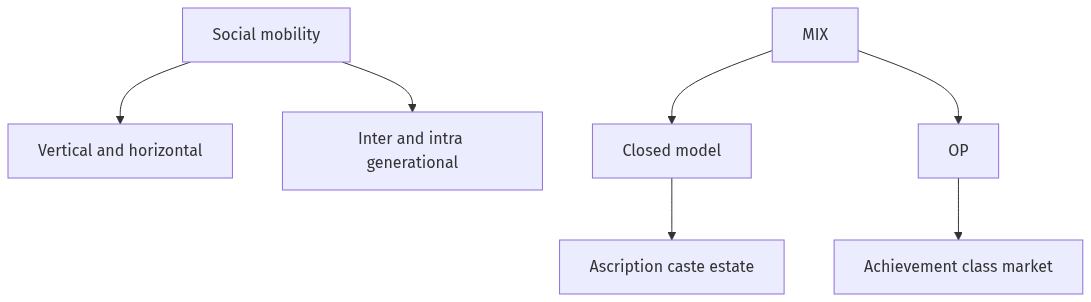
Vertical mobility is a change of rank. Horizontal mobility is a change of position without a clear rise or fall, such as a move from one job to another of similar standing. Inter-generational mobility compares parent and child. Intra-generational mobility tracks one career. Structural mobility occurs when the whole occupational system expands, as when industry creates new white-collar posts. Exchange mobility is a zero-sum swap of winners and losers. Karl Marx expected class polarisation more than a large middle rise. Later class analysis, including John Goldthorpe’s work, measured actual rates. In India, the story of mobility is tied to education, reservation, migration and the informal sector.
Closed and open models
A closed model of stratification treats position as ascribed by birth. The ideal type is a caste or estate order with endogamy, ritual barriers and little legitimate individual climb. A slave order is even more closed. An open model treats position as achieved through talent, education and market success. The ideal type is a class or meritocratic order in which the child need not repeat the parent. Weber’s class, status and party already warn that honour can stay closed while markets look open.
The classification is useful as a first cut. It is weak if it is used as a simple contrast of “traditional India” and “modern West”. M. N. Srinivas’s Sanskritisation is group mobility inside a supposedly closed caste order. Dominant castes hold land and votes. Andre Beteille showed that class, caste and power do not always coincide. Industrial Britain had class closure through property and elite schools even while it preached openness. Reservation policy in India is an attempt to force openness in public employment against ascriptive closure. Marriage markets still close many paths that classrooms open.
A critical view therefore says that closed and open are poles on a scale. Every complex society mixes ascription and achievement. The ideology of an open society can hide inherited cultural capital, as Pierre Bourdieu argued. The ideology of a closed society can hide money and local power. Mobility studies must measure rates, barriers and group strategies rather than rest on the two labels alone.
Flow diagram
Conclusion
Social mobility is movement across ranked positions in one life or across generations. Closed and open models name ascription and achievement as poles. They help teaching, but living systems mix caste honour, class property and state policy. Criticism begins when the labels are mistaken for whole societies.
Quick related
Students also ask
-
Do you think that the boundary line between ethnicity and race is blurred? Justify your answer
Next question on this syllabus topic (2023 · Q1(e)). View answer →
-
Is caste a perfectly closed system?
As a model it is closed by birth and marriage. In history, groups have moved through Sanskritisation, politics and class.
-
Does industrialisation automatically open stratification?
It changes occupational structure, but property, elite schooling and status honour can keep closure alive.
Same topic · past papers
UPSC has asked this before
These previous-year questions sit on the same topic. Open one to practise the earlier ask.
-
2022 · Q2(c) · Sociology GS 1 · 15 marks
Discuss social mobility in open and closed system. -
2020 · Q4(c) · Sociology GS 1 · 15 marks
Critically assess social mobility in closed and open systems. -
2015 · Q1(e) · Sociology GS 1 · 10 marks
"No society can either be completely open or completely closed." comment. -
2018 · Q5(e) · Sociology GS 1 · 10 marks
In social mobility possible in closed systems of stratification ? Illustrate from research work. -
2016 · Q1(e) · Sociology GS 1 · 10 marks
"Vertical mobility brings structural change even in a closed social system." Comment
More from this topic
Q7(b) · UPSC Mains 2026 · Sociology GS 1 · 20 marks · Solution
According to Weber how do class, status and power interact to produce and sustain social inequality?
Stratification and Mobility: Concepts
Max Weber departed from Marx's purely economic view by proposing a multidimensional model of stratification based on class, status, and power. Class operates in the economic order via market situations, producing property and non-property groupings. Status operates in the social order through shared lifestyles, honour, and social esteem, often creating communities. Power operates in the political order through parties and organizational capacity to influence collective outcomes. These three dimensions interact dynamically; economic wealth can convert into social prestige and political influence, reinforcing systemic inequality. While analytically distinct, they frequently overlap to sustain durable structures of stratification in modern societies.
Q5(e) · UPSC Mains 2026 · Sociology GS 1 · 10 marks · Solution
How do different theories explain social dimensions of social movements? Discuss.
Stratification and Mobility: Concepts
• Structural-functionalism views movements as responses to institutional strain and anomie, aiming to restore social equilibrium (e.g., Smelser's value-added theory). • Conflict and Marxist perspectives ground movements in material inequalities and class struggle, helping disadvantaged groups challenge existing power relations. • Resource Mobilization Theory shifts focus from grievances to practical assets like leadership, money, and communication networks. • Rational choice approaches view participation as a calculated decision based on selective incentives rather than just emotional outrage. • Cultural and identity-oriented theories (like New Social Movements) emphasize values, symbols, and lifestyle politics over purely economic demands. • Relational factors highlight how networks, alliances, and political opportunities shape movement emergence and success. • Ultimately, understanding social movements requires combining structural, cultural, and relational perspectives since no single theory explains everything.
Q5(b) · UPSC Mains 2025 · Sociology GS 1 · 10 marks · Solution
Does the structural-functionalist perspective on social stratification promote a status quo? Give reasons for your answer.
Stratification and Mobility: Concepts
Davis and Moore treat unequal rewards as devices to fill important positions. Parsons ties ranking to a shared value system and role allocation. That logic easily sanctifies the present hierarchy as necessary. Tumin asked who defines importance and why talent and reward match so neatly. Unpaid gendered labour and caste inheritance expose the payoff story. Merton’s dysfunctions qualify equilibrium but do not make functionalism a conflict theory.