
Revision summary
Mixed method is a designed combination of numerical and interpretive strategies. Sequence, weight and integration are part of the design, not an afterthought. Strengths include triangulation, complementarity and better measurement. Limitations include cost, dual skill, sampling clash and failed integration. Pragmatism defends mixing; purists on both sides resist it. Indian survey-plus-fieldwork studies show the promise and the ritual risk.
Model answer
Copper italics in this answer — like this — are the key facts. Each one is unpacked in the Facts & figures rail.
Introduction
A mixed method design uses both numerical measurement and interpretive inquiry in a planned way in one study. It is not a casual extra interview after a survey, and it is not a few percentages dropped into an ethnography. Alan Bryman, John Creswell and others have treated mixing as a research strategy with its own choices of sequence, weight and integration. The question asks for that meaning, then for strengths and limits in social research.
Body
What mixed method means
Quantitative work counts, scales and tests associations. Qualitative work interprets meanings, cases and processes. Mixing may be sequential: a survey to map a field, then interviews to explain a surprising cell in a table. It may be concurrent: ethnography and a small census in the same neighbourhood. It may give equal weight or let one method lead. The point is integration at the level of question, sampling and inference. Durkheim’s Suicide was not mixed in the modern sense, but later community studies often were. The Indian NFHS can be followed by village fieldwork. A study of gig work may combine platform data, time-use numbers and worker narratives.
Philosophically, mixing sits between positivist and interpretive camps. Pragmatist writers argue that the research problem, not a school loyalty, should choose tools. Purists on both sides dislike this.
Strengths
- The first strength is triangulation: one method can check another. A claim about women’s labour force participation is stronger if PLFS tables and factory ethnography point the same way. The second is complementarity. Numbers show extent. Stories show mechanism. Why a scheme fails in one block can be heard in interviews after a large sample has shown that it fails. The third is development of instruments. Qualitative work can improve questionnaire wording on caste, stigma or unpaid care, which official categories often mishandle. Mixed designs also help in evaluation research for the state, where both coverage and lived experience are required.
Limitations
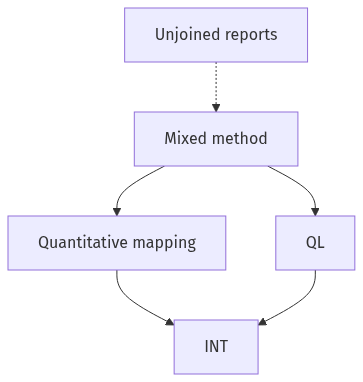
Mixing is costly in time, money and skill. One person may not be good at both regression and long fieldwork. Teams can split into two unjoined reports. That is the most common failure: data are collected twice and never truly integrated. Paradigmatic tension remains. A p-value and a life history do not automatically answer the same question. Sampling logics clash: probability samples versus theoretical cases. Ethics multiply, because images, interviews and large data sets sit under different risks. In Indian official research, mixed method can become a ritual chapter of “case studies” that do not disturb the tables.
Mixed method is therefore powerful when the design states what each strand is for. It is weak as a slogan that more methods mean more truth.
A worked sociological use
Take a study of school dropout among adolescent girls. A quantitative strand can estimate the association with household wealth, distance to school and caste category, using a probability sample. A qualitative strand can then follow a smaller set of households through the year, watching harvest labour, early marriage talk and the school’s hidden curriculum. Integration happens when a cell in the table, such as high dropout among a particular OBC group in one district, is explained by a mechanism heard in the field, and when that mechanism is then checked against other districts. If the interviews only decorate the report, the design was mixed in name. If the survey categories cannot be revised after fieldwork, the mixing was one-way. Strength and limitation both appear in that test of integration.
Flow diagram
Conclusion
Mixed method is a planned joining of quantitative and qualitative strategies. Its strengths are check, complementarity and better instruments. Its limits are cost, skill and the frequent failure to integrate. In social research it should be chosen for a clear inferential job, not as decoration.
Quick related
Students also ask
-
What is the distinctiveness of the feminist method of social research? Comment
Next question on this syllabus topic (2023 · Q1(a)). View answer →
-
Is adding three quotes to a survey mixed method?
Not in a serious sense. Mixing requires a design for how the strands will jointly support a claim.
-
Can mixed method settle the positivism debate?
It does not dissolve the debate. It can still produce stronger, more usable sociological answers when well designed.
Same topic · past papers
UPSC has asked this before
These previous-year questions sit on the same topic. Open one to practise the earlier ask.
-
2020 · Q6(c) · Sociology GS 1 · 15 marks
Analyse the strengths and weaknesses of social survey method in social research. -
2026 · Q8(c) · Sociology GS 1 · 10 marks
Discuss the significance and limitations of 'intersectionality' in social research -
2023 · Q4(a) · Sociology GS 1 · 20 marks
Do you think that common sense is the starting point of social research? What are its advantages and limitations? Explain -
2023 · Q1(a) · Sociology GS 1 · 10 marks
What is the distinctiveness of the feminist method of social research? Comment -
2016 · Q4(a) · Sociology GS 1 · 20 marks
Examine Max Weber's method of maintaining objectivity in social research.
More from this topic
Q7(a) · UPSC Mains 2026 · Sociology GS 1 · 20 marks · Solution
Compare and critically assess 'the grounded theory' with 'theory-driven research method' in sociology
Sociology as Science
• Grounded theory uses inductive emergence and constant comparison to build concepts directly from raw data without prior hypotheses. • Theory-driven research uses deductive verification, starting with established frameworks to test specific hypotheses against empirical reality. • Grounded methodology relies on iterative coding (open, axial, selective) happening simultaneously with ongoing data collection. • Theory-driven methodology requires strict operational definitions, variable isolation, and standardized protocols before field deployment. • Grounded theory excels at generating thick, micro-level context and thick descriptions, but struggles with macro-level generalizability. • Theory-driven research risks forcing complex social realities into rigid conceptual boxes, while grounded approaches risk subjective bias. • Contemporary sociology increasingly uses a pragmatic synthesis, leveraging grounded insights to refine broader macro-theoretical frameworks.
Q5(d) · UPSC Mains 2025 · Sociology GS 1 · 10 marks · Solution
How does Weber's Verstehen address the objectivity-subjectivity debate in sociology?
Sociology as Science
Verstehen is interpretative understanding of meaningful social action. Ideal types help compare cases without pretending to be full copies of reality. Value relevance selects topics; value freedom forbids twisting evidence to preach. This rejects naive positivist objectivity as a view from nowhere. It also rejects the idea that interpretation is only the scholar’s private feeling. Actors’ meanings remain checkable through comparison, documents and consequences.
Q2(c) · UPSC Mains 2025 · Sociology GS 1 · 10 marks · Solution
What do you mean by reliability? Discuss the importance of reliability in social science research.
Sociology as Science
Reliability is the consistency of a measure across time, items and raters. It differs from validity, which asks whether the right concept is being measured. Types include test–retest, split-half or alpha, and inter-coder agreement. Durkheimian rates and modern surveys both depend on stable classification. Qualitative work still needs transparent, repeatable coding. Without reliability, comparison, replication and policy use of data collapse.