
Revision summary
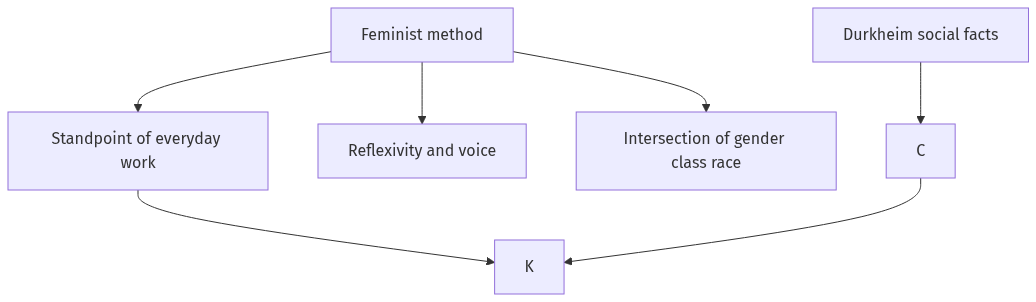
Feminist method starts from women’s everyday work and treats gender as power, not as an extra variable. Smith, Harding, Oakley, and Collins made standpoint, reflexivity, and intersection the core tools. It criticises Durkheim-style distance that treated the male public actor as the normal subject. Indian care work, dowry, and the double day show what occupation surveys miss. The method stays empirical. It is not a substitute for evidence.
Model answer
Copper italics in this answer — like this — are the key facts. Each one is unpacked in the Facts & figures rail.
Introduction
The feminist method treats gender as a relation of power that shapes what is asked, who is heard, and how knowledge is certified. Its distinctiveness is not only that it studies women. It is a critique of methods that took the male public actor as the normal subject.
Body
What makes the method distinct
- Dorothy Smith argued that sociology had been written from a ruling standpoint and that research must start from women’s everyday work of care, not from official categories alone.
- Sandra Harding and Nancy Hartsock treated standpoint as a claim that those who live subordination can see relations that the dominant group treats as natural.
- Ann Oakley showed that the textbook interview, which pretends to be a one-way extraction of facts, hides the interviewer’s power and silences talk of housework, violence, and the body.
- Patricia Hill Collins added that race, class, and gender intersect, so a method that samples only middle-class women still misses Black and Dalit standpoints.
- The method therefore prefers reflexivity, the naming of the researcher’s location, and methods that let respondents speak as knowers, not only as cases.
Contrast with older research rules
- Emile Durkheim’s Rules of Sociological Method asked the sociologist to treat social facts as things and to keep the observer outside the fact.
- Max Weber allowed verstehen, but his ideal types still often centred the public career of the male actor.
- Feminist work keeps systematic comparison and evidence. It rejects the claim that value-freedom is achieved by ignoring gender in the design of the study.
Comment
- Distinctiveness lies in the research question, the ethics of voice, and the reading of private labour as public structure.
- Indian illustrations include studies of unpaid care, dowry violence, and the double day of employed women, which survey items on occupation often miss.
- The method is not a licence to invent data. It is a demand that sampling, coding, and theory name gender instead of burying it in the household residual.
Flow diagram
Conclusion
The feminist method is distinctive because it starts from gendered everyday life, treats the researcher as located, and treats private labour as a public fact. It remains scientific when it keeps evidence and comparison. It ceases to be distinctive if it only adds women as a variable and leaves the old standpoint unchanged.
Quick related
Students also ask
-
Discuss the relationship between sociology and political science
Next question on this syllabus topic (2023 · Q1(b)). View answer →
-
Is feminist method only about studying women?
No. It is a method for seeing how gender organises all social life, including men’s work, the state, and science itself.
-
Does it reject science?
It rejects the claim that ignoring gender produces neutrality. It still uses comparison, sampling, and documented evidence.
Same topic · past papers
UPSC has asked this before
These previous-year questions sit on the same topic. Open one to practise the earlier ask.
-
2026 · Q1(d) · Sociology GS 1 · 10 marks
Although sociology, as a subject of study, overarches all disciplines in social sciences yet it maintains its distinctiveness. Comment. -
2024 · Q4(a) · Sociology GS 1 · 20 marks
What do you understand by 'mixed method'? Discuss its strengths and limitations in social research -
2020 · Q6(c) · Sociology GS 1 · 15 marks
Analyse the strengths and weaknesses of social survey method in social research. -
2016 · Q4(a) · Sociology GS 1 · 20 marks
Examine Max Weber's method of maintaining objectivity in social research. -
2026 · Q8(c) · Sociology GS 1 · 10 marks
Discuss the significance and limitations of 'intersectionality' in social research
More from this topic
Q7(a) · UPSC Mains 2026 · Sociology GS 1 · 20 marks · Solution
Compare and critically assess 'the grounded theory' with 'theory-driven research method' in sociology
Sociology as Science
• Grounded theory uses inductive emergence and constant comparison to build concepts directly from raw data without prior hypotheses. • Theory-driven research uses deductive verification, starting with established frameworks to test specific hypotheses against empirical reality. • Grounded methodology relies on iterative coding (open, axial, selective) happening simultaneously with ongoing data collection. • Theory-driven methodology requires strict operational definitions, variable isolation, and standardized protocols before field deployment. • Grounded theory excels at generating thick, micro-level context and thick descriptions, but struggles with macro-level generalizability. • Theory-driven research risks forcing complex social realities into rigid conceptual boxes, while grounded approaches risk subjective bias. • Contemporary sociology increasingly uses a pragmatic synthesis, leveraging grounded insights to refine broader macro-theoretical frameworks.
Q5(d) · UPSC Mains 2025 · Sociology GS 1 · 10 marks · Solution
How does Weber's Verstehen address the objectivity-subjectivity debate in sociology?
Sociology as Science
Verstehen is interpretative understanding of meaningful social action. Ideal types help compare cases without pretending to be full copies of reality. Value relevance selects topics; value freedom forbids twisting evidence to preach. This rejects naive positivist objectivity as a view from nowhere. It also rejects the idea that interpretation is only the scholar’s private feeling. Actors’ meanings remain checkable through comparison, documents and consequences.
Q2(c) · UPSC Mains 2025 · Sociology GS 1 · 10 marks · Solution
What do you mean by reliability? Discuss the importance of reliability in social science research.
Sociology as Science
Reliability is the consistency of a measure across time, items and raters. It differs from validity, which asks whether the right concept is being measured. Types include test–retest, split-half or alpha, and inter-coder agreement. Durkheimian rates and modern surveys both depend on stable classification. Qualitative work still needs transparent, repeatable coding. Without reliability, comparison, replication and policy use of data collapse.