
Revision summary
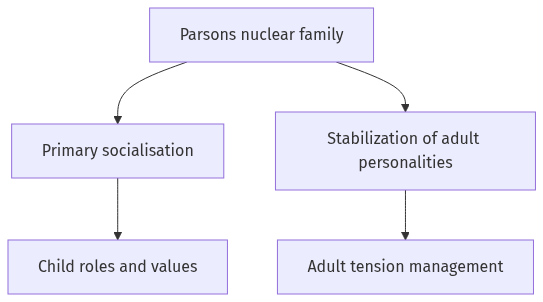
Parsons said the modern family had two basic and irreducible functions. Primary socialisation trains the child in society’s values and roles. Stabilization of adult personalities gives emotional support in an industrial economy. He tied these functions to instrumental and expressive sex roles. Feminist and Indian family studies criticise the male-breadwinner assumption. The two functions remain the syllabus core of the question.
Model answer
Copper italics in this answer — like this — are the key facts. Each one is unpacked in the Facts & figures rail.
Introduction
Talcott Parsons, writing with Robert Bales on the American family, argued that the modern nuclear family had lost many older economic and political tasks. Two functions, he said, remained basic and irreducible. The first is the primary socialisation of children. The second is the stabilization of adult personalities. The claim belongs to structural functionalism. It must be explained in his terms before it is criticised.
Body
Primary socialisation
Primary socialisation is the child’s first training in the values, roles and motives of the wider society. Parsons held that the isolated conjugal family, with a small number of children, could give intense emotional training that a large kin group scattered across work and farm could not. The child internalises a superego and learns to take roles. George Herbert Mead’s play and game stages sit nearby, but Parsons stressed the family’s fit with industrial society. The family, in this view, is a factory of personalities that the occupational system needs.
Stabilization of adult personalities
Adults, especially in a competitive industrial economy, face strain. The family is a place where the adult can receive emotional support and restore balance. Parsons linked this to a gendered division: the husband as instrumental leader toward the occupational world, the wife as expressive leader inside the home. The marriage is a personality system that manages tension. Without this function, he feared, adults would carry unresolved strain into work and politics.
A necessary critical note
Feminist sociologists such as Ann Oakley and later Sylvia Walby argued that the expressive role was unpaid labour and a structure of patriarchy, not a natural function. Cross-cultural families, joint households in India, and dual-earner couples show that socialisation and emotional support can be shared more widely. I. P. Desai and A. M. Shah studied Indian household forms that do not match the isolated American nuclear type. Parsons named two functions that families often do perform. He over-stated their uniqueness and tied them too tightly to a male-breadwinner model.
Flow diagram
Conclusion
Parsons’s basic and irreducible functions are the child’s first socialisation and the emotional stabilisation of adults. They explain his picture of the modern conjugal family. A full answer states those two functions clearly and then notes that later work has questioned their gender and their claim to be the only forms that can do this work.
Quick related
Students also ask
-
Describe the main idea of Max Weber's book, *The Protestant Ethic and the Spirit of Capitalism* as a critique of Marxism
Next question on this syllabus topic (2024 · Q3(b)). View answer →
-
Did Parsons say the family has only these two functions in all history?
He said that in modern industrial society other functions had been lost to other institutions, leaving these two as basic.
-
Is the Indian joint family outside this theory?
Parsons modelled the isolated American nuclear family. Indian joint and household studies show other ways of doing socialisation and care.
Same topic · past papers
UPSC has asked this before
These previous-year questions sit on the same topic. Open one to practise the earlier ask.
More from this topic
Q7(c) · UPSC Mains 2026 · Sociology GS 1 · 10 marks · Solution
Compare the social organisation of work in industrial capitalism and platform capitalism
Sociological Thinkers: Karl Marx
• **Setting:** Industrial capitalism centres work in physical factories; platform capitalism disperses it via digital apps. • **Control:** Factories use direct managerial supervision and time-discipline; platforms use invisible algorithms and automated ratings. • **Contracts:** Industrial work relies on standard, secure employment with welfare benefits; platform work relies on gig contracts and independent contractors. • **Risk:** Factories shoulder capital costs; platform capitalism shifts risks and equipment costs onto individual workers. • **Solidarity:** Shared factory spaces foster collective class consciousness; digital isolation creates an atomised "precariat." • **Surplus Value:** Both systems extract surplus value, but platforms obscure exploitation behind the illusion of entrepreneurial freedom.
Q5(d) · UPSC Mains 2026 · Sociology GS 1 · 10 marks · Solution
How does Max Weber's 'theory of authority' shape bureaucracy? Analyse.
Sociological Thinkers: Karl Marx
Max Weber's sociological framework links different forms of legitimate domination directly to the rise of modern rational-legal bureaucracy. Traditional and charismatic authority provide historical context, but rational-legal authority creates the impersonal rules, hierarchy, and technical expertise defining bureaucratic structures. While ensuring efficiency, this iron cage of rationalisation also poses risks of alienation and goal displacement, which later thinkers critiqued.
Q3(c) · UPSC Mains 2026 · Sociology GS 1 · 10 marks · Solution
How does Emile Durkheim conceptualize religion as a 'social fact'? Explain
Sociological Thinkers: Karl Marx
Emile Durkheim treats religion as a quintessential social fact in 'The Elementary Forms of the Religious Life' (1912). Moving away from supernatural or animistic definitions, he argues that religion is fundamentally a collective product. Society objectifies its own moral authority and solidarity through sacred symbols and rituals. By separating the sacred from the profane, religious practices reinforce social integration and collective consciousness. Thus, religion is society worshipping itself, operating as an external and coercive constraint upon individual thought and action.