
Revision summary
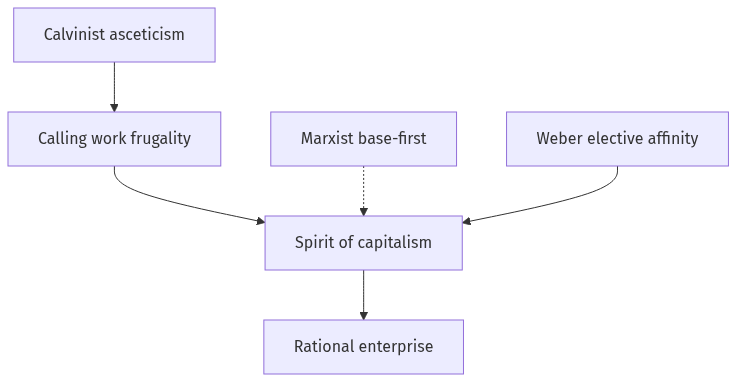
Weber distinguished modern rational capitalism from ordinary greed. Some Protestant ethics, especially Calvinist worldly asceticism, formed a methodical conduct of life. The idea of calling made work a duty and success a possible sign of election. Elective affinity, not a single cause, links this ethic to the capitalist spirit. The argument criticises a Marxism that treats religion as mere reflection of the base. Weber still accepted material interests; he denied that they exhaust explanation.
Model answer
Copper italics in this answer — like this — are the key facts. Each one is unpacked in the Facts & figures rail.
Introduction
Max Weber’s The Protestant Ethic and the Spirit of Capitalism asks why modern rational capitalism, with its methodical pursuit of profit and reinvestment, grew with particular force in parts of the Protestant West. His main idea is that a religious ethic, especially Calvinist this-worldly asceticism, formed a habit of disciplined work, saving and calling that fitted the capitalist spirit. The book is a critique of a one-sided Marxist claim that ideas are only a reflection of the economic base.
Body
The main idea of the book
- Weber distinguished the adventurous greed of all ages from the spirit of modern capitalism: a sober, continuous, rational organisation of labour and capital. He found in some Protestant teachings a worldly calling. Martin Luther’s idea of vocation treated ordinary work as a duty before God. John Calvin’s doctrine of predestination, as believers lived it, produced anxiety about salvation. Methodical labour, frugality and success in a calling became signs that one might be among the elect. Inner-worldly asceticism turned away from monastery flight and toward disciplined conduct in business. Benjamin Franklin’s maxims about time and credit illustrated the later, more secular spirit. Once capitalism stood on its own feet, Weber said, the religious root could wither, leaving a steel-hard housing of work without belief.
This is an argument of elective affinity, not a simple claim that Calvin invented factories. Weber used historical comparison with other world religions in later essays to ask why a similar spirit did not become dominant elsewhere in the same way.
As a critique of Marxism
Karl Marx treated religion as part of the superstructure and, in a famous phrase, as the opium of the people. Historical materialism, in its strong form, explains the rise of capitalism from forces and relations of production, primitive accumulation and class. Weber did not deny class, markets or technology. He denied that they were a complete explanation of the capitalist ethos. Ideas, for him, can switch the tracks on which interests run. The Protestant ethic thesis is therefore a critique of reduction: religious meanings helped form a type of economic actor. Friedrich Engels had already allowed some reaction of the superstructure on the base. Weber made that reaction historically specific and empirically argued.
The critique is limited in ways a fair answer must note. Historians have debated whether the chronology of Puritanism and capitalist growth is as neat as the essay suggests. R. H. Tawney and later writers gave more weight to politics and class. Marxist replies say that Protestantism itself needs a material explanation. Weber also never claimed that only ideas matter. In Economy and Society he kept class, status and party together. The book’s force as critique is the demonstration that a cultural ethic can be a causal ingredient in economic history, which a base-only Marxism cannot fully absorb.
Flow diagram
Conclusion
The Protestant ethic thesis says that a disciplined religious conduct of life had an elective affinity with the spirit of rational capitalism. As a critique of Marxism it restores ideas and meaning to the explanation of economic action. Weber still leaves room for material interests. The book attacks one-sided materialism, not the study of class itself.
Quick related
Students also ask
-
Critically explain the salient features of 'alienation' as propounded by Karl Marx
Next question on this syllabus topic (2024 · Q3(c)). View answer →
-
Did Weber say Calvinism caused capitalism?
He said it was one important cultural condition in a particular historical path, not the sole cause.
-
Is the book only against Marx?
It is also a study of rationalisation. The critique of Marxism is the syllabus point of this question, not the whole of Weber.
Same topic · past papers
UPSC has asked this before
These previous-year questions sit on the same topic. Open one to practise the earlier ask.
-
2018 · Q1(b) · Sociology GS 1 · 10 marks
Distinguish between fact and value in Weber's Protestant Ethic and the Spirit of Capitalism
More from this topic
Q7(c) · UPSC Mains 2026 · Sociology GS 1 · 10 marks · Solution
Compare the social organisation of work in industrial capitalism and platform capitalism
Sociological Thinkers: Karl Marx
• **Setting:** Industrial capitalism centres work in physical factories; platform capitalism disperses it via digital apps. • **Control:** Factories use direct managerial supervision and time-discipline; platforms use invisible algorithms and automated ratings. • **Contracts:** Industrial work relies on standard, secure employment with welfare benefits; platform work relies on gig contracts and independent contractors. • **Risk:** Factories shoulder capital costs; platform capitalism shifts risks and equipment costs onto individual workers. • **Solidarity:** Shared factory spaces foster collective class consciousness; digital isolation creates an atomised "precariat." • **Surplus Value:** Both systems extract surplus value, but platforms obscure exploitation behind the illusion of entrepreneurial freedom.
Q5(d) · UPSC Mains 2026 · Sociology GS 1 · 10 marks · Solution
How does Max Weber's 'theory of authority' shape bureaucracy? Analyse.
Sociological Thinkers: Karl Marx
Max Weber's sociological framework links different forms of legitimate domination directly to the rise of modern rational-legal bureaucracy. Traditional and charismatic authority provide historical context, but rational-legal authority creates the impersonal rules, hierarchy, and technical expertise defining bureaucratic structures. While ensuring efficiency, this iron cage of rationalisation also poses risks of alienation and goal displacement, which later thinkers critiqued.
Q3(c) · UPSC Mains 2026 · Sociology GS 1 · 10 marks · Solution
How does Emile Durkheim conceptualize religion as a 'social fact'? Explain
Sociological Thinkers: Karl Marx
Emile Durkheim treats religion as a quintessential social fact in 'The Elementary Forms of the Religious Life' (1912). Moving away from supernatural or animistic definitions, he argues that religion is fundamentally a collective product. Society objectifies its own moral authority and solidarity through sacred symbols and rituals. By separating the sacred from the profane, religious practices reinforce social integration and collective consciousness. Thus, religion is society worshipping itself, operating as an external and coercive constraint upon individual thought and action.