
Revision summary
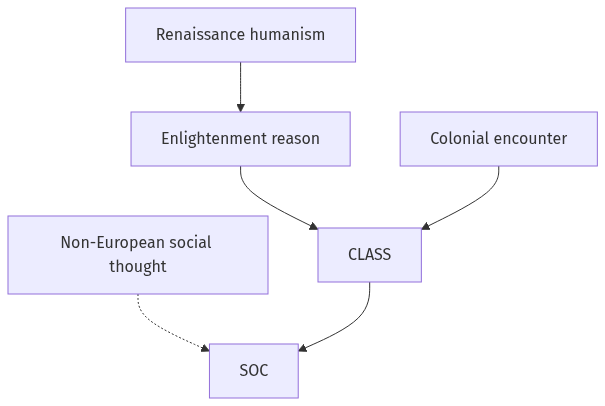
The Renaissance and Enlightenment made society an object of this-worldly reason. The French and industrial revolutions supplied the classic problems of order and change. Comte, Marx, Durkheim and Weber institutionalised European sociology. The statement is only a half-truth if it ignores Ibn Khaldun and other older social thought. Colonial encounter and later Southern Theory show that Europe was not the only workshop. Indian sociology had to name caste and colonial capitalism beyond the Enlightenment citizen.
Model answer
Copper italics in this answer — like this — are the key facts. Each one is unpacked in the Facts & figures rail.
Introduction
The statement says that sociology is a child of the European Renaissance and Enlightenment. There is a strong historical case for this. The Renaissance recovered a this-worldly interest in human affairs. The Enlightenment asked that society be explained by reason and evidence rather than by sacred tradition alone. The French and industrial revolutions then made order and change into urgent problems. A critical examination must grant this origin story and then show what it leaves out.
Body
What the statement gets right
Niccolo Machiavelli and later Renaissance humanists treated politics as a human craft. Enlightenment writers such as Montesquieu compared governments and climates. The Scottish moralists, including Adam Smith and Adam Ferguson, wrote about commercial society, sympathy and the division of labour. Auguste Comte, after Saint-Simon, named sociology and offered a law of three stages from theology to positive science. Karl Marx wrote in the wake of industrial capitalism and Hegelian philosophy. Emile Durkheim’s science of social facts, and Max Weber’s study of rationalisation, are unthinkable without a European crisis of church, market and state. R. W. Connell and others still accept that the canonical textbooks were written in this setting. The dual revolution that Eric Hobsbawm described, political in France and industrial in Britain, produced the classic questions of class, bureaucracy, anomie and the city.
What a critical examination must add
The Renaissance and Enlightenment were not the only sources of social thought. Ibn Khaldun had already written a science of social organisation and group feeling. Indian, Chinese and Islamic traditions reasoned about kingship, caste, law and ethics. The European canon itself was formed in a colonial world. Marx wrote on India and Ireland. Weber compared world religions. Anthropology grew from the imperial encounter. To say that sociology is only a European product is to confuse the institutional birth of a university discipline with the whole history of thinking about society.
Feminist and postcolonial critics, including Raewyn Connell’s Southern Theory, argue that the metropolitan canon treated the colony as data and Europe as theory. Indian sociology after G. S. Ghurye, D. P. Mukerji and A. R. Desai had to study caste, village and colonial capitalism, which the Enlightenment pair of individual and citizen did not fully name. Religion did not simply die as Comte expected. The Enlightenment also had exclusions of women, the poor and the colonised.
A fair critical examination therefore holds two sentences together. The professional discipline called sociology was organised in Europe under the signs of reason, science and the modern state. Its problems, methods and later global practice cannot be reduced to that one origin. The statement is a useful half-truth.
What the examination answer should still grant
The syllabus still needs the European story in some detail. Saint-Simon’s industrialism, Comte’s hierarchy of the sciences, and the moral statistics of Quetelet prepared Durkheim’s suicide tables. The Scottish Enlightenment’s account of commercial society prepared Marx’s and Weber’s questions about markets. Renaissance humanism made the human city a legitimate object of writing. None of that is cancelled by pointing to Ibn Khaldun. What is cancelled is the boast that only Europe could think society. Indian university sociology, from Bombay and Lucknow, used the European toolkit on caste, village, joint family and colonial class. D. P. Mukerji asked for a sociology that knew Indian tradition as a living process. That is how a critical examination ends: origin in Europe as an institution, continuation as a global craft that must name non-European structures.
Flow diagram
Conclusion
Sociology as a named academic discipline did grow from European Renaissance and Enlightenment currents, and from the shock of industrial and political revolution. A critical view adds non-European social thought, the colonial context of the canon, and later work that decentres Europe. The statement should be examined, not swallowed whole.
Quick related
Students also ask
-
How do you view and assess the increasing trend of digital ethnography and the use of visual culture in sociological research?
Next question on this syllabus topic (2024 · Q3(a)). View answer →
-
Does a critical answer deny European founders?
No. It locates them historically and then shows the limits of treating their setting as the whole birth of social thought.
-
Is Indian sociology only an import?
The university form was imported. The problems of caste, village and colonial rule forced original work.
Same topic · past papers
UPSC has asked this before
These previous-year questions sit on the same topic. Open one to practise the earlier ask.
-
2023 · Q3(c) · Sociology GS 1 · 10 marks
Is Weber's idea of bureaucracy a product of the historical experiences of Europe? Comment
More from this topic
Q8(c) · UPSC Mains 2026 · Sociology GS 1 · 10 marks · Solution
Discuss the significance and limitations of 'intersectionality' in social research
Sociology
Intersectionality, coined by Kimberlé Crenshaw, examines how overlapping identities like race, class, and gender shape systemic oppression. Its significance in social research lies in capturing lived realities beyond single-axis frameworks and preventing reductive generalisations. However, limitations include methodological complexity, risks of infinite regress, and difficulties in operationalising fluid categories. Effective application requires balancing structural macro-analysis with micro-level lived experiences.
Q6(b) · UPSC Mains 2026 · Sociology GS 1 · 20 marks · Solution
Critically analyse the nature-nurture debate from different perspectives
Sociology
1. The nature-nurture debate explores whether biology or society primarily shapes human behavior
Q6(a) · UPSC Mains 2026 · Sociology GS 1 · 20 marks · Solution
Discuss the intellectual origins of sociology and its evolution as a distinct field of study
Sociology
Sociology arose in 19th-century Western Europe to make sense of massive upheavals caused by the Industrial and French Revolutions. Enlightenment thinkers laid the groundwork by championing reason, empirical observation, and human agency over traditional dogma. Auguste Comte gave the discipline its name, pushing for a positivist "physics of society" based on scientific laws. Émile Durkheim secured its academic legitimacy by defining "social facts" and using empirical methods to study human behavior. Max Weber introduced interpretive sociology, while Karl Marx focused on material conditions and class struggle. In the 20th century, Talcott Parsons advanced structural-functionalism to study systemic equilibrium. Later, conflict theories, the Frankfurt School, and postmodern critiques broadened the field to address power and marginalisation. Today, sociology continues to evolve by analyzing globalisation, digital shifts, and modern identity politics.