
Revision summary
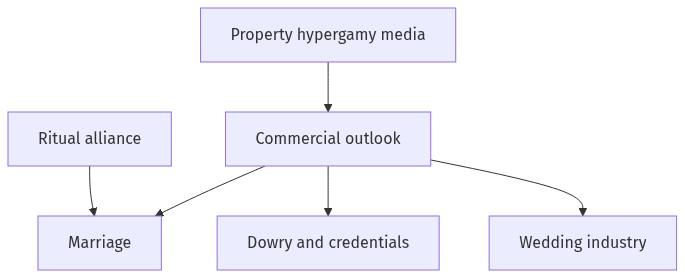
Older marriage was a ritual alliance of families, caste and honour. A commercial outlook prices grooms, dowry and wedding display. Hypergamy and scarce high-status jobs inflate the market. Media, urban consumption and the wedding industry make the ceremony a public show. Law against dowry exists, but practice still follows family bargaining. Ritual form can survive while the outlook becomes commercial.
Model answer
Copper italics in this answer — like this — are the key facts. Each one is unpacked in the Facts & figures rail.
Introduction
Marriage in much of India was long treated as a ritual alliance between families, not as a contract between two individuals. Hindu law books called it a sacrament. Caste endogamy, gifts and honour surrounded the rite. The same institution now often looks like a market. Families bargain over grooms, dowry, lifestyle and wedding display. The change is radical in outlook even where the ritual form survives. Sociology must name the factors, not only regret the cost.
Body
From ritual to commercial outlook
A ritual outlook treats marriage as a duty that completes householder life, transfers women between patrilineages, and reproduces caste. Louis Dumont and later kinship studies stressed alliance. The commercial outlook treats the wedding as a package of goods and the spouse as a bundle of credentials: job, salary, skin colour, overseas visa and family property. Matrimonial sites and newspaper columns make this market visible. Veena Das and others have shown how honour still sits inside this market, so the change is not a simple move from sacred to secular. It is a move toward pricing of status.
Factors behind the change
Hypergamy pushes families to buy a higher-status groom. Uma Chakravarti’s account of Brahmanical patriarchy links control of women’s sexuality to caste property. Dowry inflation follows when education and government jobs become scarce status goods. M. N. Srinivas already noted the modernisation of dowry among groups that once practised bride-price. Urban middle-class consumer culture, television and social media turn the wedding into a public performance. The wedding industry, hotels and gold markets have a material interest in this display. Legal bans such as the Dowry Prohibition Act exist, but weak enforcement and family complicity keep the market alive. Migration and the NRI groom have added a global price list.
The commercial outlook does not mean that love or ritual has disappeared. Companionable marriage and court choice have grown in cities. The point of the question is the dominant public language of bargaining, costing and show. Capitalism did not invent arranged marriage. It has commercialised the search and the ceremony.
Flow diagram
Conclusion
Marriage has shifted from a mainly ritual alliance to an outlook that prices status, grooms and display. Property, hypergamy, media and a weak legal net explain the change. The rite continues, but the market now speaks loudly inside it.
Quick related
Students also ask
-
Sociology is the product of European enlightenment and renaissance. Critically examine this statement
Next question on this syllabus topic (2024 · Q2(a)). View answer →
-
Has marriage become a free contract of two individuals?
Not for most families. Individual choice has grown, but the commercial outlook still works through family status and bargaining.
-
Is this only a Hindu urban story?
The pattern is strongest in some caste and class settings, but competitive weddings and credential markets appear across communities.
Same topic · past papers
UPSC has asked this before
These previous-year questions sit on the same topic. Open one to practise the earlier ask.
-
2020 · Q2(b) · Sociology GS 1 · 15 marks
How are Hierarchy and Exclusion the major impediments in the transformation of societies ? Discuss. -
2015 · Q5(b) · Sociology GS 1 · 10 marks
"Ideology is crucial for social transformation in a democracy." Discuss.
More from this topic
Q8(c) · UPSC Mains 2026 · Sociology GS 1 · 10 marks · Solution
Discuss the significance and limitations of 'intersectionality' in social research
Sociology
Intersectionality, coined by Kimberlé Crenshaw, examines how overlapping identities like race, class, and gender shape systemic oppression. Its significance in social research lies in capturing lived realities beyond single-axis frameworks and preventing reductive generalisations. However, limitations include methodological complexity, risks of infinite regress, and difficulties in operationalising fluid categories. Effective application requires balancing structural macro-analysis with micro-level lived experiences.
Q6(b) · UPSC Mains 2026 · Sociology GS 1 · 20 marks · Solution
Critically analyse the nature-nurture debate from different perspectives
Sociology
1. The nature-nurture debate explores whether biology or society primarily shapes human behavior
Q6(a) · UPSC Mains 2026 · Sociology GS 1 · 20 marks · Solution
Discuss the intellectual origins of sociology and its evolution as a distinct field of study
Sociology
Sociology arose in 19th-century Western Europe to make sense of massive upheavals caused by the Industrial and French Revolutions. Enlightenment thinkers laid the groundwork by championing reason, empirical observation, and human agency over traditional dogma. Auguste Comte gave the discipline its name, pushing for a positivist "physics of society" based on scientific laws. Émile Durkheim secured its academic legitimacy by defining "social facts" and using empirical methods to study human behavior. Max Weber introduced interpretive sociology, while Karl Marx focused on material conditions and class struggle. In the 20th century, Talcott Parsons advanced structural-functionalism to study systemic equilibrium. Later, conflict theories, the Frankfurt School, and postmodern critiques broadened the field to address power and marginalisation. Today, sociology continues to evolve by analyzing globalisation, digital shifts, and modern identity politics.