
Revision summary
Power has economic, political, ideological and status dimensions. Marx stressed property; Weber added status and party; Gramsci stressed hegemony. Foucault and Bourdieu highlight discipline, capital forms and symbolic violence. Hierarchies of class, caste and gender are built when these dimensions align. Maintenance is both spectacular force and daily honour, schooling and family rule. Splits among dimensions, such as legal equality versus ritual rank, create change.
Model answer
Copper italics in this answer — like this — are the key facts. Each one is unpacked in the Facts & figures rail.
Introduction
A social hierarchy is a ranked order of groups and persons that lasts beyond one encounter. Power is what builds that order and what keeps it standing. Power is not only the police. It has several dimensions: control of resources, control of office and force, control of meaning and honour, and control of everyday conduct. These dimensions work together in class, caste, gender and bureaucracy.
Body
Dimensions of power
- Karl Marx emphasised economic power: ownership of the means of production and extraction of surplus. Those who command capital construct a class hierarchy and maintain it through the state’s legal protection of property. Max Weber added status honour and party or organisational power, so that hierarchy is three-dimensional. Antonio Gramsci’s hegemony names ideological power: the capacity to make a hierarchy seem common sense. Michel Foucault described disciplinary power in schools, prisons and clinics, which trains bodies and does not only forbid. Pierre Bourdieu spoke of economic, cultural and social capital, and of symbolic violence that makes the dominated collude in their ranking. Steven Lukes distinguished overt conflict, agenda-setting and preference-shaping as faces of power.
Construction and maintenance of hierarchies
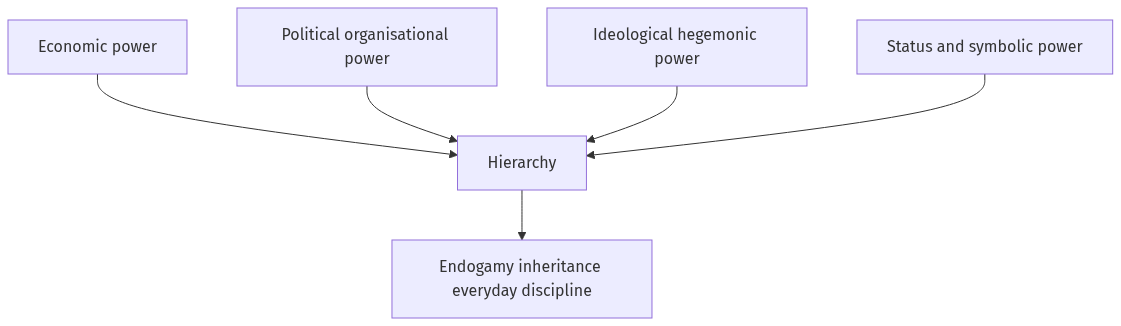
Hierarchies are constructed when these dimensions crystallise into durable positions. Caste hierarchy is maintained by endogamy, ritual honour, economic dependence and, historically, religious ideology. Ambedkar and Uma Chakravarti show that gender control is inside that maintenance. Class hierarchy is maintained by inheritance, elite schools, and the conversion of money into cultural capital. Gender hierarchy is maintained by unpaid care, violence, law and the naturalisation of roles. In organisations, Weberian bureaucracy constructs official ranks, while informal cliques maintain them through patronage.
Maintenance is daily. It happens in language, in who interrupts whom, in residential segregation, and in the fear of falling. It also happens in crisis, when force is used. A hierarchy that loses ideological consent becomes expensive to police. That is why schools, temples, media and the family are sites of power, not only parliaments.
A full answer therefore refuses a single-factor story. Economic power is fundamental in Marx’s sense for class. Status and symbolic power are fundamental for caste and gender. Political and organisational power lock the structure into the state. The dimensions construct hierarchy when they align, and they open a chance of change when they split, as when legal citizenship contradicts ritual rank.
Flow diagram
Conclusion
Power constructs and maintains hierarchy through property, office, honour and everyday discipline. Marx, Weber, Gramsci, Foucault and Bourdieu name different dimensions of that work. Hierarchies last when these dimensions support one another. They shake when law, economy and meaning fall out of line.
Quick related
Students also ask
-
How is civil society useful in deepening the roots of democracy?
Next question on this syllabus topic (2023 · Q5(b)). View answer →
-
Is all hierarchy only class?
Class is central for property. Caste and gender hierarchies use honour, sexuality and everyday ritual that class analysis must not swallow whole.
-
Does Foucault replace Marx?
He shifts attention to micro-discipline. Many sociologists use both: capital and the workshop of everyday power.
Same topic · past papers
UPSC has asked this before
These previous-year questions sit on the same topic. Open one to practise the earlier ask.
-
2019 · Q7(b) · Sociology GS 1 · 20 marks
Feminist scholars argue that 'New media' is masculine and hence reinforces structural hierarchies rather than reconfiguring them. Comment
More from this topic
Q8(a) · UPSC Mains 2026 · Sociology GS 1 · 20 marks · Solution
How are the concepts of nation, state and citizenship interrelated in a democracy? Elaborate
Politics and Society
• The state is the sovereign institutional apparatus that maintains law and order within a defined territory. • The nation is an imagined community bound by shared culture, history, language, or political values. • Citizenship acts as the legal bridge connecting individuals to the collective through rights and duties. • Modern democracies must constantly balance universal citizenship rights with particular national cultural loyalties. • State authority derives its democratic legitimacy directly from the active participation of its citizens. • Globalisation, migration, and multiculturalism increasingly challenge the traditional boundaries of nation-states. • Maintaining a healthy democracy requires inclusive citizenship that prevents majoritarian identities from marginalising minorities.
Q4(a) · UPSC Mains 2026 · Sociology GS 1 · 20 marks · Solution
Elaborate major sociological theories of power. How does power shape political process in modern societies?
Politics and Society
• Marx views power as structurally tied to economic ownership and class dominance. • Weber defines power as
Q1(e) · UPSC Mains 2026 · Sociology GS 1 · 10 marks · Solution
Explain in brief the relationship between social movement, collective action and revolution in bringing about social and political changes.
Politics and Society
This 10-marker for Sociology Paper I examines the continuum between everyday collective action, structured social movements, and radical revolutions in driving systemic social and political change. Collective action provides the foundational mobilization, social movements sustain ideological and institutional pressure, and revolution marks a structural rupture leading to regime change. The answer utilizes classical sociological frameworks from Tilly, Marx, and Smelser to explain this continuum. It includes a concise Mermaid flowchart illustrating the progressive escalation from mobilization to structural transformation. The response concludes by linking grassroots agency to democratic consolidation and policy reform.