
Revision summary
Civil society is associations and public talk between family, market, and state. It deepens democracy through civic skill, oversight, and the conversion of injury into agenda. Tocqueville, Putnam, Habermas, and Gramsci supply the classical map. MKSS and the RTI Act, 2005, are Indian illustrations. Oligarchy and communal associations show that the sphere is not automatically democratic.
Model answer
Copper italics in this answer — like this — are the key facts. Each one is unpacked in the Facts & figures rail.
Introduction
Civil society is the sphere of associations, movements, and public talk that stands between family, market, and the state. Democracy is deepened when that sphere trains citizens, watches power, and brings excluded groups into public claim. It is not automatically democratic, because associations can also organise exclusion.
Body
What it does for democracy
- Alexis de Tocqueville treated voluntary associations as schools of self-rule. Robert Putnam later measured trust and networks as social capital that makes institutions work.
- Jurgen Habermas placed the public sphere as the space where arguments, not only votes, test authority.
- Antonio Gramsci treated civil society as the field of hegemony, where consent for rule is organised, and therefore also where counter-hegemony can be built.
- The MKSS campaign in Rajasthan and the Right to Information Act, 2005, show associations turning secrecy into a citizen’s file.
- Social movements of farmers, women, and Dalits convert private injury into public agenda, which elections alone may not do.
How roots deepen
- Associations produce skills of meeting, accounting, and compromise that a vote every five years does not teach.
- They pluralise power so that a parliamentary majority is not the only voice.
- They document exclusion that official statistics miss, which is Weber’s status order made visible in practice.
Cautions
- Michels’s oligarchy appears inside NGOs and parties of civil society as well.
- Communal associations can deepen a majority’s grip rather than democracy.
- Donor-funded professional NGOs may replace membership organisations, which Putnam would count as thinner capital.
- Usefulness is therefore conditional on internal democracy, plurality, and a legal space to organise.
Flow diagram
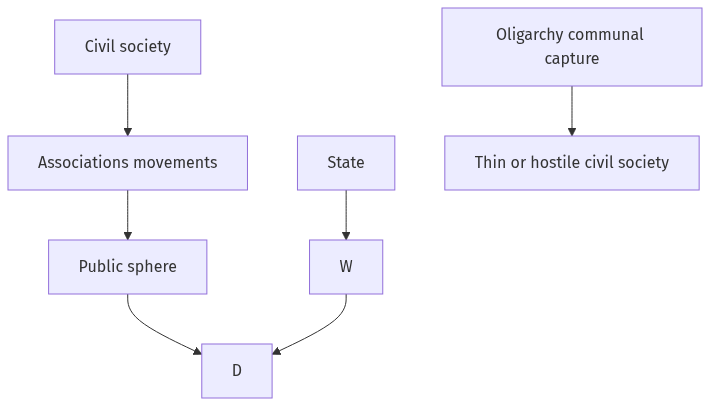
Conclusion
Civil society deepens democracy by training citizens, watching the state, and opening the public sphere to excluded groups, as RTI and social movements show. Gramsci and Putnam explain consent and trust. The same sphere can organise oligarchy or communal closure, so the use is real and conditional.
Quick related
Students also ask
-
Analyse the nature of transition from ideology to identity politics in India.
Next question on this syllabus topic (2022 · Q6(b)). View answer →
-
Is every NGO civil society for democracy?
No. Professional contractors and exclusionary associations may not deepen citizenship.
-
Can civil society replace elections?
No. It supplements votes with voice and watch. It does not appoint the government.
Same topic · past papers
UPSC has asked this before
These previous-year questions sit on the same topic. Open one to practise the earlier ask.
-
2024 · Q1(d) · Sociology GS 1 · 10 marks
Democracy needs a vibrant culture of civil society in order to strengthen its foundation of citizenship. Comment. -
2026 · Q8(a) · Sociology GS 1 · 20 marks
How are the concepts of nation, state and citizenship interrelated in a democracy? Elaborate -
2025 · Q3(b) · Sociology GS 1 · 20 marks
Are pressure groups a threat to or a necessary element of democracy? Explain with suitable illustrations -
2020 · Q2(c) · Sociology GS 1 · 15 marks
Explain democracy as an order of society. What are the factors preventing people's participation in politics? -
2016 · Q5(b) · Sociology GS 1 · 10 marks
Discuss the importance of 'power elite' in democracy.
More from this topic
Q8(a) · UPSC Mains 2026 · Sociology GS 1 · 20 marks · Solution
How are the concepts of nation, state and citizenship interrelated in a democracy? Elaborate
Politics and Society
• The state is the sovereign institutional apparatus that maintains law and order within a defined territory. • The nation is an imagined community bound by shared culture, history, language, or political values. • Citizenship acts as the legal bridge connecting individuals to the collective through rights and duties. • Modern democracies must constantly balance universal citizenship rights with particular national cultural loyalties. • State authority derives its democratic legitimacy directly from the active participation of its citizens. • Globalisation, migration, and multiculturalism increasingly challenge the traditional boundaries of nation-states. • Maintaining a healthy democracy requires inclusive citizenship that prevents majoritarian identities from marginalising minorities.
Q4(a) · UPSC Mains 2026 · Sociology GS 1 · 20 marks · Solution
Elaborate major sociological theories of power. How does power shape political process in modern societies?
Politics and Society
• Marx views power as structurally tied to economic ownership and class dominance. • Weber defines power as
Q1(e) · UPSC Mains 2026 · Sociology GS 1 · 10 marks · Solution
Explain in brief the relationship between social movement, collective action and revolution in bringing about social and political changes.
Politics and Society
This 10-marker for Sociology Paper I examines the continuum between everyday collective action, structured social movements, and radical revolutions in driving systemic social and political change. Collective action provides the foundational mobilization, social movements sustain ideological and institutional pressure, and revolution marks a structural rupture leading to regime change. The answer utilizes classical sociological frameworks from Tilly, Marx, and Smelser to explain this continuum. It includes a concise Mermaid flowchart illustrating the progressive escalation from mobilization to structural transformation. The response concludes by linking grassroots agency to democratic consolidation and policy reform.