
Revision summary
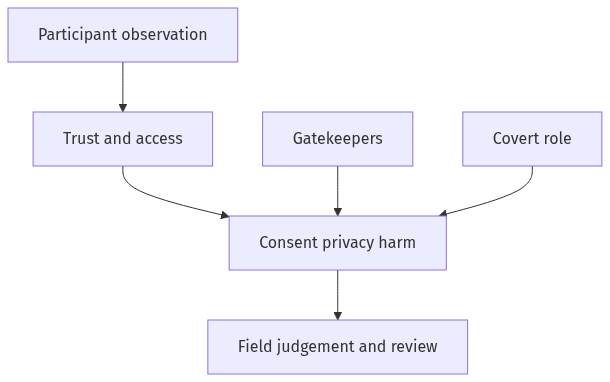
Participant observation gathers data from inside a group role. Ethical issues are consent, covert identity, privacy, harm, and gatekeeper power. Humphreys and the depth of Whyte’s notes show how publication can injure. Role conflict and exit create further duties. Overtness and protection of identifiers are the minimum response, not a full solution.
Model answer
Copper italics in this answer — like this — are the key facts. Each one is unpacked in the Facts & figures rail.
Introduction
Participant observation collects data by taking a role in the group under study. The method yields Goffman-like detail of everyday life. It also places the researcher inside relationships of trust, so ethical issues are not an appendix. They are part of the method.
Body
Consent and disclosure
- Covert observation withholds the research identity. It can reduce performance for the observer, and it violates informed consent.
- Whyte in Cornerville was known as a visitor, yet the depth of secrets still raised questions of what may be published.
- Formal written consent is hard in a street or a factory where membership shifts by the hour.
Harm, privacy, and power
- Field notes can identify informants when places and nicknames are thin disguises.
- The researcher may see illegal work, violence, or party funds and then face a duty to protect or to report.
- Laud Humphreys’s tearoom study showed how tracing men from a public place into their homes destroyed privacy.
- Hierarchy in the group can make a gatekeeper’s yes stand in for the consent of juniors, women, or Dalit workers.
Role conflict and exit
- Taking a role creates obligations. Leaving can feel like betrayal.
- The observer may be asked to take sides in a faction. Neutrality is then an ethical and a methodological problem.
- Feminist method requires that the researcher’s location be stated, which conflicts with a fantasy of the invisible guest.
How to handle the issues
- Prefer overt roles where safety allows. Minimise covert work to public settings with no named persons.
- Separate identifiers from notes. Delay publication that could cost jobs or prosecutions unless there is a clear public-interest rule.
- Institutional ethics review is a floor, not a substitute for judgement in the field.
Flow diagram
Conclusion
Participant observation faces ethical issues of consent, privacy, harm, gatekeeper power, and role conflict. The method’s strength, closeness, is the source of the risk. Overtness, disguise of identities, and a stated standpoint reduce the harm. They do not make the method innocent.
Quick related
Students also ask
-
Explain how economic globalization has brought changes in the patterns of employment in the 21st century
Next question on this syllabus topic (2023 · Q7(a)). View answer →
-
Is covert observation always unethical?
It is ethically costly. Some public settings with no named persons are argued as lesser harm. Private life is not that setting.
-
Does ethics review solve the field?
It sets a floor before entry. Side-taking, illegal knowledge, and exit still require judgement.
Same topic · past papers
UPSC has asked this before
These previous-year questions sit on the same topic. Open one to practise the earlier ask.
-
2016 · Q4(b) · Sociology GS 1 · 15 marks
"Participant observation is the most effective tool for collecting facts." Comment.
More from this topic
Q8(c) · UPSC Mains 2026 · Sociology GS 1 · 10 marks · Solution
Discuss the significance and limitations of 'intersectionality' in social research
Sociology
Intersectionality, coined by Kimberlé Crenshaw, examines how overlapping identities like race, class, and gender shape systemic oppression. Its significance in social research lies in capturing lived realities beyond single-axis frameworks and preventing reductive generalisations. However, limitations include methodological complexity, risks of infinite regress, and difficulties in operationalising fluid categories. Effective application requires balancing structural macro-analysis with micro-level lived experiences.
Q6(b) · UPSC Mains 2026 · Sociology GS 1 · 20 marks · Solution
Critically analyse the nature-nurture debate from different perspectives
Sociology
1. The nature-nurture debate explores whether biology or society primarily shapes human behavior
Q6(a) · UPSC Mains 2026 · Sociology GS 1 · 20 marks · Solution
Discuss the intellectual origins of sociology and its evolution as a distinct field of study
Sociology
Sociology arose in 19th-century Western Europe to make sense of massive upheavals caused by the Industrial and French Revolutions. Enlightenment thinkers laid the groundwork by championing reason, empirical observation, and human agency over traditional dogma. Auguste Comte gave the discipline its name, pushing for a positivist "physics of society" based on scientific laws. Émile Durkheim secured its academic legitimacy by defining "social facts" and using empirical methods to study human behavior. Max Weber introduced interpretive sociology, while Karl Marx focused on material conditions and class struggle. In the 20th century, Talcott Parsons advanced structural-functionalism to study systemic equilibrium. Later, conflict theories, the Frankfurt School, and postmodern critiques broadened the field to address power and marginalisation. Today, sociology continues to evolve by analyzing globalisation, digital shifts, and modern identity politics.