
Revision summary
Qualitative method interprets meaning through ethnography, interviews, and texts. Dimensions include epistemology, design, researcher role, analysis, and ethics. It deepens insight into process and standpoint, as Whyte, Goffman, and Srinivas show. It does not generalise like a large survey and can over-represent a vivid case. Join it to counts when both mechanism and incidence are needed.
Model answer
Copper italics in this answer — like this — are the key facts. Each one is unpacked in the Facts & figures rail.
Introduction
Qualitative method collects and interprets meaning, sequence, and context rather than only counts. Its dimensions include the site of enquiry, the role of the researcher, and the form of data. It does help to gain deeper sociological insight when the question is about lived order. It does not replace measurement when the question is about rates.
Body
Dimensions
- Epistemology: interpretative understanding in Weber’s sense, not only external correlation.
- Design: ethnography, case study, life history, focus group, and qualitative interview.
- Data: talk, text, image, and observed sequence, as in Malinowski’s field diary or William Foote Whyte’s Street Corner Society.
- Role: complete observer, participant observer, or insider, each with a different access and bias.
- Analysis: coding of themes, thick description in Clifford Geertz’s sense, and comparison across a small set of cases.
- Quality checks: triangulation, member check, and audit of field notes, which stand in for survey reliability.
- Ethics: consent, harm, and anonymity, which become acute when the researcher lives with the group.
Does it give deeper insight?
- Yes, for questions of meaning, process, and hidden labour. Durkheim’s rates cannot show how a mourner or a clerk makes a day.
- Goffman’s encounters and Mead’s self become researchable only if interaction is watched and recorded in language.
- M. N. Srinivas’s Rampura study showed Sanskritisation as a process in a village, not as a cell in a table.
- Feminist method uses qualitative talk to recover unpaid work that occupational codes miss.
- Depth here means mechanism and standpoint, not a mystic extra.
Reasons on the other side
- Small N limits generalisation. A village is not India.
- The researcher’s location can colonise the account, which Smith’s standpoint warns against.
- Without any count, a vivid case can be mistaken for the typical case.
- Mixed methods therefore join rates to cases: suicide rates plus notes, census plus ethnography.
Judgement
- Qualitative method deepens insight into how structure is lived. It is not a deeper science in every problem. Choice of method follows the question.
Flow diagram
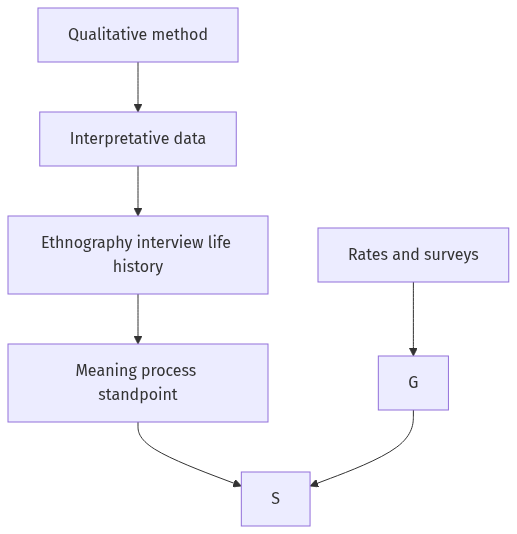
Conclusion
Qualitative method has dimensions of interpretation, design, data, role, analysis, and ethics. It does help deeper insight into meaning and process, as Weber, Goffman, Whyte, and Srinivas show. It does not replace rates. Depth without comparison can mislead. Use it where lived order is the object, and join it to counts where incidence is the object.
Quick related
Students also ask
-
What are the ethical issues that a researcher faces in making use of participant observation as a method of collecting data? Explain
Next question on this syllabus topic (2023 · Q6(c)). View answer →
-
Is qualitative method unscientific?
It is systematic interpretation. It is not unscientific because it does not always use probability samples.
-
Can one interview give deeper insight than a survey?
It can reveal mechanism. It cannot by itself establish how common the mechanism is.
Same topic · past papers
UPSC has asked this before
These previous-year questions sit on the same topic. Open one to practise the earlier ask.
-
2017 · Q3(c) · Sociology GS 1 · 10 marks
Examine epistemological foundation of qualitative methods of social research -
2016 · Q1(c) · Sociology GS 1 · 10 marks
Analyze the importance of qualitative methods in social research -
2021 · Q1(b) · Sociology GS 1 · 10 marks
Do you think ethnomethodology helps us in getting reliable and valid data ? Justify your answer -
2015 · Q6(a) · Sociology GS 1 · 20 marks
"Education helps in perpetuating social and economic inequalities." Critically examine the statement.
More from this topic
Q8(c) · UPSC Mains 2026 · Sociology GS 1 · 10 marks · Solution
Discuss the significance and limitations of 'intersectionality' in social research
Sociology
Intersectionality, coined by Kimberlé Crenshaw, examines how overlapping identities like race, class, and gender shape systemic oppression. Its significance in social research lies in capturing lived realities beyond single-axis frameworks and preventing reductive generalisations. However, limitations include methodological complexity, risks of infinite regress, and difficulties in operationalising fluid categories. Effective application requires balancing structural macro-analysis with micro-level lived experiences.
Q6(b) · UPSC Mains 2026 · Sociology GS 1 · 20 marks · Solution
Critically analyse the nature-nurture debate from different perspectives
Sociology
1. The nature-nurture debate explores whether biology or society primarily shapes human behavior
Q6(a) · UPSC Mains 2026 · Sociology GS 1 · 20 marks · Solution
Discuss the intellectual origins of sociology and its evolution as a distinct field of study
Sociology
Sociology arose in 19th-century Western Europe to make sense of massive upheavals caused by the Industrial and French Revolutions. Enlightenment thinkers laid the groundwork by championing reason, empirical observation, and human agency over traditional dogma. Auguste Comte gave the discipline its name, pushing for a positivist "physics of society" based on scientific laws. Émile Durkheim secured its academic legitimacy by defining "social facts" and using empirical methods to study human behavior. Max Weber introduced interpretive sociology, while Karl Marx focused on material conditions and class struggle. In the 20th century, Talcott Parsons advanced structural-functionalism to study systemic equilibrium. Later, conflict theories, the Frankfurt School, and postmodern critiques broadened the field to address power and marginalisation. Today, sociology continues to evolve by analyzing globalisation, digital shifts, and modern identity politics.