
Revision summary
Poverty is relative deprivation and capability failure, not only a low rupee line. Social exclusion is the process of being shut out of work, services, and belonging. The two interlock through caste, gender, informality, and space. Indian illustrations include hamlet services, gig work without security, and discriminatory schooling. Measurement must join consumption lines to multidimensional and relational indicators.
Model answer
Copper italics in this answer — like this — are the key facts. Each one is unpacked in the Facts & figures rail.
Introduction
Poverty is a lack of resources relative to what a society treats as a normal life. Social exclusion is the process that shuts people out of that life in work, rights, and belonging. Poverty is a form of exclusion because low income is both a cause and a result of being kept off the common stage.
Body
Poverty as exclusion
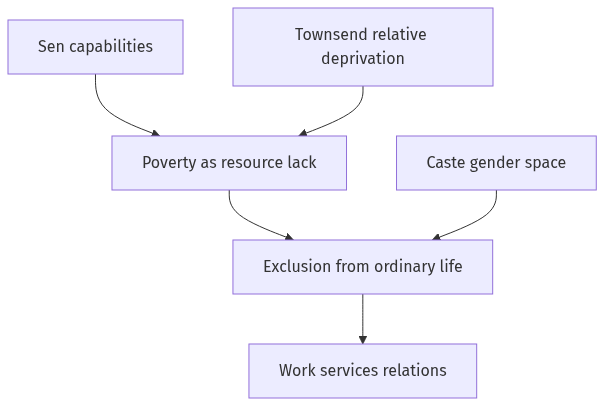
- Peter Townsend treated poverty as relative deprivation: people are poor when they cannot join the ordinary diets, customs, and activities of their society.
- Amartya Sen treated poverty as capability failure: not only low income, but the inability to be and do what one has reason to value.
- Exclusion names the relational side: stigma, discrimination, and closed networks that keep the poor outside labour markets, schools, and public space.
- Ruth Levitas and others in European debate listed exclusion from work, from services, and from social relations as linked processes.
Dimensions of poverty
- Income and consumption poverty, measured in India through expert lines such as Tendulkar and Rangarajan, and through the Socio-Economic Caste Census lists.
- Multidimensional poverty: health, schooling, and living standards, as in the Oxford and UNDP index used in NITI Aayog reports.
- Time poverty, especially for women who combine unpaid care with low-paid work.
- Asset and insecurity poverty: no buffer against illness, crop failure, or job loss.
- Spatial poverty of slum, dry village, and Adivasi hinterland, where services do not arrive.
Dimensions of social exclusion
- Economic: informal labour, unemployment, and denial of credit.
- Political: weak voice, distance from panchayat and party, and barriers to documents that unlock rights.
- Social and cultural: caste untouchability, tribal stigma, disability, and minority prejudice.
- Spatial: gated cities and segregated hamlets.
- Legal: lack of enforceable contracts and delayed justice.
Illustrations
- A Dalit hamlet without a water point is income-poor and excluded from the village commons at once.
- A gig worker with a phone but no social security is inside the market and outside the citizenship of labour law.
- Amartya Sen’s work on famine showed that food can exist while groups are excluded from entitlement.
- Schooling without dignity, as in reports of caste discrimination in midday meals, converts a service into an exclusionary site.
How the two join
- Poverty without exclusion would be a temporary lack with open re-entry. Exclusion without income poverty can still exist as stigma of a well-off minority. In mass experience they interlock.
Flow diagram
Conclusion
Poverty is a form of social exclusion because it blocks participation in the ordinary life of a society, not only because a rupee count is low. Dimensions run through income, capabilities, time, space, caste, gender, and voice. Townsend, Sen, and Indian measurement debates all point to that relational fact.
Quick related
Students also ask
-
How do sociologists construct gender in their analysis on social inequality?
Next question on this syllabus topic (2022 · Q1(e)). View answer →
-
Can a person be excluded without being income-poor?
Yes. Stigma and legal barriers can exclude a group that is not the poorest on a consumption line.
-
Is exclusion only a European idea?
The word travelled from European policy. The facts of caste hamlets and informal labour are Indian.
Same topic · past papers
UPSC has asked this before
These previous-year questions sit on the same topic. Open one to practise the earlier ask.
-
2016 · Q4(c) · Sociology GS 1 · 15 marks
Discuss the relationship between poverty and social exclusion -
2026 · Q2(b) · Sociology GS 1 · 20 marks
Differentiate between social hierarchy and social exclusion and substantiate your answer with reference to the caste system -
2020 · Q2(b) · Sociology GS 1 · 15 marks
How are Hierarchy and Exclusion the major impediments in the transformation of societies ? Discuss. -
2019 · Q5(b) · Sociology GS 1 · 10 marks
Discuss the issues of access and exclusion in higher education in India
More from this topic
Q7(b) · UPSC Mains 2026 · Sociology GS 1 · 20 marks · Solution
According to Weber how do class, status and power interact to produce and sustain social inequality?
Stratification and Mobility: Concepts
Max Weber departed from Marx's purely economic view by proposing a multidimensional model of stratification based on class, status, and power. Class operates in the economic order via market situations, producing property and non-property groupings. Status operates in the social order through shared lifestyles, honour, and social esteem, often creating communities. Power operates in the political order through parties and organizational capacity to influence collective outcomes. These three dimensions interact dynamically; economic wealth can convert into social prestige and political influence, reinforcing systemic inequality. While analytically distinct, they frequently overlap to sustain durable structures of stratification in modern societies.
Q5(e) · UPSC Mains 2026 · Sociology GS 1 · 10 marks · Solution
How do different theories explain social dimensions of social movements? Discuss.
Stratification and Mobility: Concepts
• Structural-functionalism views movements as responses to institutional strain and anomie, aiming to restore social equilibrium (e.g., Smelser's value-added theory). • Conflict and Marxist perspectives ground movements in material inequalities and class struggle, helping disadvantaged groups challenge existing power relations. • Resource Mobilization Theory shifts focus from grievances to practical assets like leadership, money, and communication networks. • Rational choice approaches view participation as a calculated decision based on selective incentives rather than just emotional outrage. • Cultural and identity-oriented theories (like New Social Movements) emphasize values, symbols, and lifestyle politics over purely economic demands. • Relational factors highlight how networks, alliances, and political opportunities shape movement emergence and success. • Ultimately, understanding social movements requires combining structural, cultural, and relational perspectives since no single theory explains everything.
Q5(b) · UPSC Mains 2025 · Sociology GS 1 · 10 marks · Solution
Does the structural-functionalist perspective on social stratification promote a status quo? Give reasons for your answer.
Stratification and Mobility: Concepts
Davis and Moore treat unequal rewards as devices to fill important positions. Parsons ties ranking to a shared value system and role allocation. That logic easily sanctifies the present hierarchy as necessary. Tumin asked who defines importance and why talent and reward match so neatly. Unpaid gendered labour and caste inheritance expose the payoff story. Merton’s dysfunctions qualify equilibrium but do not make functionalism a conflict theory.