
Revision summary
Race was coded as biology and ethnicity as culture and believed descent. Weber and Barth treat ethnicity as honour and boundary, not as a trait list. States recode the same populations as race or ethnicity across time. Both produce endogamy, stigma, and unequal chances, so the lived line is blurred. Keep the analytical distinction so that body-talk and peoplehood-talk are not mixed by accident.
Model answer
Copper italics in this answer — like this — are the key facts. Each one is unpacked in the Facts & figures rail.
Introduction
Race has been treated as a classification of bodies. Ethnicity has been treated as a classification of culture, language, and origin. In social practice the line is blurred, because both are made in history, law, and closure, not found as two natural kinds.
Body
Classical distinction
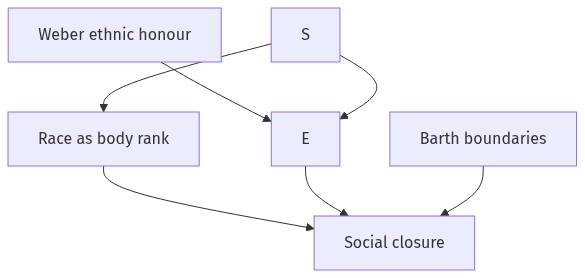
- Race was used, especially in colonial and United States law, as a supposedly biological rank of human types.
- Ethnicity, in Max Weber’s sense of ethnic groups, is a believed common descent, often tied to language, memory, and honour, whether or not the genealogy is true.
- Fredrik Barth shifted ethnicity from a list of traits to a boundary that groups maintain in interaction.
Why the boundary blurs
- What counts as race in one state counts as ethnicity in another. Jews, Irish, and Italians were racialised in some United States periods and later recoded as white ethnics.
- Colonial India used race talk for tribes and caste, while the Census and later politics recoded many of the same populations as ethnic, linguistic, or Scheduled groups.
- Racism attributes destiny to the body. Ethnic closure attributes destiny to culture. Both produce endogamy, stigma, and unequal life chances.
- W. E. B. Du Bois and later writers showed that the colour line is a social fact. Barth showed that ethnic boundaries are also social facts. The mechanisms overlap.
Justification
- Yes, the line is blurred in lived classification, in census boxes, and in violence that attacks both body and culture.
- The analytical distinction remains useful: race talk claims nature; ethnicity talk claims peoplehood. Conflating them hides how states switch labels.
- Indian debates on Adivasi identity, caste as race in some United Nations forums, and language politics show the same switching, not a clean two-box map.
Flow diagram
Conclusion
The boundary between ethnicity and race is blurred because both are socially constructed closures that states and groups can recode. The distinction still matters as two languages of ranking. A justified answer is therefore yes, blurred in practice, with a remaining analytical difference between body-talk and peoplehood-talk.
Quick related
Students also ask
-
How is poverty a form of social exclusion? Illustrate in this connection the different dimensions of poverty and social exclusion
Next question on this syllabus topic (2023 · Q4(b)). View answer →
-
If the line is blurred, should the two words be dropped?
No. They name different claims, nature versus peoplehood, even when the same people are targeted.
-
Is caste race?
Caste is a birth-status order with its own history. Some effects resemble racialisation. Equating the two words erases that history.
Same topic · past papers
UPSC has asked this before
These previous-year questions sit on the same topic. Open one to practise the earlier ask.
-
2021 · Q1(b) · Sociology GS 1 · 10 marks
Do you think ethnomethodology helps us in getting reliable and valid data ? Justify your answer -
2021 · Q3(c) · Sociology GS 1 · 10 marks
Do you agree with Max Weber's idea that bureaucracy has the potential to become an iron cage ? Justify your answer -
2021 · Q5(e) · Sociology GS 1 · 10 marks
Do you think Talcott Parsons gave an adequate theory of social change? Justify your answer
More from this topic
Q7(b) · UPSC Mains 2026 · Sociology GS 1 · 20 marks · Solution
According to Weber how do class, status and power interact to produce and sustain social inequality?
Stratification and Mobility: Concepts
Max Weber departed from Marx's purely economic view by proposing a multidimensional model of stratification based on class, status, and power. Class operates in the economic order via market situations, producing property and non-property groupings. Status operates in the social order through shared lifestyles, honour, and social esteem, often creating communities. Power operates in the political order through parties and organizational capacity to influence collective outcomes. These three dimensions interact dynamically; economic wealth can convert into social prestige and political influence, reinforcing systemic inequality. While analytically distinct, they frequently overlap to sustain durable structures of stratification in modern societies.
Q5(e) · UPSC Mains 2026 · Sociology GS 1 · 10 marks · Solution
How do different theories explain social dimensions of social movements? Discuss.
Stratification and Mobility: Concepts
• Structural-functionalism views movements as responses to institutional strain and anomie, aiming to restore social equilibrium (e.g., Smelser's value-added theory). • Conflict and Marxist perspectives ground movements in material inequalities and class struggle, helping disadvantaged groups challenge existing power relations. • Resource Mobilization Theory shifts focus from grievances to practical assets like leadership, money, and communication networks. • Rational choice approaches view participation as a calculated decision based on selective incentives rather than just emotional outrage. • Cultural and identity-oriented theories (like New Social Movements) emphasize values, symbols, and lifestyle politics over purely economic demands. • Relational factors highlight how networks, alliances, and political opportunities shape movement emergence and success. • Ultimately, understanding social movements requires combining structural, cultural, and relational perspectives since no single theory explains everything.
Q5(b) · UPSC Mains 2025 · Sociology GS 1 · 10 marks · Solution
Does the structural-functionalist perspective on social stratification promote a status quo? Give reasons for your answer.
Stratification and Mobility: Concepts
Davis and Moore treat unequal rewards as devices to fill important positions. Parsons ties ranking to a shared value system and role allocation. That logic easily sanctifies the present hierarchy as necessary. Tumin asked who defines importance and why talent and reward match so neatly. Unpaid gendered labour and caste inheritance expose the payoff story. Merton’s dysfunctions qualify equilibrium but do not make functionalism a conflict theory.