
Revision summary
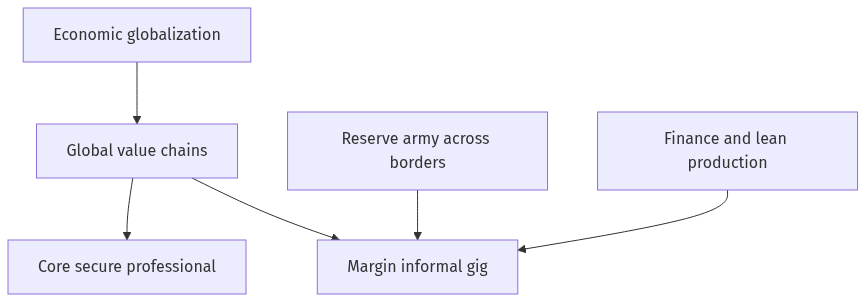
Globalization reorganised work through cross-border value chains and lean contracts. Indian IT, garments, SEZs, and platforms show a split of secure core and flexible margin. Informalisation, precarity, feminised export work, and migration are the main patterns. Marx’s reserve army and Standing’s precariat read the discipline of wages. Formalisation of the mass of Indian labour did not follow growth.
Model answer
Copper italics in this answer — like this — are the key facts. Each one is unpacked in the Facts & figures rail.
Introduction
Economic globalization is the tightening of trade, finance, and production across borders. In the twenty-first century it has changed where work is done, how contracts are written, and who bears risk. The pattern is not one story of more jobs everywhere. It is a split between a small secure core and a large flexible margin.
Body
What changed in the organisation of work
- Global value chains locate design in some countries and assembly in others, which Gary Gereffi and others mapped as buyer-driven and producer-driven chains.
- Export processing, special economic zones, and business-process outsourcing moved routine tasks to cheaper labour, including large Indian IT and call-centre employment after the 1990s reforms.
- Just-in-time production and lean staffing borrowed Taylorist control without Taylor’s promise of a high industrial wage for the mass of workers.
- Finance and retail concentration press suppliers to cut labour cost, which informalises work at the bottom of the chain.
Patterns of employment
- Informalisation: a large share of Indian workers remain without written contracts, which the ILO and Indian labour statistics record as the normal form, not a residue.
- Precarity: Guy Standing named a class of workers with unstable hours, no career ladder, and thin social security.
- Platform and gig work: ride-hail and delivery apps classify workers as partners, which shifts social-security cost off the firm.
- Feminisation of some export and care chains, with women in garments and electronics on short contracts, while unpaid care at home is unchanged.
- Skill polarisation: high returns to a narrow professional layer, and deskilling or stagnant pay in routine services.
- Migration: internal and international labour moves to construction, care, and logistics, with remittances as household wage.
Theoretical reading
- Marx’s reserve army is visible as a global pool that disciplines local wages.
- Weber’s market class situation now includes cross-border competition for the same task.
- Frank’s underdevelopment thesis is too simple as a total law, but the hierarchy of design versus assembly still organises employment chances.
- Castells described a network enterprise. The network is real. So is the exclusion of those off the node.
What did not happen
- Full formalisation of the Indian workforce did not follow growth.
- A global equalisation of wages did not occur. Gaps between cores and margins remain.
- Trade unions lost coverage in many tradable sectors even as new worker associations appear in platforms.
Explanation in sum
- Twenty-first century employment under globalization is more cross-border, more contractual at the top, and more informal and platform-based at the margin.
Flow diagram
Conclusion
Economic globalization changed employment by stretching production across chains, expanding informal and gig contracts, polarising skill, and using a global reserve of labour. Indian IT and garment work show the split. Marx, Standing, and chain analysis explain the pattern better than a story of uniform job creation.
Quick related
Students also ask
-
Do you think that the social media has brought significant changes in the forms of protest? Argue your case
Next question on this syllabus topic (2023 · Q7(b)). View answer →
-
Did globalization only destroy jobs?
It created export and service jobs and destroyed or informalised others. The net is a changed pattern, not a single loss figure.
-
Is gig work the whole of twenty-first century employment?
No. It is a visible new form. Public jobs, factory jobs, and farm work still employ large numbers, often under new chain pressures.
Same topic · past papers
UPSC has asked this before
These previous-year questions sit on the same topic. Open one to practise the earlier ask.
-
2023 · Q3(b) · Sociology GS 1 · 20 marks
How do you assess the changing patterns in kinship relations in societies today?
More from this topic
Q8(c) · UPSC Mains 2026 · Sociology GS 1 · 10 marks · Solution
Discuss the significance and limitations of 'intersectionality' in social research
Sociology
Intersectionality, coined by Kimberlé Crenshaw, examines how overlapping identities like race, class, and gender shape systemic oppression. Its significance in social research lies in capturing lived realities beyond single-axis frameworks and preventing reductive generalisations. However, limitations include methodological complexity, risks of infinite regress, and difficulties in operationalising fluid categories. Effective application requires balancing structural macro-analysis with micro-level lived experiences.
Q6(b) · UPSC Mains 2026 · Sociology GS 1 · 20 marks · Solution
Critically analyse the nature-nurture debate from different perspectives
Sociology
1. The nature-nurture debate explores whether biology or society primarily shapes human behavior
Q6(a) · UPSC Mains 2026 · Sociology GS 1 · 20 marks · Solution
Discuss the intellectual origins of sociology and its evolution as a distinct field of study
Sociology
Sociology arose in 19th-century Western Europe to make sense of massive upheavals caused by the Industrial and French Revolutions. Enlightenment thinkers laid the groundwork by championing reason, empirical observation, and human agency over traditional dogma. Auguste Comte gave the discipline its name, pushing for a positivist "physics of society" based on scientific laws. Émile Durkheim secured its academic legitimacy by defining "social facts" and using empirical methods to study human behavior. Max Weber introduced interpretive sociology, while Karl Marx focused on material conditions and class struggle. In the 20th century, Talcott Parsons advanced structural-functionalism to study systemic equilibrium. Later, conflict theories, the Frankfurt School, and postmodern critiques broadened the field to address power and marginalisation. Today, sociology continues to evolve by analyzing globalisation, digital shifts, and modern identity politics.