
Revision summary
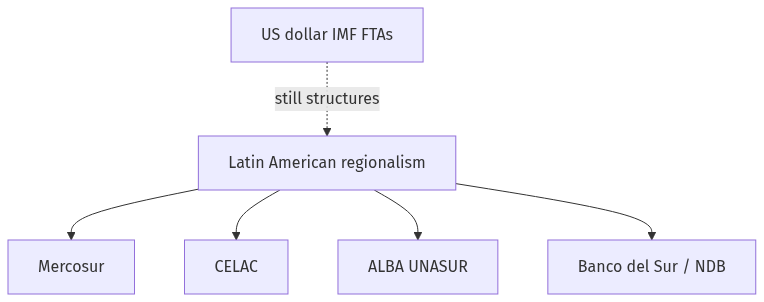
Latin America answered U.S. economic primacy with Mercosur, ALBA, UNASUR, CELAC, Banco del Sur and Brazil’s BRICS role. The intellectual root is ECLAC, Prebisch and dependency: unequal exchange and the need for regional policy space. Success is moderate: some intra-trade, a diplomacy without Washington in CELAC, and diversified China markets. The dollar, IMF programmes and U.S. financial cycles still dominate crises. Cyclical politics and a reluctant Brazilian paymaster explain the ceiling.
Model answer
Copper italics in this answer — like this — are the key facts. Each one is unpacked in the Facts & figures rail.
Introduction
Latin America has long tried to write an economic geography that is not only a backyard of the United States. ECLAC, Raúl Prebisch and dependency writers supplied the diagnosis: unequal exchange and a commodity trap. The organisations of the last three decades — Mercosur, ALBA, UNASUR, CELAC, Banco del Sur, and Brazil’s seat in BRICS — are the institutional reply. Success has been moderate, which is both a fair grade and a warning against romance.
Body
The organisational map
Mercosur (1991) is a customs-union project around Brazil and Argentina; it deepened some intra-trade and then stalled on protection and political swings. ALBA, pushed by Chávez’s Venezuela with Cuba, was a petro-ideological alternative to the U.S.-led FTAA; it redistributed some oil rents and did not build a durable production structure. UNASUR tried a South American political roof, including a defence council, and then emptied as governments changed colour. CELAC (2010) convenes the hemisphere without the United States and Canada — a sovereignty signal, useful for China summits, thin as a market. Banco del Sur was proposed as a regional lender against IMF conditionality; capitalisation and operations lagged. Brazil in BRICS and the New Development Bank is the extra-regional hedge: a seat beside China, India, Russia and South Africa, not a Latin union.
Against the U.S. order
The U.S. order here means dollar invoicing, IMF programmes after debt spikes, Wall Street cycles, and bilateral trade deals that survived the death of FTAA. Washington still sanctions, still defines much of the Caribbean security map, and still absorbs migrants and remittances. Moderate success is real: a language of autonomy, some intra-regional value chains, Chinese commodity demand that diversified export markets, and CELAC as a diplomatic fact. It is moderate because macro shocks still arrive in English: taper tantrums, Fed hikes, and 2025 tariff politics. Venezuela’s collapse, Argentina’s repeated IMF returns, and dollarisation debates show the ceiling.
Why only moderate
Regionalism needs a paymaster and a legal core. Brazil is a reluctant, cyclical paymaster. Left and right pink tides reverse each other, so organisations are personalised. Extra-regional China is a partner and a new dependency. For PSIR, the lesson matches Q3(c): alternative development needs finance and rules, not only communiqués. Latin America’s experiments remain the most sustained Southern attempt to pluralise the Americas. They have not dethroned the dollar. That is moderate success, honestly graded.
Flow diagram
Conclusion
CELAC, Mercosur, ALBA, Banco del Sur and BRICS overlap are Latin America’s toolkit for sovereignty and alternative development. They shifted language and some trade. They did not replace the U.S.-centred monetary and financial order. Moderate is the right word.
Quick related
Students also ask
-
Discuss the potential role that India could play as the leader of the Global South in realising the goal of establishing a new international economic order in the 21st century.
Next question on this syllabus topic (2024 · Q6(c)). View answer →
-
Did ALBA defeat the FTAA?
The FTAA failed for many reasons, including Brazilian and public opposition. ALBA was a leftover coalition, not the sole cause, and it did not become a development model.
-
Is BRICS a Latin American organisation?
No. Brazil’s membership is an extra-regional hedge that overlaps the regional sovereignty story without being owned by CELAC or Mercosur.
Same topic · past papers
UPSC has asked this before
These previous-year questions sit on the same topic. Open one to practise the earlier ask.
-
2025 · Q7(c) · PSIR GS 2 · 15 marks
NonAlignment 2·0 underscores India's unique aspiration to emerge as a site for an alternative universality. Comment
More from this topic
Q8(a) · UPSC Mains 2026 · PSIR GS 2 · 20 marks · Solution
Critically evaluate India-Russia relations in the 21st century. How have both the countries responded to America meddling in their relations in the recent times?
India and the Global South
- India and Russia share a "Special and Privileged Strategic Partnership" driven by defense, energy, and multipolar goals, moving beyond Cold War ties. - Core cooperation rests on defense production (BrahMos), discounted oil imports pushing trade past $50 billion, and joint platforms like BRICS and SCO. - Structural challenges include Russia's heavy reliance on China post-2022, a major trade deficit favoring Moscow, and differing views on the Indo-Pacific. - Both capitals counter Western pressure (like CAATSA and SWIFT restrictions) by asserting strategic autonomy and bypassing dollar-based payment systems. - Moscow implicitly tolerates India's QUAD participation, while New Delhi maintains independent foreign policy choices despite U.S. pressure. - The relationship survives on pragmatic adaptation rather than sentiment, remaining a vital pillar of India's multi-aligned foreign policy framework.
Q7(b) · UPSC Mains 2026 · PSIR GS 2 · 15 marks · Solution
The island of Kachchatheevu remains an intractable issue in India-Sri Lanka relations. Comment
India and the Global South
The Kachchatheevu island issue stems from the 1974 and 1976 Indo-Sri Lankan maritime boundary agreements which ceded the islet to Colombo. While legally settled, it persists as a live domestic political debate involving Tamil Nadu's regional parties and New Delhi. Livelihood concerns of Indian fishermen facing Sri Lankan naval action complicate bilateral ties. Strategic anxieties regarding regional security further elevate the issue in contemporary geopolitics. Resolving it requires a fine balance between cooperative maritime diplomacy and safeguarding domestic fisherfolk interests.
Q6(b) · UPSC Mains 2026 · PSIR GS 2 · 15 marks · Solution
Critically evaluate the important factors of India-Maldives relations on the eve of sixty years of diplomatic ties between the two countries
India and the Global South
• India and the Maldives are marking 60 years of diplomatic ties anchored in