
Revision summary
Global South diplomacy continues NAM and G77 in a new institutional setting. India hosted South summits and used G20 2023 to seat the African Union. ITEC, credit, vaccines, and UN peacekeeping are the material side. WTO food and IP fights remain part of the same file. China’s finance is the main competitor for Southern attention.
Model answer
Copper italics in this answer — like this — are the key facts. Each one is unpacked in the Facts & figures rail.
Introduction
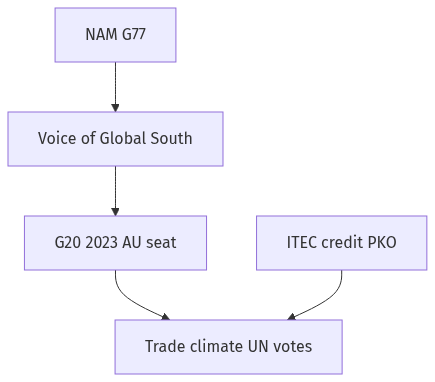
Global South diplomacy is India’s claim to speak with developing countries on trade, climate finance, food, and UN reform. It continues NAM and G77 habits with new platforms such as the Voice of Global South Summit and the G20 year 2023.
Body
Lineage
- NAM, the G77, and UNCTAD are the older stages. India used them for decolonisation, NIEO language, and later for climate differentiation.
- The claim is leadership without a formal empire and without OECD membership.
Current instruments
- Voice of Global South Summits collected demands on debt, fuel, and fertiliser before and during the Indian G20 presidency.
- African Union seating in the G20 was presented as a South win inside a Northern-heavy table.
- ITEC, lines of credit, vaccines, and peacekeeping are material complements to speeches.
- At the WTO, India still defends public stockholding and told the TRIPS-waiver story in 5(c).
Limits
- Many Southern States also deal with China as banker and builder. India’s offer is smaller in capital.
- Multi-alignment with the Quad can look, to some NAM members, like a tilt. India answers with autonomy and with Russia and energy ties.
- Diplomacy succeeds when it delivers finance, technology, and UN voice, not when it only recalls Bandung.
Flow diagram
Conclusion
India’s Global South diplomacy is NAM lineage plus G20-era convening and development tools. It is real as voice and training. It is constrained as a capital alternative to China.
Quick related
Students also ask
-
Describe the composition of the International Court of Justice (ICJ). Discuss its voluntary jurisdiction
Next question on this syllabus topic (2022 · Q2(c)). View answer →
-
Is Global South a formal organisation?
No. It is a political category. NAM and G77 are organisations. G20 is a mixed table that India tried to open further.
-
Does Quad membership cancel this diplomacy?
It creates a tension that India manages by insisting on autonomy and by keeping South forums active.
Same topic · past papers
UPSC has asked this before
These previous-year questions sit on the same topic. Open one to practise the earlier ask.
More from this topic
Q2(b) · UPSC Mains 2026 · PSIR GS 2 · 15 marks · Solution
International Human Rights frameworks are hostage to politics among nations. Comment
Contemporary Global Concerns
• Westphalian sovereignty and national interests frequently override universal human rights norms in global politics. • Powerful states often shield strategic allies from accountability while using human rights rhetoric selectively against adversaries. • The UN Security Council is frequently deadlocked by geopolitical rivalries, paralyzing responses to mass atrocities. • Human rights mechanisms depend heavily on voluntary funding from developed nations, skewing global priorities. • The principle of non-interference is routinely invoked to protect authoritarian regimes from international scrutiny. • Bridging enforcement gaps requires reforming multilateral institutions and amplifying the influence of the Global South.
Q7(b) · UPSC Mains 2024 · PSIR GS 2 · 15 marks · Solution
Critically examine India's persistent refusal to sign the nuclear non-proliferation treaty (NPT) despite being recognized as a de facto nuclear power.
Contemporary Global Concerns
The NPT recognises five weapon states and asks others to stay non-nuclear; India rejected this as nuclear apartheid. China–Pakistan nuclear conditions and empty P5 disarmament made signature look like unilateral abstinence. There is still no legal path for India to join as a weapon state; the 2008 waiver worked around the treaty. Persistent refusal is therefore structural, not mood. Costs remain in export controls and non-proliferation politics; a test moratorium and minimum deterrence are how India manages them.
Q1(d) · UPSC Mains 2023 · PSIR GS 2 · 10 marks · Solution
What is the structure and functions of International Court of Justice?
Contemporary Global Concerns
The ICJ is the UN’s principal judicial organ, with 15 judges elected by the Assembly and the Council. Contentious cases are between States that have consented to jurisdiction. Advisory opinions answer legal questions from authorised UN bodies. Article 38 lists the sources the Court applies. Enforcement of judgments can go to the Security Council, which limits the Court against the P5.