
Revision summary
Trump’s 2025 return prices NATO, Ukraine aid, tariffs and WHO/WTO scepticism as bargaining tools. The jolt pushes the EU toward defence spending, ammunition, and a European pillar inside or beside NATO. Economic and tech revival means chips, green industry and less naive China trade, plus faster India–EU talks. U.S. enablers remain; Hungary-style vetoes and pro-Trump parties can fragment the response. The incentive is real; a finished strategic autonomy is still a project, not a fact.
Model answer
Copper italics in this answer — like this — are the key facts. Each one is unpacked in the Facts & figures rail.
Introduction
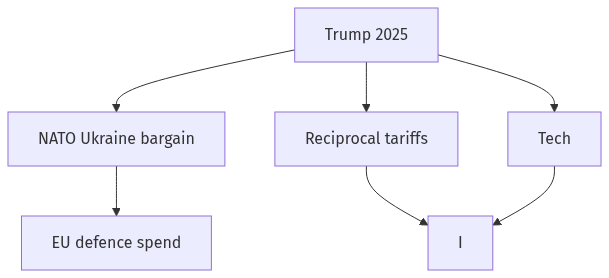
Donald Trump’s return to the White House in 2025 is a jolt, not a mystery. The first term already priced NATO as a bill, tariffs as a tool, and Brussels as a rival regulator. The second term arrives with reciprocal tariffs, a harder bargain over Ukraine, and scepticism toward WHO and WTO. The European Union is being told, in deeds, to pay for its own defence and to revive its economic and technological base.
Body
Defence
NATO’s European members have lived under a U.S. nuclear and conventional umbrella since 1949. Trump’s language of conditionality — pay or perish — forces ReArm debates, ammunition production, and talk of a European pillar. France’s strategic autonomy, Poland’s hard spending, and Germany’s slow turning from the post-1945 reflex are the internal map. Ukraine is the exam: if Washington shortens the cheque, Europe must fund artillery and air defence or watch a revisionist war on its border. That is a jolt. It is also incomplete: the U.S. still holds enablers — lift, intelligence, nuclear sharing — that the EU cannot mint in a year.
Economy and technology
Tariffs on European steel, cars and possibly digital services collide with the single market’s export model. The jolt pushes industrial policy: chips, green tech, critical minerals, and a less naive China commercial stance. The EU already had GDPR, the Digital Markets Act and CBAM as regulatory power (Anu Bradford’s Brussels effect). Trumpism says regulation without a foundry is not sovereignty. Hence subsidies, champion firms, and closer India–EU trade talks as Europe seeks markets that are not only the U.S. and China. Energy after 2022 already broke the Russian cheap-gas model; 2025 adds transatlantic trade risk.
Comment, not cheer
The statement in the question is largely right as incentive. It is too neat as outcome. Hungary and Slovakia can still veto. Populist parties inside the EU admire Trump more than they admire von der Leyen. Defence procurement remains national. A jolt can produce either integration or fragmentation. Macron may get a hearing; a two-speed EU may be the real result. For India, a Europe that spends and makes is a better FOIP and FTA partner; a Europe that splits is a weaker pole in a claimed multipolar world.
- So: Trump’s return is a jolt to invest. Whether the EU becomes a defence-industrial pole, or only a market with better press releases, will be decided in budgets, not in communiqués.
Flow diagram
Conclusion
The 2025 White House is a shock to NATO burden-sharing, to tariff-free Atlantic commerce, and to Europe’s tech complacency. The EU is pushed to invest in defence, industry and digital capacity. The push is real; the landing is not guaranteed.
Quick related
Students also ask
-
Would you agree with the contention that India's inclination to lean on a 'more aggressive hyper-realist posture' has gained a new momentum in the aftermath of the Pahalgam terrorist strike? Comment.
Next question on this syllabus topic (2025 · Q5(b)). View answer →
-
Does this mean the end of NATO?
Not automatically. It means a more transactional NATO and a European scramble to look less like a protectorate. Collapse is a risk, not a timetable.
-
Why should a PSIR answer mention India–EU?
Because the same tariff shock is named in Q6(c). Europe’s search for markets and India’s search for technology meet in that hedge.
Same topic · past papers
UPSC has asked this before
These previous-year questions sit on the same topic. Open one to practise the earlier ask.
-
2026 · Q6(c) · PSIR GS 2 · 15 marks
"The mother of all deals" is a transformative milestone in Indo-EU trade relations. Elaborate on the new Security and Defence partnership -
2025 · Q7(b) · PSIR GS 2 · 15 marks
Trump's unilateral imposition of reciprocal tariffs on scores of countries poses impending threat to the future of the rule-based multilateral global trading system under the WTO. What options do the WTO members have to salvage the organization?
More from this topic
Q7(a) · UPSC Mains 2026 · PSIR GS 2 · 20 marks · Solution
How does illegal cross border migration pose challenges to India's security? Discuss the steps taken by the government in this direction and their effectiveness
Comparative Politics
Illegal cross-border migration undermines India's national security by altering demographic balances, straining economic resources, and exacerbating internal security vulnerabilities. The government has responded through border fencing, technological integration like SMART fencing, institutional mechanisms, and bilateral agreements. However, porous terrain, regional political complexities, and local connivance limit the complete effectiveness of these measures. A holistic approach combining strict border management with socio-economic development and robust legal frameworks is essential for sustainable containment.
Q5(d) · UPSC Mains 2026 · PSIR GS 2 · 10 marks · Solution
Discuss the main features of the land-boundary agreement between India and Bangladesh.
Comparative Politics
• Operationalized via the 100th Constitutional Amendment Act of 2015 to resolve Radcliffe Line anomalies. • Rooted in the unratified 1974 bilateral agreement and the 2011 additional protocol. • Involved the peaceful exchange of 111 Indian enclaves in Bangladesh and 51 Bangladeshi enclaves in India. • Granted affected residents the sovereign right to choose their nationality and place of residence. • Demarcated roughly 6.1 km of previously un-demarcated land boundaries to end administrative confusion. • Secured human rights and welfare access for over 50,000 formerly stateless enclave residents. • Reduced bilateral trust deficits, paving the way for deeper cooperation in security and connectivity.
Q4(c) · UPSC Mains 2026 · PSIR GS 2 · 15 marks · Solution
What is UNCLOS? Explain its salient features
Comparative Politics
UNCLOS, established in 1982, serves as the constitution of the oceans, codifying customary international law regarding maritime jurisdictions. Its salient features include distinct maritime zones ranging from territorial waters to the high seas, balancing coastal state sovereignty with freedom of navigation. It establishes compulsory dispute settlement mechanisms through institutions like ITLOS. The convention also mandates environmental protection and sustainable management of marine resources. For India, UNCLOS provides a rules-based order in the Indo-Pacific while respecting navigational rights. It remains central to addressing contemporary maritime security and resource challenges.