
Revision summary
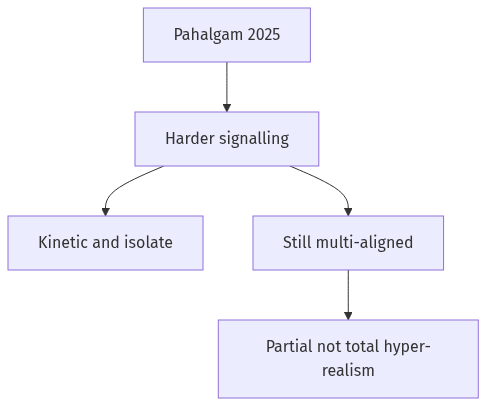
The 2025 Pahalgam attack on tourists in Kashmir invited a harder Indian security response. Hyper-realism here means more public force, isolation of Pakistan-based terror, and refusal of U.S. Kashmir mediation. The contention is partly right: the groove since Balakot already ran that way and Pahalgam accelerated it. It is not total: Russia, the Quad, the EU and economic diplomacy remain other registers. Agree partially — acceleration, not a new religion of offensive realism.
Model answer
Copper italics in this answer — like this — are the key facts. Each one is unpacked in the Facts & figures rail.
Introduction
The Pahalgam terrorist strike of 2025 — tourists killed in the Baisaran meadows of Kashmir — was designed to smear India’s security claim in the Valley and to invite a spectacle of revenge. The contention that India then leaned harder into a hyper-realist posture is plausible. It is not the whole of Indian foreign policy. A 10-mark comment should agree in part.
Body
What hyper-realism means here
In theory, realism already expects self-help. Hyper-realism, in the Indian debate, means a thicker willingness to use cross-border force, public military signalling, and a lower patience for third-party sermons — Kautilya’s danda as first language, Mearsheimer’s offensive logic in a nuclear neighbourhood. After Pulwama–Balakot (2019) and the 2020s pattern of naming Pakistan-based groups without the old composite-dialogue theatre, Pahalgam fitted an existing groove: punish, isolate, and refuse U.S. mediation on Kashmir as a favour.
Where the contention is right
Domestic politics after mass-casualty terror rewards visible toughness. Forces, intelligence, and diplomatic demarches harden together. India can tighten the Indus conversation, the FATF spotlight, and visa and sporting isolation while keeping kinetic options on the table. That is a more aggressive mix than the 1990s ‘strategic restraint’ Stephen Cohen described. Jaishankar’s energetic diplomacy is not pacifism; it is activity in the service of a harder core.
Where it is only partial
India did not become a one-note offensive realist. It still buys oil and arms logic from Russia while courting the United States in the Quad; it still talks Indo-Pacific public goods; it still wants EU capital. Hyper-realism toward one adversary can sit beside institutionalism toward others. Permanent crisis also has costs: tourism in Kashmir, investment, and the risk of two-front stress with China on the LAC. Delhi has not emptied the toolbox of talks, covert quiet, and multilateral lawfare.
Pahalgam accelerated a posture already in motion since 2016–19. It did not found a new school. Agreement should be partial, not a conversion story.
Flow diagram
Conclusion
After Pahalgam, India looked more hyper-realist because terror politics punishes hesitation. The lean is real toward Pakistan-facing force and refusal of mediation. It is not the sum of a foreign policy that still needs markets, Russia, the U.S. and a usable Valley.
Quick related
Students also ask
-
The tariff threats have pushed India and the European Union closer. Evaluate the India-EU partnership
Next question on this syllabus topic (2025 · Q6(c)). View answer →
-
Is hyper-realism the same as nuclear first use?
No. It is a posture of conventional and diplomatic hardness. India’s official nuclear doctrine remains a separate, still-declared file.
-
Does toughness work against terrorism?
It can raise costs and satisfy domestic audiences. It does not, by itself, end recruitment or third-party safe havens. That is why partial agreement is honest.
Same topic · past papers
UPSC has asked this before
These previous-year questions sit on the same topic. Open one to practise the earlier ask.
-
2021 · Q6(b) · PSIR GS 2 · 15 marks
Examine the Geo-strategic points of contention in the bilateral relationship between India and China
More from this topic
Q7(a) · UPSC Mains 2026 · PSIR GS 2 · 20 marks · Solution
How does illegal cross border migration pose challenges to India's security? Discuss the steps taken by the government in this direction and their effectiveness
Comparative Politics
Illegal cross-border migration undermines India's national security by altering demographic balances, straining economic resources, and exacerbating internal security vulnerabilities. The government has responded through border fencing, technological integration like SMART fencing, institutional mechanisms, and bilateral agreements. However, porous terrain, regional political complexities, and local connivance limit the complete effectiveness of these measures. A holistic approach combining strict border management with socio-economic development and robust legal frameworks is essential for sustainable containment.
Q5(d) · UPSC Mains 2026 · PSIR GS 2 · 10 marks · Solution
Discuss the main features of the land-boundary agreement between India and Bangladesh.
Comparative Politics
• Operationalized via the 100th Constitutional Amendment Act of 2015 to resolve Radcliffe Line anomalies. • Rooted in the unratified 1974 bilateral agreement and the 2011 additional protocol. • Involved the peaceful exchange of 111 Indian enclaves in Bangladesh and 51 Bangladeshi enclaves in India. • Granted affected residents the sovereign right to choose their nationality and place of residence. • Demarcated roughly 6.1 km of previously un-demarcated land boundaries to end administrative confusion. • Secured human rights and welfare access for over 50,000 formerly stateless enclave residents. • Reduced bilateral trust deficits, paving the way for deeper cooperation in security and connectivity.
Q4(c) · UPSC Mains 2026 · PSIR GS 2 · 15 marks · Solution
What is UNCLOS? Explain its salient features
Comparative Politics
UNCLOS, established in 1982, serves as the constitution of the oceans, codifying customary international law regarding maritime jurisdictions. Its salient features include distinct maritime zones ranging from territorial waters to the high seas, balancing coastal state sovereignty with freedom of navigation. It establishes compulsory dispute settlement mechanisms through institutions like ITLOS. The convention also mandates environmental protection and sustainable management of marine resources. For India, UNCLOS provides a rules-based order in the Indo-Pacific while respecting navigational rights. It remains central to addressing contemporary maritime security and resource challenges.